
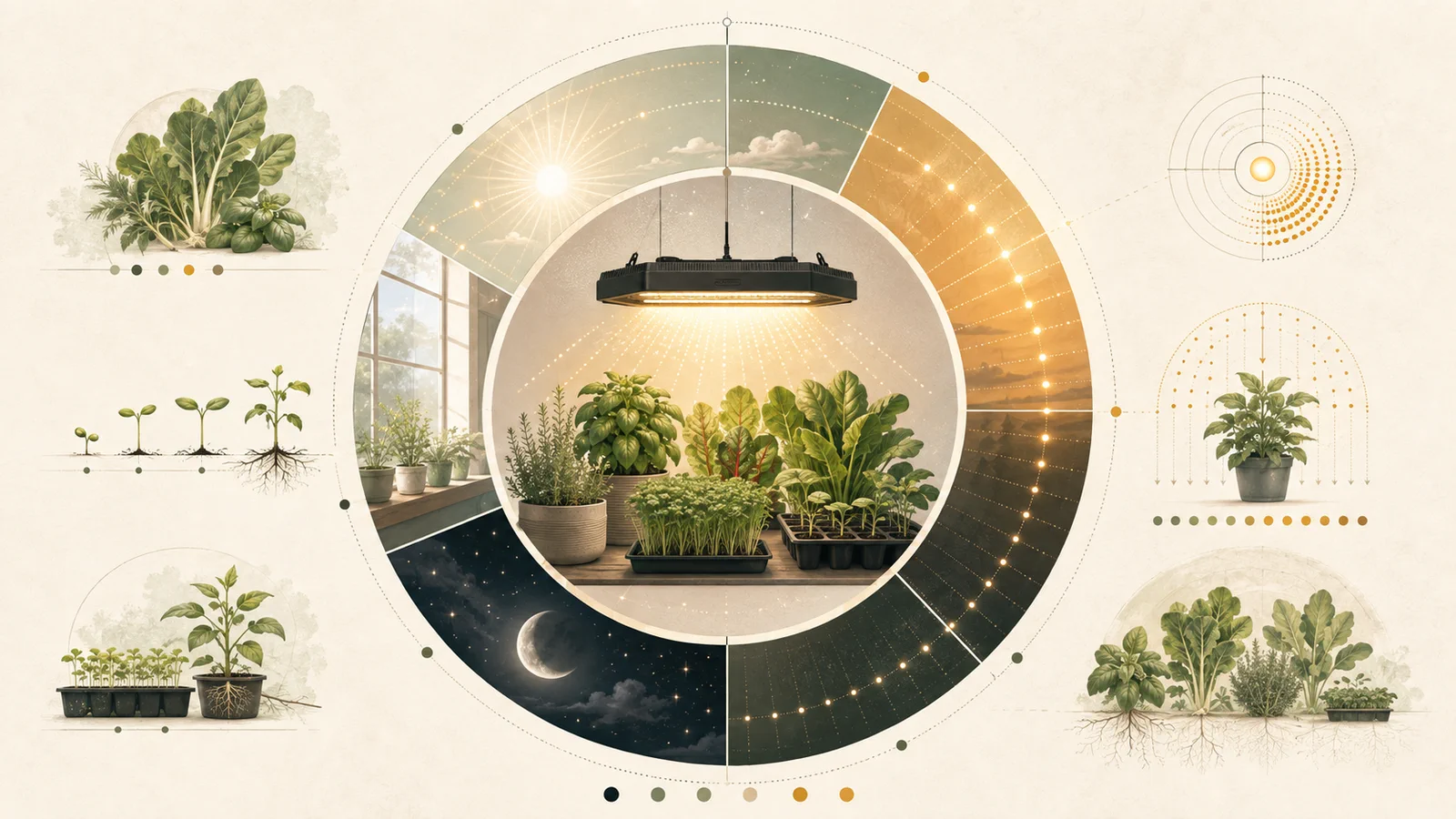
Evidence status: This is a source-based scheduling workflow for indoor herbs, leafy greens, and seedlings. Root & Photon did not own, operate, measure, test, rank, or review a light, timer, crop, or schedule for this article. The examples demonstrate calculation and decision boundaries; they are not crop prescriptions or product recommendations.
Quick answer
Do not choose grow-light hours from a generic chart alone. First identify the crop and stage, then use a source-qualified daily light integral or planning input, account for natural light, and measure or obtain a representative canopy-level PPFD for the exact setup. Calculate the electric-light hours, then check whether that result fits the crop’s source-supported photoperiod and dark-period boundary.
That second check matters because photoperiod and DLI are not interchangeable. Two schedules can deliver the same DLI and still produce different growth, morphology, or quality under controlled research conditions. When the arithmetic hours conflict with the retained crop/stage evidence, change the light delivery or revisit the input—do not force the timer.
Photoperiod workflow summary
| Gate | Question | Pass result | Fail result |
|---|---|---|---|
| Crop/stage evidence | Do you have an authoritative source for the exact crop, stage, and objective? | Record the source and its photoperiod/DLI limits. | Stop; do not invent a range. |
| Photon-dose input | Do you know representative canopy PPFD and natural-light DLI? | Calculate electric-light DLI and hours. | Measure, source, or preserve the unknown. |
| Biological schedule | Do the calculated hours fit the retained light/dark window? | Use the schedule as a provisional starting point. | Reconfigure PPFD/layout or revisit the input/source. |
| Execution | Can you hold height, mode, layout, and timer state constant? | Log the schedule and recheck on material changes. | Do not attribute outcomes to photoperiod. |
Decision inputs
- Crop and cultivar
- “Herbs” or “leafy greens” is not an exact biological identity. Record the species and cultivar when the source indicates cultivar effects.
- Growth stage and objective
- Germination, transplant seedlings, vegetative leaf harvest, and flowering control are different tasks. This article covers seedlings and vegetative herbs/leafy greens only.
- Light context
- State whether the fixture is the sole source of light or supplements daylight. Supplemental calculations require a daily natural-light input.
- Representative PPFD
- Use the exact plant-plane map or a representative grid for the current height, mode, layout, and fixture quantity. Nominal watts or one centre value is not enough.
- DLI input
- Use an authoritative crop/stage reference or label a value as hypothetical. Do not turn a broad category table into a precise prescription.
- Photoperiod boundary
- Record the source-supported light window and any dark-period or developmental qualification separately from the DLI target.
Photoperiod, dark period, PPFD, and DLI are different
| Term | What it describes | What it cannot establish alone |
|---|---|---|
| Photoperiod | How many hours the crop receives light in a 24-hour cycle. | Total photon dose, coverage, or crop suitability. |
| Dark period | The unlighted interval and, for some crops, a developmental signal. | One universal minimum that applies to every cultivar and stage. |
| PPFD | Instantaneous photon density at the plant plane while the light is on. | Daily dose unless duration is included. |
| DLI | Accumulated photosynthetic photon exposure per square metre per day. | Spectrum, distribution, temperature, morphology, flowering response, or a safe/product-approved schedule. |
For a constant representative PPFD:
DLI = PPFD × hours × 0.0036
Hours = electric-light DLI needed ÷ (representative PPFD × 0.0036)
The factor 0.0036 converts micromoles per second and hours into moles per day. If PPFD, dimming, daylight, or geometry changes during the day, use integration or a qualified estimate instead of treating one reading as constant.
Source-qualified starting examples
The following values show how authoritative guidance can differ by stage and context. They are not a merged recommendation table.
| Source context | Example | How to use it |
|---|---|---|
| UMN general indoor-lighting guide, reviewed 2026 | Seedlings: 16–18 total light hours; hydroponic lettuce and herbs: 12–14 hours. | Use as broad extension starting guidance, then verify crop/stage DLI and actual PPFD. |
| UMN herb seed-starting guide | 14–16 hours daily for herb seedlings in the described indoor-starting context. | Do not transfer automatically to mature herbs or a different fixture/intensity. |
| UMN starting-seeds guide | 12–16 hours and do not leave lights on continuously. | Shows that extension ranges vary; retain the specific source rather than averaging pages. |
| UNH seedling-lighting guide | Runtime varies substantially with fixture output and distance; its tables are rough. | Measure crop-level PPFD and calculate DLI instead of copying lamp-type hours. |
Prerequisites
- An exact crop and stage, plus cultivar when the evidence says it matters.
- A defined objective: transplant seedling or vegetative leaf production.
- A source-qualified DLI input and a separately recorded photoperiod/dark-period window.
- A representative canopy-level PPFD for the exact fixture configuration.
- A daily natural-light contribution when sunlight is material.
- A stable fixture height, operating mode, dimming state, layout, and timer.
- A log for dates, inputs, calculated hours, actual on/off times, and recheck triggers.
Calculation and verification steps
Step 1: Define the crop, stage, and objective
Write the species, cultivar when relevant, growth stage, and purpose. Do not use a flowering or fruiting schedule for a vegetative leafy crop, and do not apply a seed-starting range to a mature crop without supporting evidence.
Step 2: Record the source-qualified light inputs
Record the selected DLI or DLI range, the source-supported photoperiod window, any dark-period qualification, and the source’s exact applicability. If the only available value comes from a generic blog chart, stop.
Step 3: Determine natural-light contribution
For sole-source production, use zero natural-light DLI. For supplemental light, use a measured, logged, or appropriately sourced daily value at the plant plane. A noon PPFD reading is not a daily integral.
Step 4: Verify representative electric-light PPFD
Use a comparable manufacturer map or a representative plant-plane grid under the exact height, mode, layout, and fixture count. Keep height and mode fixed during the schedule calculation. If the distribution is poor, fix the layout or return to the sizing/height workflow before changing hours.
Step 5: Calculate electric-light hours
Electric-light DLI needed = selected total DLI − natural-light DLI
Hours = electric-light DLI needed ÷ (representative PPFD × 0.0036)
Round only after the full calculation. Preserve the unrounded result in the log. A negative electric-light DLI requirement becomes zero for the arithmetic dose calculation, but that does not answer a separate photoperiodic-development question.
Step 6: Apply the biological schedule gate
Compare the calculated hours with the retained crop/cultivar/stage light/dark boundary. If the value is outside the supported window, do not force it. Increase or redistribute PPFD, reduce an unsupported DLI assumption, choose a better-documented setup, or seek stronger crop evidence.
Step 7: Run a stable, logged schedule
Use a timer for consistency, but verify the actual on/off times. Do not change height, dimming, fixture quantity, spectrum, and hours together if you want to understand the effect of schedule. Record outages and material changes.
Step 8: Recheck when the system changes
Recalculate when the canopy grows, the light is raised or dimmed, the crop enters a new stage, the natural-light season changes, or the layout changes. A schedule that was defensible for one stage and geometry is not permanently approved.
Worked examples
Example A: Sole-source arithmetic
Illustrative selected DLI = 12.0 mol/m²/day
Natural-light DLI = 0
Representative PPFD = 220 µmol/m²/s

Hours = 12 ÷ (220 × 0.0036)
      = 15.1515...
      = 15.15 hours
This is not a crop target. The provisional result passes only if the crop/stage source supports approximately 15.15 hours under the relevant conditions.
Example B: Supplemental-light arithmetic
Illustrative total DLI = 14.0 mol/m²/day
Natural-light DLI = 5.0 mol/m²/day
Electric-light DLI needed = 9.0 mol/m²/day
Representative electric-light PPFD = 180 µmol/m²/s

Hours = 9 ÷ (180 × 0.0036)
      = 13.8888...
      = 13.89 hours
The 5.0 mol/m²/day input must represent the relevant day, season, transmission, and plant plane. It cannot be inferred from one instant reading.
Example C: Stop when arithmetic and biology conflict
Illustrative total DLI = 16.0 mol/m²/day
Natural-light DLI = 2.0 mol/m²/day
Electric-light DLI needed = 14.0 mol/m²/day
Representative PPFD = 180 µmol/m²/s

Hours = 14 ÷ (180 × 0.0036)
      = 21.6049...
      = 21.60 hours
If the retained crop/stage source supports only a hypothetical 12–16 hour window, 21.60 hours fails. The next action is to improve PPFD/distribution, revisit the DLI input or source, or stop—not to publish a 21.6-hour recommendation.
Equal DLI does not mean equal treatment
200 × 18 × 0.0036 = 12.96 mol/m²/day
300 × 12 × 0.0036 = 12.96 mol/m²/day
400 ×  9 × 0.0036 = 12.96 mol/m²/day
Those were treatment combinations in a 2024 basil study. The plants responded differently despite equal DLI. The numbers demonstrate a limitation of arithmetic equivalence; they are not schedules for your basil.
Checks and recheck triggers
| Check | Evidence to record | Recheck trigger |
|---|---|---|
| Crop/stage identity | Species, cultivar if material, stage, objective, source. | Transplant, harvest stage, bolting/flowering objective, cultivar change. |
| PPFD and distribution | Map/grid, height, mode, layout, representative value. | Height, dimming, fixture quantity, canopy, or layout change. |
| Natural-light DLI | Daily measurement/log or appropriate source and transmission assumption. | Season, weather regime, window/greenhouse, or plant-position change. |
| Timer execution | Planned and actual on/off times, outages. | Timer reset, power interruption, automation change. |
| Biological boundary | Source-supported photoperiod/dark-period qualification. | New authoritative crop/cultivar/stage evidence. |
Plant observations such as stretching, pale growth, tip injury, slow growth, or bolting can justify investigation, but they do not identify photoperiod as the sole cause. Review PPFD, DLI, distribution, temperature, water, nutrition, stage, and other conditions instead of diagnosing from one symptom.
Failure conditions
- The crop/stage source is missing, weak, or replaced by an unattributed timer chart.
- PPFD is unknown, measured at the wrong plane, or represented by watts/lumens/lux/one centre point.
- Natural light is material but the daily contribution is unknown.
- The computed hours conflict with the source-supported photoperiod or dark-period boundary.
- The calculation assumes constant PPFD while daylight, dimming, movement, or geometry varies materially.
- Multiple variables are changed together without a designed protocol.
- A 24-hour experimental treatment is being converted into a universal continuous-light recommendation.
- The decision depends on exact product performance, yield, quality, safety, wiring, sleep, certification, or commercial facts outside this package.
Stop and hand off
Stop with insufficient evidence when the crop/stage source, representative PPFD, natural-light input, or schedule boundary cannot be resolved. Use the sizing workflow when the available PPFD is too low, the height workflow when distribution or geometry is unresolved, the cost method when electricity expense is the question, and a qualified safety workflow when the issue becomes electrical, fire, optical, sleep, certification, installation, or emergency guidance.
Methodology
Root & Photon reviewed current U.S. university extension guidance and primary controlled-environment studies. Extension pages control the broad home/seedling context and calculation method. Primary studies are used only to demonstrate that equal DLI treatments can differ biologically and that stage, temperature, spectrum, cultivar, PPFD, and photoperiod can interact. Every formula was independently recalculated. No product was obtained, operated, measured, or tested.
Sources
- University of Minnesota Extension — Lighting for indoor plants and starting seeds
- University of Missouri Extension — Controlled Environment Agriculture: Understanding Grow Lights
- Iowa State University Extension — Important Considerations for Providing Supplemental Light to Indoor Plants
- University of New Hampshire Extension — Growing Seedlings Under Lights
- University of New Hampshire Extension — Supplemental Lighting Run Time Worksheet
- University of Minnesota Extension — Growing herbs in home gardens
- Eghbal et al. — Basil under different photoperiod/intensity combinations at constant DLI
- Jeong et al. — Lettuce under different photoperiod/intensity combinations at constant DLI
- Elkins and van Iersel — Longer photoperiods at the same DLI in lettuce
- Akter et al. — Dynamic light intensity and photoperiod in indoor basil
- University of Minnesota Extension — Starting seeds indoors