
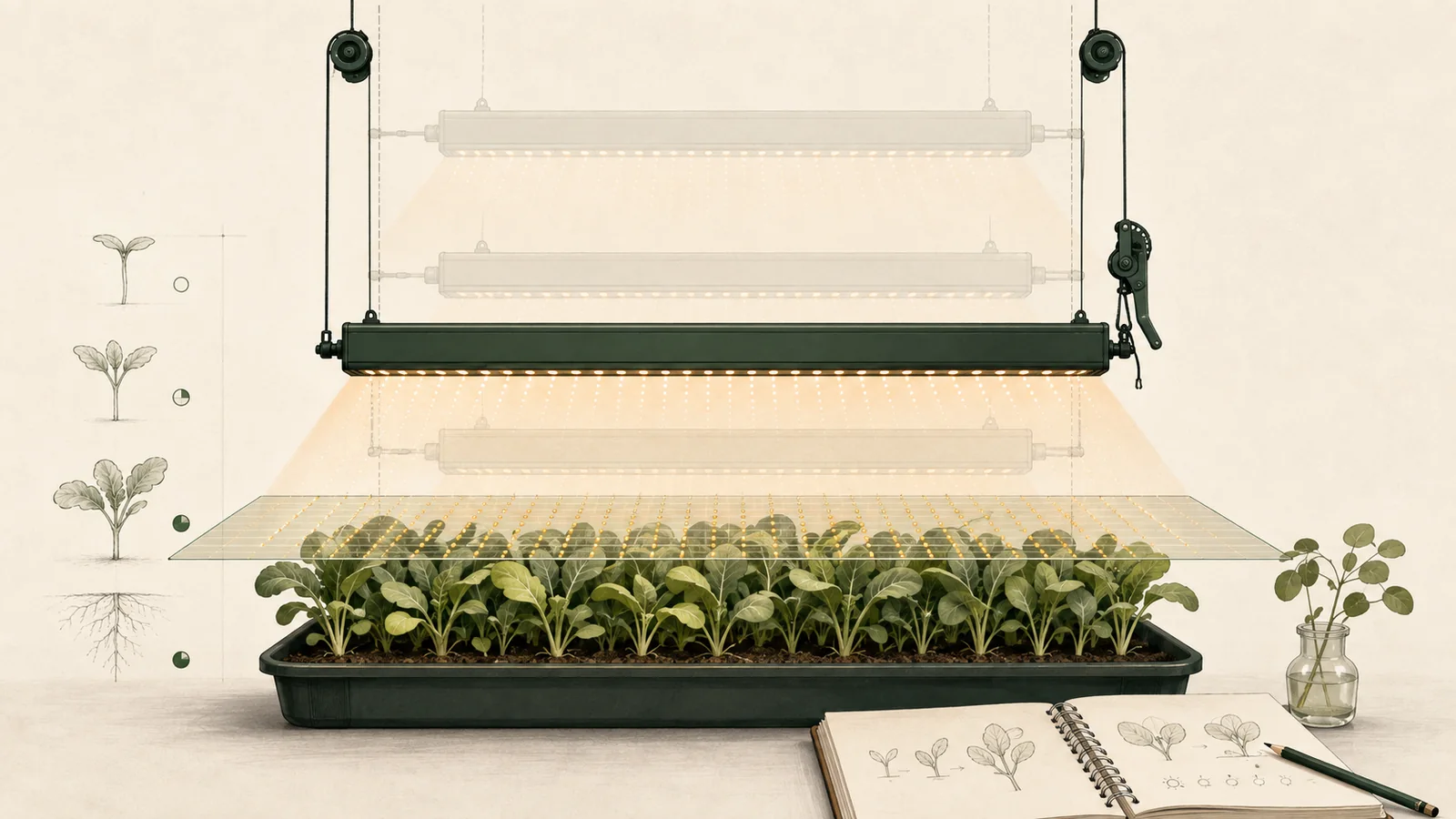
Evidence status: This is a source-based grow-light positioning workflow. Root & Photon did not own, install, measure, test, map, rank, or review a fixture or crop response for this article. A distance, symptom, technology label, wattage, or centre reading does not establish the correct position for an exact setup.
Quick answer
Do not choose grow-light height from a universal inches chart. Start with the exact fixture’s instructions or a PPFD map that matches its operating mode and intended area. Then verify the same canopy or foliage plane with a representative grid, keep the schedule and dimming unchanged, adjust height as one controlled variable, and compare average, minimum, maximum, edge behaviour, and estimated DLI.
Raise or lower the fixture only when the evidence supports the change. Stretching, scorch, or bleaching can trigger a recheck, but those symptoms do not prove that height is the cause. Stop rather than guess when the exact map, measurement method, crop/stage reference, or manufacturer constraints are missing.
Height-adjustment workflow
- Carry forward the exact area, plant plane, crop/stage reference, and uncertainty from the sizing workflow.
- Record the fixture, quantity, layout, operating mode, hours, natural-light context, and current distance to the canopy.
- Use an exact comparable map or a representative canopy-plane grid.
- Change height or dimming—not both—and keep the photoperiod fixed while isolating the change.
- Recheck the same grid and recalculate descriptive distribution and DLI.
- Use plant observations as prompts to investigate, not as measurements or diagnosis.
- Repeat after material canopy, layout, mode, schedule, or natural-light change.
- Stop when evidence or the exact manufacturer’s instructions do not support the required setup.
Decision factors
- Measurement plane
- The current top of the canopy or intended foliage plane—not the tray, floor, shelf, or fixture face.
- Comparable evidence
- An exact manufacturer map or a measured grid with the same fixture, quantity, layout, operating mode, height, area, and relevant boundaries.
- Crop and stage reference
- A source-qualified range selected in the sizing workflow, with its applicability limits still attached.
- Controlled variable
- Height is evaluated while dimming, hours, layout, and other material inputs remain unchanged.
- Distribution
- Average, minimum, maximum, edge and corner behaviour matter together. A high centre point is not a coverage result.
- Daily exposure
- When representative PPFD and hours are stable, estimate DLI as PPFD × hours × 0.0036.
- Confidence boundary
- No comparable map or appropriate measurement means insufficient evidence, not permission to guess a height.
Prerequisites
Complete the sizing decision before adjusting height. You need an actual lit area, a defined plant plane, a source-qualified crop/stage reference, a natural-light treatment, and enough exact fixture information to assess the intended configuration. If those inputs are missing, height cannot repair the underlying sizing problem.
| Input | Record | Why it matters |
|---|---|---|
| Fixture identity | Exact model, quantity, layout, driver or ballast, and operating mode | Technology or nominal watts do not define received light. |
| Plant plane | Current canopy or foliage height | The distance changes as plants grow. |
| Area and grid | Length, width, point locations, and boundaries | Different areas or grids cannot be compared directly. |
| Crop/stage reference | Source, range, and applicability limits | The article does not choose a universal target. |
| Schedule | Hours and any dimming or mode schedule | DLI changes when intensity or hours change. |
| Natural light | Measured contribution or explicit uncertainty | Window and seasonal light can change total daily exposure. |
| Manufacturer constraints | Current instructions and disclosed map conditions | A required setup that conflicts with exact instructions must be rejected. |
Step 1: Record the current plant plane and setup
Measure height to the current canopy or foliage plane. Do not reuse a tray-to-fixture or floor-to-fixture distance after plants have grown. Record the fixture identity, quantity, layout, operating mode, dimming state, hours, natural-light context, measured area, grid, reflective boundaries, and major obstructions.
This record is the baseline. Without it, a later change cannot be attributed to height and cannot be reproduced even as an editorial calculation.
Step 2: Choose a documented starting position
Use the exact manufacturer’s current instructions or a PPFD map that matches the fixture and operating mode. If no exact documentation exists, use an appropriate canopy-plane measurement method. Do not substitute a retailer’s generic technology chart, a nominal wattage, or an extension distance written for a different fixture and crop.
Extension pages publish different distance examples because their educational setups differ. That variability is a reason to retain source context, not a reason to average the numbers into one starting height.
Step 3: Verify a comparable map or canopy-plane grid
A comparable map discloses the exact fixture, quantity, layout, height, area, grid, and operating mode. It should also disclose enough information about dimming and boundaries to judge whether the planned setup is similar. An official map remains manufacturer specification evidence unless it was independently measured.
When measuring, use the same representative point locations before and after the change. A centre point alone cannot establish coverage. At minimum, retain the centre and representative edges or corners; a denser grid can reveal local hot or dark zones that a five-point sample misses.
| Field | Pass condition | Failure result |
|---|---|---|
| Fixture and quantity | Exact match | Do not use the map as the controlling setup. |
| Operating mode | Same dimming, power, channels, or spectrum mode | Record as unknown or re-measure. |
| Height and plane | Same fixture-to-plant-plane distance | Values are not directly portable. |
| Area and grid | Same dimensions and disclosed point placement | Average and uniformity cannot be compared. |
| Layout and boundaries | Comparable orientation, overlap, reflectors, walls, and obstructions | Use an exact combined-layout check. |
| Evidence owner | Manufacturer map is attributed; measurement method is disclosed | Do not imply independent Root & Photon testing. |
Step 4: Change one variable at a time
When testing height, keep fixture mode, dimming, quantity, layout, hours, point locations, and the measured area unchanged. Do not change height and dimming together. Do not change height and photoperiod together. A one-variable record does not eliminate every environmental difference, but it makes the comparison interpretable.
Record the before and after positions rather than relying on memory. The workflow does not prescribe a universal increment; the appropriate step depends on the exact fixture, available documentation, measurement resolution, and room constraints.
Step 5: Recalculate distribution and DLI
For each position, calculate or report:
- average PPFD across the disclosed grid;
- minimum and maximum point values;
- minimum divided by average as a descriptive uniformity indicator;
- centre-to-edge or centre-to-corner pattern;
- representative DLI when PPFD and hours are sufficiently stable.
Constant representative PPFD:
DLI (mol/m²/day) = PPFD (µmol/m²/s) × hours × 0.0036
This estimates daily exposure. It does not choose the crop target or determine whether the photoperiod is biologically suitable.
Do not treat one ratio as a universal pass threshold. Grid density, crop placement, edge tolerance, canopy shape, and the selected source-qualified reference all affect interpretation.
Step 6: Monitor plants and the environment without diagnosing from one symptom
Stretching or elongation can be a reason to investigate insufficient light. Scorch or bleaching can be a reason to investigate excessive light. Neither observation reports the actual PPFD or proves that height is the cause. Temperature, watering, nutrition, crowding, cultivar, disease, and other conditions can produce similar changes.
Use observations as stop-and-recheck signals. Revisit the grid, schedule, natural-light context, and other growing conditions. Do not turn a visual symptom into a measurement, guaranteed correction, or crop-treatment claim.
Step 7: Recheck as the canopy and natural light change
The plant plane rises as plants grow. The canopy can become denser or less even. Window contribution can change with season, weather, curtains, or nearby shading. Recheck after any material change to canopy height, layout, fixture mode, dimming, schedule, natural light, or reflective boundaries.
A previously acceptable position is not permanent evidence. The record remains current only while its material conditions remain comparable.
Worked hypothetical map comparison
The following values are invented for arithmetic QA. They do not represent a product, crop, correct height, or Root & Photon measurement. Both positions use the same five points and a 14-hour schedule.
| Metric | Position A | Position B |
|---|---|---|
| Four corners (µmol/m²/s) | 140, 150, 145, 155 | 190, 195, 185, 200 |
| Centre (µmol/m²/s) | 430 | 300 |
| Five-point average | 204.0 | 214.0 |
| Minimum ÷ average | 0.686 | 0.864 |
| Maximum ÷ minimum | 3.071 | 1.622 |
| Estimated DLI at 14 hours | 10.28 mol/m²/day | 10.79 mol/m²/day |
A centre-only view would prefer Position A because 430 is higher than 300. The full five-point view shows Position B has a higher average and a more even pattern in this hypothetical case. That does not make Position B correct: the crop/stage reference, exact full map, manufacturer instructions, natural light, and other constraints are still needed.
Checks after every adjustment
- The distance is measured to the same current plant plane.
- The exact fixture, quantity, layout, operating mode, dimming, and hours are recorded.
- The same area and point locations were used.
- Average, minimum, maximum, and edge/corner pattern were reviewed together.
- DLI was recalculated only under a stated representative-PPFD assumption.
- The crop/stage reference still comes from a current approved source.
- Natural-light change is measured or retained as uncertainty.
- No symptom was treated as proof or a measurement.
- The setup remains within the exact manufacturer’s instructions.
Failure conditions
| Failure | Why it fails | Required response |
|---|---|---|
| Generic inches or wattage chart | No exact output, optics, mode, area, grid, or crop context | Obtain exact documentation or measurement. |
| Centre point only | Coverage and edge performance remain unknown | Use a representative disclosed grid. |
| Different areas or grids before and after | Average and distribution are not comparable | Repeat with the same plane, area, and points. |
| Height, dimming, and hours changed together | The effect cannot be attributed and DLI changed for multiple reasons | Run separate controlled comparisons. |
| Map conditions do not match | Fixture, mode, height, layout, or boundaries differ | Find a comparable map or measure the exact setup. |
| Symptoms are the only evidence | Symptoms are nonexclusive and do not report PPFD or DLI | Investigate and measure; do not diagnose from the symptom alone. |
| Required result conflicts with exact instructions | The proposed setup is outside the approved workflow | Stop and use a different documented configuration or qualified workflow. |
Stop and hand off
Stop this workflow when the exact fixture instructions are unavailable, the map or measurement is not comparable, the required position conflicts with documented product constraints, the crop/stage reference is unresolved, or the decision depends on electrical, fire, optical, sleep, certification, installation, emergency, or other elevated safety guidance.
The correct result in those cases is insufficient evidence or a separate qualified workflow—not a guessed distance.
Before you adjust
- Confirm that the sizing workflow and exact IG-C006 inputs are current.
- Write down the current fixture-to-canopy distance and operating mode.
- Save the exact map conditions or measurement grid.
- Keep hours and dimming fixed when height is the variable.
- Compare distribution, not just the centre.
- Recalculate DLI only with a stated representative-PPFD assumption.
- Repeat after material canopy or natural-light change.
- Stop on missing evidence or manufacturer-constraint conflict.
Methodology
Root & Photon reviewed current United States extension and standards-adjacent sources, retained PAR/PPF/PPFD/PPE/DLI terminology from the existing metric authority, and required the exact prior sizing package before activating this workflow. We compared source-specific distance examples only to show why they are not portable. We independently recalculated the hypothetical grid averages, ratios, and DLI values. No product was owned, installed, measured, tested, ranked, or reviewed.
Sources
- University of Missouri Extension — Controlled Environment Agriculture: Understanding Grow Lights
- Iowa State University Extension — Important Considerations for Providing Supplemental Light to Indoor Plants
- Iowa State University Extension — How to Determine How Much Supplemental Light to Provide for Indoor Plants
- Iowa State University Extension — How to Set Up Supplemental Lights for Indoor Plants
- University of New Hampshire Extension — Growing Seedlings Under Lights
- University of Minnesota Extension — Lighting for Indoor Plants and Starting Seeds
- Utah State University Extension — Starting Vegetable Seeds Indoors: IV. Seedling Culture and Transplanting
- ASABE — ANSI/ASABE S644 public scope abstract