Evidence status: This is a source-based comparison of LED and fluorescent grow-light categories. Root & Photon did not own, measure, test, rank, or review a fixture for this article. Category-level evidence does not establish the performance, safety, lifetime, price, or suitability of an exact product.
Quick answer
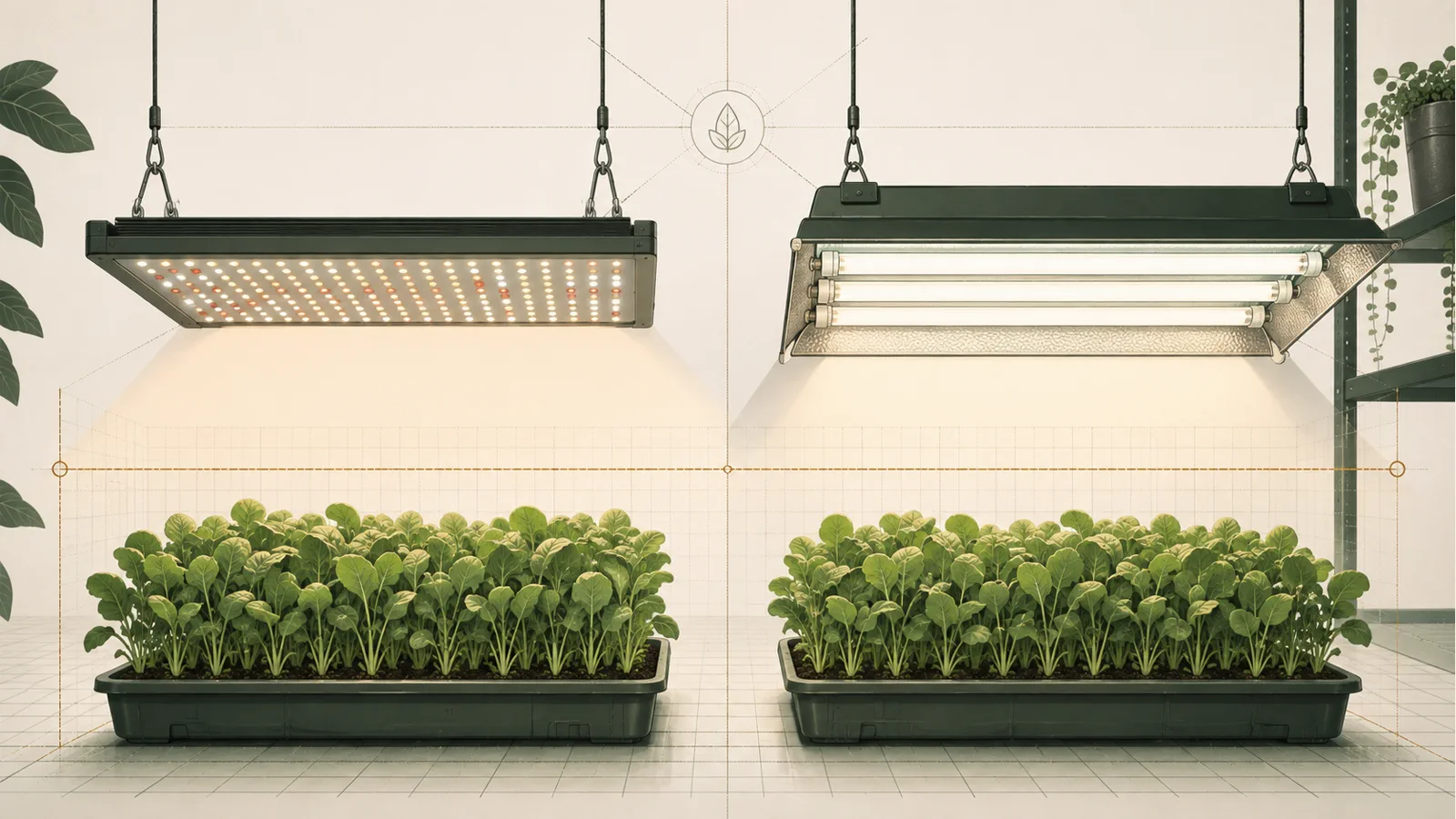
LED is usually the stronger category to investigate first when limited vertical space, documented photon efficacy, dimming, compact form factor, or spectrum control matters. Fluorescent can still be reasonable for a modest seed-starting or propagation task when an existing setup delivers adequate, reasonably even light and its lamps, ballast, reflector, spacing, and schedule are known.
Neither category wins from the technology label alone. Compare the same plant task, lit area, measurement plane, operating mode, fixture quantity, and schedule. Then inspect delivered-light evidence, distribution, spectrum, controls, room fit, maintenance, and reliability documentation for the exact fixture.
Comparison decision
| Scenario | Category to investigate first | Important qualification |
|---|---|---|
| Low vertical clearance, documented efficacy, dimming, or spectrum control is important | LED | Verify the exact fixture’s output, map, operating mode, controls, and system documentation. |
| You already own a functioning fluorescent setup for a modest seedling task | Keep fluorescent in the comparison set | Check delivered light across the tray, lamp and ballast condition, reflector geometry, spacing, and runtime before deciding to retain or replace it. |
| The seller provides only watts, lumens, color words, or one center reading | Neither | The evidence set is too weak for a confident category or product decision. |
Key facts
| Decision point | Evidence-based finding |
|---|---|
| Technology label | LED and fluorescent describe broad categories, not delivered plant light, coverage, daily exposure, lifetime, or outcome. |
| Input watts | Equal watts do not prove equal photon output, PPFD, distribution, or daily exposure. |
| Received light | Use a PPFD map or representative readings at the intended plant plane; one center value cannot establish full-area coverage. |
| Spectrum | The exact spectrum matters within both categories. “Full spectrum” or tunability alone does not prove better growth or value. |
| Energy comparison | Compare input power only after matching the delivered-light task, area, fixture quantity, operating mode, and runtime. |
| Maintenance and reliability | LED reliability is a system question; fluorescent maintenance depends on lamps, ballast, reflector, age, and replaceable components. |
Equivalent comparison set and scenario
A useful comparison starts by defining the job both alternatives must perform. Use the same plant task and growth stage, the same lit area and measurement plane, the same schedule or daily-exposure objective, and the same expectation for edge coverage. Record the number of fixtures, exact operating mode, fixture dimensions, component placement, controls, and maintenance assumptions.
Do not compare one fluorescent shelf fixture with one LED fixture merely because both use the same input watts or occupy the same shelf. A fair comparison requires evidence that each alternative addresses the same delivered-light task.
Plant-light evidence to collect
- Photosynthetic photon flux (PPF) and photosynthetic photon efficacy (PPE), when reported for the exact configuration.
- A photosynthetic photon flux density (PPFD) map or representative readings at the intended plant plane.
- Measurement height, mapped area, grid, edge values, optics or reflector geometry, and operating mode.
- The exact spectrum or scoped spectral documentation.
- Input watts, dimming or channel behavior, and any controller requirements.
- Useful-life definition, replaceable components, maintenance path, and system-level reliability evidence.
These quantities answer different questions. PPF describes source output, PPFD describes photon density at a specified plane, PPE relates photon output to electrical energy, and input watts describe electrical power. None substitutes for the others.
Criteria table
| Criterion | LED category | Fluorescent category | What must be verified |
|---|---|---|---|
| Photon efficacy | Strong category-level potential; exact performance varies. | Can support modest tasks; exact system efficiency varies. | PPF, PPE, input watts, operating mode, and matched delivered task. |
| Coverage | Depends on diode layout, optics, spacing, height, and fixture design. | Depends on tube layout, reflector, spacing, height, and lamp condition. | Area, measurement plane, grid, edge values, and full PPFD distribution. |
| Spectrum and controls | May offer fixed, mixed, dimmable, or multi-channel output. | Depends on the exact lamps, phosphors, ballast, and control arrangement. | Exact spectrum, channel behavior, control compatibility, and operating configuration. |
| Vertical and room fit | Compact forms and remote drivers may be available. | Linear fixtures can spread light across a shelf; lamp and ballast geometry matter. | Dimensions, component placement, manufacturer limits, and the actual room layout. |
| Maintenance | System aging can involve packages, optics, drivers, electronics, and controls. | Lamp output, ballast condition, reflector condition, and replacement parts matter. | Useful-life definition, replacement path, warranty terms, and evidence for the complete product. |
| Operating energy | May use less electrical energy for an equivalent delivered-light task. | An existing adequate setup may avoid an unnecessary replacement decision. | Matched task, fixture quantity, input watts, runtime, and a separate tariff calculation. |
Tradeoffs that survive the evidence check
LED
LED is the stronger category to investigate when documented photon efficacy, dimming, compact form factor, or spectrum control is important. U.S. Department of Energy analysis supports meaningful category-level energy-savings potential in agricultural lighting, but that market analysis does not establish a savings percentage for a home fixture or a reader’s setup.
LED reliability cannot be reduced to a diode or package rating. DOE stress-testing work shows that packages, optics, electronics, controls, and system architecture can age differently and affect long-term optical performance. Evaluate the complete product and its evidence.
Fluorescent
University extension guidance continues to recognize fluorescent fixtures as usable for seedlings and indoor plants. An existing linear setup can remain a reasonable candidate when its current plant-plane light and coverage are adequate for the modest task.
That conclusion depends on the actual tubes, ballast, reflector, spacing, age, distance, and runtime. Source examples are not universal prescriptions, and a fluorescent category label does not prove adequate output.
Spectrum and room fit
Both categories contain products with different spectra. LED may provide more options for fixed or adjustable output, but spectrum flexibility alone does not prove a better plant result. Both categories consume electrical power and add heat to the room. Treat component placement and thermal behavior as product-documentation and room-fit questions; this article does not provide clearance, wiring, fire, or other elevated safety instructions.
Fit by scenario
| Scenario | Likely next step | Evidence still required |
|---|---|---|
| New compact shelf with limited vertical clearance | Investigate documented LED options first. | PPFD map, operating mode, dimensions, driver placement, spectrum, controls, and exact input power. |
| Existing fluorescent shelf used for modest seed starting | Measure or obtain representative plant-plane evidence before replacing it. | Coverage, lamp and ballast condition, reflector geometry, runtime, and maintenance path. |
| Need repeatable dimming or multi-level control | Investigate LED systems with documented control behavior. | Supported dimming range, channels, controller compatibility, operating-mode output, and standby behavior where relevant. |
| Need a cost decision | First match the delivered task, then calculate operating cost separately. | Fixture quantity, operating watts, hours, applicable tariff, maintenance assumptions, and any replacement purchase decision. |
Avoid conditions
- Avoid any comparison that treats equal watts as equal plant-light output.
- Avoid products that provide only lumens, color temperature, “full spectrum,” or one center reading without plant-plane context.
- Avoid universal lifetime, distance, runtime, or savings claims that omit the exact product and test assumptions.
- Avoid replacing an adequate existing setup solely because a newer category is available.
- Avoid keeping an old setup solely because it still turns on; verify delivered light, coverage, condition, and documentation.
When neither category fits
Neither LED nor fluorescent earns a confident decision when exact output, coverage, spectrum, power, controls, maintenance, and applicability evidence are missing. Pause the comparison when the buyer question requires crop-specific targets, an exact-product safety judgment, a current price or total-cost verdict, a hands-on test, a ranking, or a guaranteed outcome. Those tasks need separate evidence and permission.
What we could not verify
- No exact LED or fluorescent fixture, tube, ballast, driver, reflector, optic, controller, or spectrum was evaluated.
- No PPFD map, independent measurement, grow trial, reliability test, utility bill, price, warranty, retailer, or availability record was collected.
- No universal useful life, replacement interval, hanging height, runtime, crop target, energy-saving percentage, savings, return on investment, payback, or yield conclusion is supported.
- No electrical, fire, optical, sleep, emergency, certification, or individualized safety judgment is included.
Before you buy
- Write down the plant task, growth stage, lit dimensions, and intended measurement plane.
- Require exact-model PPF, PPE, input watts, spectrum, operating mode, and a full PPFD map or representative readings.
- Compare edge as well as center values and normalize fixture quantity and runtime.
- Document controls, component placement, dimensions, maintenance path, useful-life definition, and warranty terms.
- For an existing fluorescent setup, check actual adequacy before assuming replacement is necessary.
- For an LED candidate, treat category-level efficiency and control potential as a reason to investigate, not proof of product superiority.
- Calculate electricity cost only after alternatives are matched for the same delivered task.
Important limitation: This comparison identifies which category deserves further verification. It does not recommend a product, certify a setup, or authorize crop, safety, price, savings, or outcome claims.
Methodology
Root & Photon reviewed current university extension guidance on indoor plant and seedling lighting, U.S. Department of Energy material on agricultural solid-state-lighting potential, LED system stress testing, and lighting metrics and test methods. The comparison applies the controlled plant-light terminology used in the site’s metric guide and separates category-level potential from exact-product evidence.
Search-result patterns were used only to identify buyer intent and communication gaps. They were not used as evidence for material claims. No product was purchased, owned, used, measured, or tested, and no current price, retailer, affiliate program, crop prescription, safety instruction, or performance outcome was researched for this article.
Sources
- University of Missouri Extension — Controlled Environment Agriculture: Understanding Grow Lights
- University of Minnesota Extension — Lighting for Indoor Plants and Starting Seeds
- University of Minnesota Extension — Starting Seeds Indoors
- University of New Hampshire Extension — Growing Seedlings Under Lights
- U.S. Department of Energy — Energy Savings Potential of SSL in Agricultural Applications
- U.S. Department of Energy — An Update on Stress Testing Results for Multi-Source LED Lighting
- U.S. Department of Energy — Metrics and Test Methods