Evidence status: This is a source-based comparison of LED and HID/HPS grow-light categories. Root & Photon did not own, use, measure, test, rank, or review a fixture for this article. Category-level evidence does not establish the performance, safety, lifetime, price, or suitability of an exact product.
Quick answer
For a compact home setup, LED is usually the stronger category to investigate first when vertical space, documented photon efficacy, dimming, spectrum options, or the location of radiant heat matter. That is a conditional research priority, not a universal winner and not a product recommendation.
An existing high-pressure sodium setup can remain in the decision set when its lamp, ballast, reflector or luminaire, delivered light, operating load, schedule, condition, and room constraints are known. Neither category earns a decision from a technology name or nominal wattage alone. Compare the same plant task, area, measurement plane, operating mode, fixture quantity, and schedule, then examine exact PPF, PPE, PPFD distribution, spectrum, controls, maintenance evidence, and room implications.
Comparison decision
| Scenario | Category to investigate first | Important qualification |
|---|---|---|
| Compact shelf, tent, or room where vertical clearance, controls, or documented photon efficacy matter | LED | Verify the exact fixture’s output, map, spectrum, power, controls, driver, and operating conditions. |
| An existing complete HPS system already supplies adequate, reasonably distributed light for the current task | Keep HPS in the comparison | Confirm lamp, ballast, reflector or luminaire condition, plant-plane readings, input power, schedule, and room fit. |
| A seller offers only a watt-equivalent label, one center reading, generic spectrum words, or an unspecified lifetime | Neither | The evidence is not sufficient for a matched replacement or category decision. |
| The decision depends on exact price, payback, crop targets, wiring, clearance, fire, optical exposure, or product certification | Use a separate qualified workflow | Those questions are outside this E2 category comparison. |
Decision factors
- HID and HPS
- High-intensity discharge is an umbrella category that includes metal halide and high-pressure sodium lamps. In this article, HID/HPS mainly refers to horticultural HPS systems while preserving the broader HID meaning.
- System boundary
- An HPS decision concerns more than a bare lamp. The ballast, reflector or luminaire, controls, operating mode, component condition, and geometry can change system performance.
- Equivalent task
- Compare the same plant task, lit area, measurement plane, fixture quantity, schedule, and required delivered light. A nominal wattage or replacement label is not an equivalent task.
- Plant-light evidence
- PPF describes total photosynthetic photon output, PPE describes photon output per unit of electrical energy, and PPFD describes received photon density at a defined plane. None replaces the others.
- Distribution
- A PPFD map or representative grid needs height, area, edges, operating mode, and setup context. One center value cannot establish coverage.
- Energy and heat
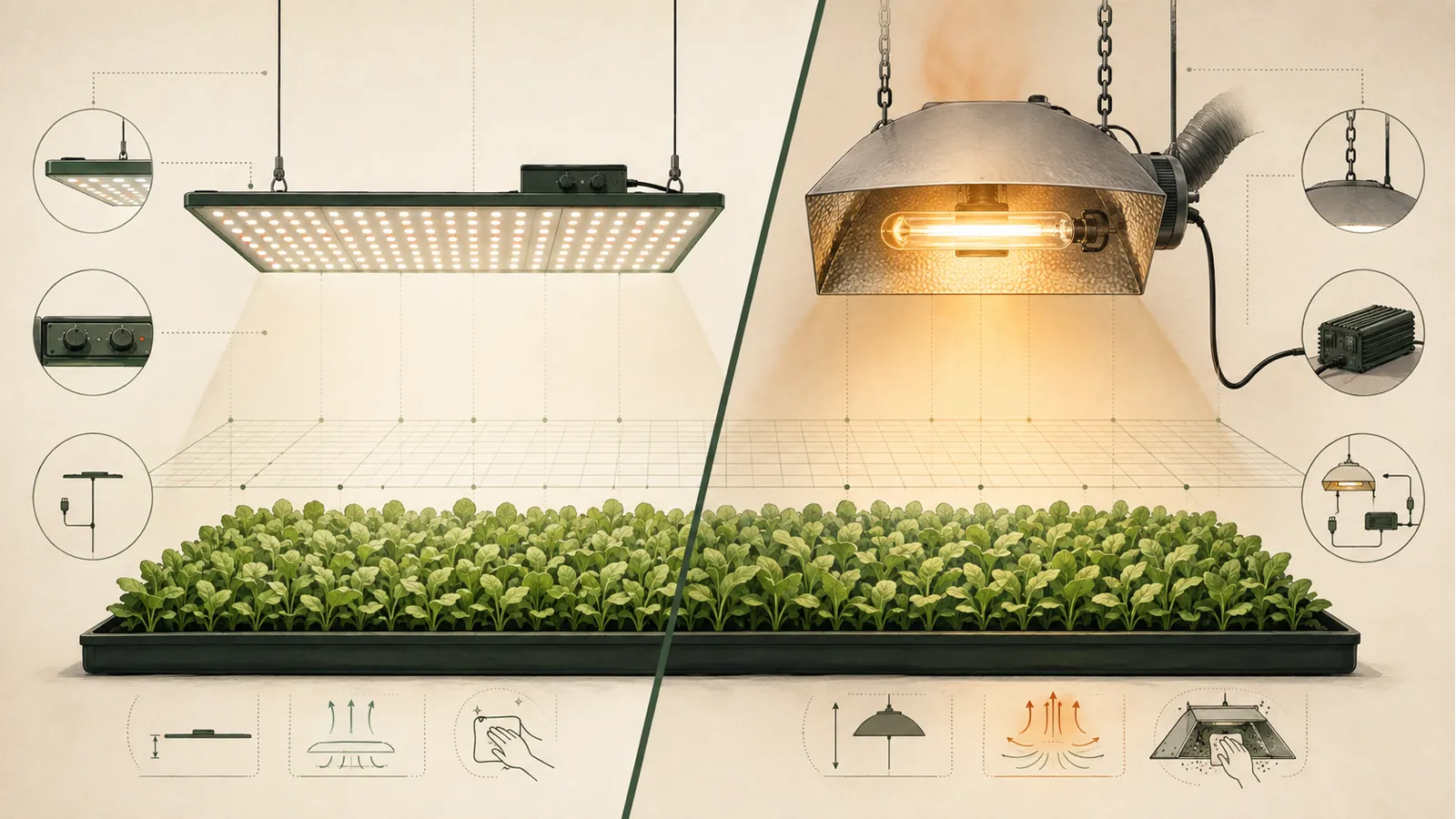
- LED has stronger category-level efficacy potential and can reduce radiant heat directed toward the crop compared with HPS. LED is not heat-free, and a room-level conclusion still requires exact power, component placement, and operating context.
- Maintenance
- HPS maintenance can involve lamp, ballast, and reflector condition. LED maintenance and useful life depend on the complete luminaire, driver, optics, controls, thermal design, test basis, and operating conditions.
- Commercial boundary
- This page contains no product ranking, model shortlist, purchase price, retailer, affiliate link, savings estimate, ROI, or payback conclusion.
Equivalent comparison set and scenario
The intended scenario is a United States beginner or intermediate home grower using a compact shelf, tent, or room for herbs, leafy greens, or seedlings. The article does not prescribe a crop-specific target. Instead, it defines what must be held constant before a technology comparison becomes meaningful.
Start with one plant-light task. Define the lit area and the plane where the plants will receive light. Use the same operating schedule or daily-exposure objective. Count how many fixtures each alternative requires. Record the exact operating mode, including dimming or multiple channels where applicable. Only then compare output, distribution, spectrum, power, controls, room fit, and maintenance.
This method prevents a common shortcut: comparing a nominal 600-watt or 1,000-watt HPS label with an LED described as “equivalent.” A replacement claim still needs a defined output and distribution basis. Lower input power can be an advantage only when the alternative still performs the same documented task.
Criteria table
| Criterion | LED evidence to request | HID/HPS evidence to request | Shortcut to avoid |
|---|---|---|---|
| Total photon output and efficacy | Exact PPF, PPE, input watts, operating mode, and test basis | Complete system input watts, PPF/PPE where available, lamp and ballast configuration | Equal watts mean equal plant light |
| Received light and coverage | PPFD map or representative plant-plane grid with height, area, edges, and dimming state | PPFD map or representative grid with reflector or luminaire, lamp, height, area, and overlap context | One center value proves coverage |
| Spectrum | Exact spectral distribution and channel state where spectrum is material | Exact lamp spectrum and operating configuration | LED, HPS, HID, or “full spectrum” is enough |
| Controls | Documented dimming range, channel behavior, controller compatibility, and power at each state | Documented ballast and control behavior for the complete system | Every LED is tunable or every HPS system is fixed in the same way |
| Room implications | Input power, driver location, fixture thermal path, dimensions, and manufacturer limits | Input power, lamp/ballast/reflector placement, dimensions, and manufacturer limits | LED produces no heat or HPS has one universal room effect |
| Maintenance and useful life | Complete-product maintenance basis, flux-maintenance evidence, driver/optics/control information, warranty terms | Lamp, ballast, reflector or luminaire condition, depreciation evidence, replacement path, warranty terms | A source/package rating or generic lamp interval proves system life |
| Operating energy | Quantity × actual input watts × runtime for the matched task | Quantity × complete-system input watts × runtime for the matched task | Apply a market-level savings percentage to a home setup |
| Evidence quality | Exact model, current document, test/reporting method, configuration, date, and limitations | Exact lamp/ballast/reflector or luminaire combination, current document, configuration, date, and limitations | Category average proves a product |
Tradeoffs that survive the evidence check
Efficacy and operating energy
Current government and extension evidence supports LED as the category with stronger photon-efficacy potential. That makes LED the first category to investigate when reducing electrical input for a matched plant-light task matters. The conclusion stops there. A facility-level or market-level energy estimate cannot be copied into a fixed home-fixture savings percentage.
For an actual comparison, use the complete-system input power for each alternative, the number of fixtures required, and the same schedule. If an LED uses less power but requires more fixtures or fails to cover the area, the comparison is incomplete. Electricity cost belongs in a separate calculation using the reader’s applicable tariff.
Distribution and photon capture
HPS is commonly implemented as a high-intensity discharge lamp with a reflector or luminaire. LED products may use bars, boards, panels, or other emitter layouts. Those architectures can create different patterns, but the category does not guarantee uniformity.
University research comparing LED and HPS has emphasized that distribution and radiation capture can be more important than fixture efficiency alone. The practical implication is simple: require plant-plane evidence across the full area. Do not replace one hotspot with another marketing claim.
Spectrum and control
LED can be designed with fixed, mixed, or adjustable spectral output and can support fast switching or dimming. These are category capabilities, not universal product features. Verify the exact spectrum, dimming range, channel behavior, controller requirements, and input power in each operating state.
HPS and other HID lamps also have exact spectral characteristics that depend on lamp type and system configuration. A broad “red-heavy,” “full spectrum,” or technology label does not establish the plant response, delivered quantity, or value for a particular setup.
Room load and form factor
LED can reduce radiant heat directed toward the crop compared with HPS and can be offered in distributed, lower-profile forms. That can matter in a compact shelf, tent, or room. It does not make LED heat-free. Compare actual electrical input, dimensions, component placement, and manufacturer documentation for the matched task.
This article does not provide ventilation, clearance, wiring, fire, optical-exposure, certification, or emergency instructions. Those topics require a separate qualified safety workflow.
Maintenance and reliability
An HPS system can involve a lamp, ballast, reflector or luminaire, and controls. Its current condition matters. An LED system includes emitters, driver or power supply, optics, thermal design, controls, connectors, and enclosure. Its useful life is also a system question.
Do not compare a generic HPS lamp interval with a generic LED package rating and call the result a lifetime verdict. Ask what was tested, at what level, under which conditions, how output maintenance is defined, which components are replaceable, and what the warranty actually covers.
Fit by scenario
| Scenario | Next category to verify | Evidence still required |
|---|---|---|
| Compact setup with limited vertical space and a need for dimming or a lower-profile distribution | LED first | Exact map, spectrum, dimming behavior, power by state, dimensions, driver location, and manufacturer limits |
| New setup where operating input power for a matched task is a major decision factor | LED first | Matched PPF/PPFD distribution, quantity, schedule, actual watts, and separate tariff calculation |
| Existing HPS setup with known components and adequate current plant-plane performance | Keep HPS as a baseline | Lamp/ballast/reflector condition, current map or readings, complete-system watts, schedule, maintenance path, and room fit |
| Replacement proposal based only on “600W equivalent,” “1000W replacement,” or one peak value | Neither yet | A defined equivalency basis and full-area matched-task evidence |
| Decision depends on current purchase price, payback, yield, exact crop dose, or installation risk | Separate workflow | Dated product/price evidence, a validated baseline, crop-specific authority, or qualified safety review as applicable |
Avoid conditions
- Avoid a comparison that uses lamp watts for HPS and complete-fixture watts for LED without identifying the system boundary.
- Avoid a seller’s equivalency statement when the output, distribution, area, height, operating mode, and test basis are missing.
- Avoid applying a DOE market-level energy percentage to one home setup.
- Avoid “LED has no heat,” “HPS always runs too hot,” or any universal room conclusion.
- Avoid lifetime claims that mix LED package maintenance, complete-luminaire life, HPS lamp life, ballast life, and useful delivered light.
- Avoid spectrum labels as a substitute for quantity, distribution, duration, and exact spectral documentation.
- Avoid replacing functioning equipment solely because one technology is newer.
- Avoid product, price, affiliate, crop-target, and safety claims that are outside the approved evidence package.
When neither category fits
Neither category fits the decision process when the exact configuration cannot be identified, the full-area light evidence is missing, the alternatives cannot be normalized to the same task, or the required room and maintenance information is unavailable. The appropriate outcome is “hold,” not a guessed winner.
Neither category also fits this article when the buyer actually needs a product recommendation, a crop-specific target, a validated installation plan, a price or payback model, or a qualified safety review. Those are separate evidence problems.
What we could not verify
- No exact LED or HID/HPS fixture, lamp, ballast, reflector, driver, controller, or warranty was evaluated.
- No current purchase price, retailer, availability, rebate, affiliate program, maintenance cost, or installation cost was collected.
- No PPFD map, electrical input, spectrum, temperature, noise, reliability result, or product lifetime was measured by Root & Photon.
- No crop-specific PPFD, DLI, photoperiod, hanging height, spectrum recipe, or outcome target is approved.
- No reader room, utility tariff, existing equipment condition, cooling interaction, or operating schedule was observed.
- The target evidence level of E3 validated was not achieved.
Before you buy
- Write down the exact plant task, area, measurement plane, schedule, and number of fixtures needed.
- For LED, record the exact model, PPF, PPE, PPFD map, spectrum, dimming state, input power, driver or power-supply arrangement, dimensions, and warranty basis.
- For HID/HPS, record the exact lamp, ballast, reflector or luminaire, operating power, spectrum, map or representative readings, component condition, and replacement path.
- Reject watt-only and center-reading-only equivalency claims.
- Compare operating energy only after the delivered task is matched. Use a separate tariff calculation rather than a generic savings percentage.
- Keep unknowns visible. If exact evidence is missing, pause the decision instead of converting category potential into a product verdict.
Method note: This checklist screens evidence; it does not certify a fixture, prescribe a crop dose, or authorize installation.
Methodology
Root & Photon reviewed current public university-extension, U.S. Department of Energy, NEMA standards-page, and university research sources. The comparison reused the controlled PPF, PPFD, PPE, watts, distribution, and daily-exposure terminology from the project’s metric authority.
Material claims were separated into atomic statements and qualified by applicability. The research distinguished current category potential from exact-product evidence, treated older LED-versus-HPS research as a comparison-method source rather than a current ranking, and used search results only to identify buyer intent and common communication gaps.
The article was then checked for matched-task logic, source scope, HTML structure, table semantics, navigation, source-link integrity, prohibited commercial language, testing claims, crop prescriptions, universal claims, and elevated-safety content. It remains E2 sourced: public documentary evidence plus editorial synthesis, with no direct testing or expert validation.
Sources
- University of Missouri Extension — Controlled Environment Agriculture: Understanding Grow Lights
- U.S. Department of Energy — Energy Savings Potential of SSL in Agricultural Applications
- U.S. Department of Energy Integrated Lighting Campaign — Unlocking Plant Growth Potential with LEDs in Indoor Horticulture
- UMass Extension — Photoperiod Control Systems for Greenhouse Crops
- U.S. Department of Energy — High-Intensity Discharge Lamps
- NEMA — Ballasts for HID and Sodium Lamps
- NEMA — Replacing HID Lamps with LED Lamps: Light Output Equivalency Claims
- Utah State University — Supplemental Greenhouse Lighting: Return on Investment for LED and HPS Fixtures
- U.S. Department of Energy — Metrics and Test Methods