
Evidence status: This is a source-based electricity-cost method built from public U.S. government and energy-data documentation. Root & Photon did not measure a grow light, verify a reader’s utility bill, or test a product for this article. The worked dollar amounts are arithmetic examples, not current tariff claims, savings forecasts, or product recommendations.
Quick answer
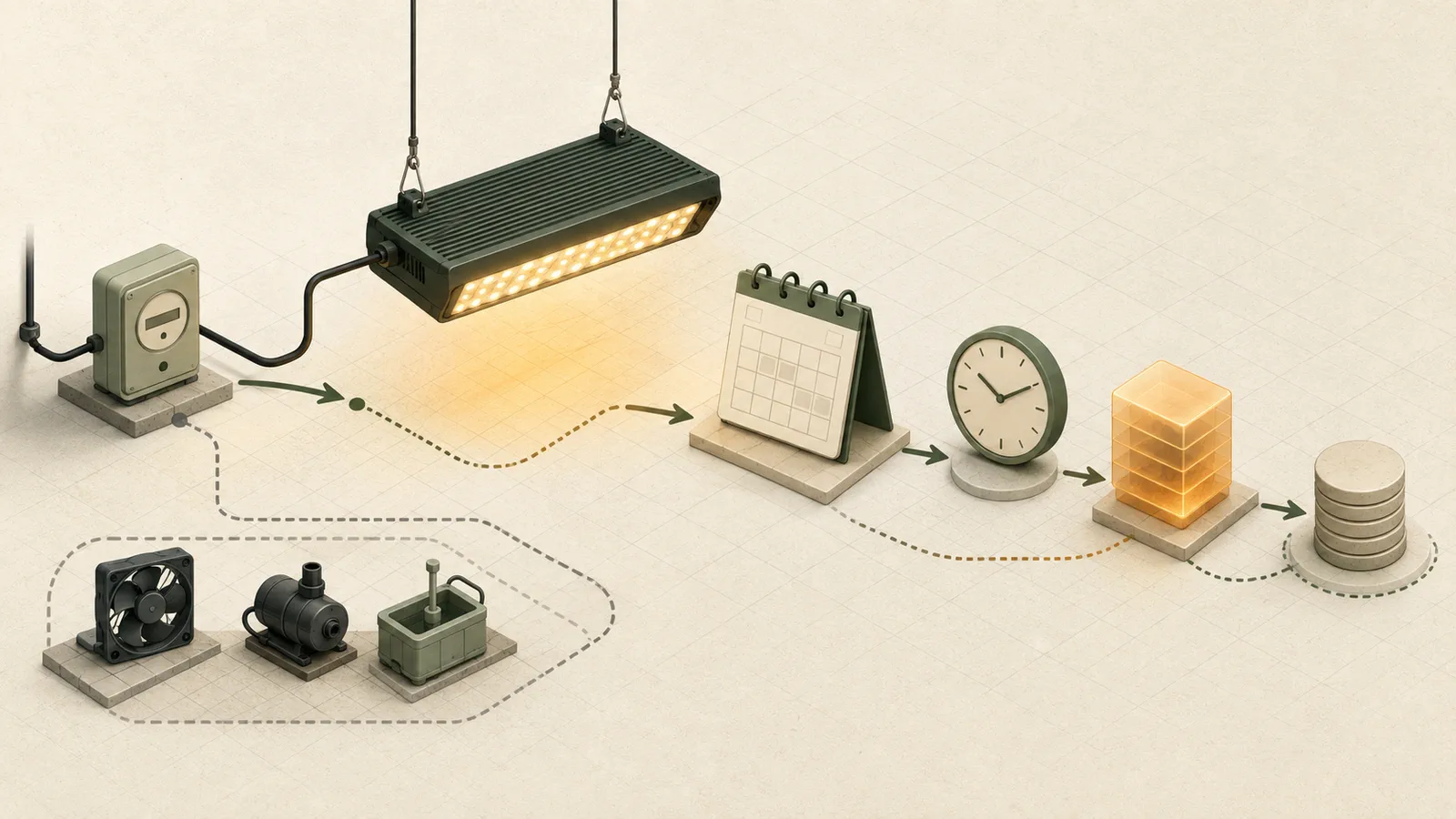
To estimate what a grow light costs to run, convert its operating input power from watts to kilowatts, multiply by the hours it runs, and then multiply the resulting kilowatt-hours by the electricity rate that actually applies to those hours.
Energy (kWh) = input watts ÷ 1,000 × operating hours
Electricity cost = energy (kWh) × applicable tariff
The arithmetic is simple; the inputs are where most errors occur. Use the input power for the exact operating configuration, not a marketing label or an unrelated model. Use the real schedule, including dimming or off periods. Use a dated tariff from the reader’s utility plan, including time-of-use periods or tiers when they affect the marginal energy charge. Keep fixed account charges separate unless the grow light changes whether a threshold or demand-related charge applies.
Cost workflow summary
| Decision point | Evidence-based finding |
|---|---|
| Power input | Use operating input watts for the exact configuration. Rated maximum power is a scenario ceiling unless the light actually runs at that level. |
| Run time | Use actual hours by day and, for time-of-use plans, allocate those hours to the correct rate periods. |
| Tariff | Use a current utility-plan rate or a clearly labeled scenario input. A national or state average is context, not the reader’s bill rate. |
| Other loads | Keep fans, pumps, controllers, heaters, humidifiers, and dehumidifiers separate unless the question is total setup cost. |
| Uncertainty | Show a range when wattage, schedule, tariff, standby power, or seasonal operation is uncertain. |
Key facts
- Watts measure power: they describe the rate of energy use at a moment, not the total energy consumed over a day or month.
- Kilowatt-hours measure energy: one kilowatt-hour is the energy used by one kilowatt for one hour.
- The applicable tariff matters: electricity prices vary by utility, location, customer class, plan, and sometimes time of use or consumption tier.
- Averages are not a bill quote: published average revenue per kilowatt-hour can provide context but does not reproduce a reader’s exact retail tariff.
- Rated and actual power can differ: dimming, duty cycle, and controls can change average use; use an observed or official operating value when available.
- Standby consumption can exist: timers, controllers, connected drivers, or other equipment may draw power while the main light output is off.
- Lighting-only cost is not setup cost: pumps, fans, heating, cooling, humidification, and other loads require separate inputs.
Takeaway: A defensible estimate is a dated scenario with explicit watts, hours, tariff, days, and uncertainty—not a universal dollar figure attached to the phrase “grow light.”
Define the scenario before calculating
Start by naming exactly what the estimate covers. A useful scenario identifies the light or lighting circuit, operating mode, daily schedule, number of days, location or utility plan, and whether the result covers only the light or the entire indoor-growing setup.
For example, “one 200-watt light operated at full input for 12 hours per day for 30 days at a scenario rate of $0.18 per kilowatt-hour” is calculable. “A grow light costs about $13 per month” is not portable evidence because it hides the wattage, schedule, tariff, and period.
Do not infer operating power from photon efficacy, PPF, PPFD, DLI, lumens, or a product category. Those quantities answer different questions. If a document provides input watts, use that value for the stated mode. If it provides only a maximum or a range, calculate a range and label the assumption.
Collect dated inputs
1. Input watts for the exact operating mode
Use the electrical input power of the exact fixture configuration and control setting. A nameplate maximum can support a high-use scenario, but it should not be represented as measured average consumption unless the unit actually operates at that level.
If the light is dimmed, cycles between settings, or is controlled dynamically, average power is more useful than a single maximum. When power fluctuates, an energy measurement over a representative interval can be divided by elapsed time to estimate average watts. Root & Photon did not perform that measurement for this article.
2. Operating hours and days
Record actual hours per day and the number of days in the period. A monthly estimate should say whether it uses 30 days, 31 days, or a calendar-specific count. An annual estimate should account for seasonal shutdowns or schedule changes instead of automatically multiplying a short high-use period by 365.
If a utility uses time-of-use pricing, split the schedule into the relevant periods. A light that runs partly during an off-peak window and partly during a peak window does not have one correct blended cost unless the blend is calculated from those hours.
3. The applicable electricity tariff
Use a current utility tariff or account-specific energy rate when available. Electricity prices vary by customer class and locality. Public averages can help compare broad contexts, but they do not reproduce every tier, time period, rider, tax, credit, or plan rule on a household bill.
The U.S. Energy Information Administration describes its average revenue per kilowatt-hour statistic as a proxy for average retail prices rather than a directly collected universal tariff. For a practical calculation, use a plan document, utility rate lookup, or user-supplied bill rate and record the date checked.
4. Standby power and connected controls
A timer, smart plug, controller, networked driver, or other connected device may consume power while the main light is off. For a rough light-only estimate this may be small, but it should not be silently assumed to be zero when the equipment remains energized.
When standby draw fluctuates, the U.S. Department of Energy recommends measuring energy over time and dividing by the measurement duration rather than relying on one unstable instantaneous reading. Add standby energy only when it is observed, documented, or included as an explicit scenario input.
Use the formulas
Convert watts to kilowatts by dividing by 1,000:
Power (kW) = input watts ÷ 1,000
Then calculate energy:
Energy per day (kWh) = input watts ÷ 1,000 × hours per day
Calculate cost:
Daily electricity cost = daily kWh × applicable tariff
Period electricity cost = daily cost × number of days
Worked arithmetic example 1
Assume 200 watts, 12 hours per day, and a scenario tariff of $0.18 per kilowatt-hour:
200 W ÷ 1,000 × 12 h = 2.4 kWh/day
2.4 kWh × $0.18/kWh = $0.432/day
$0.432 × 30 days = $12.96
$0.432 × 365 days = $157.68
These are arithmetic outputs for the stated inputs. They are not a current tariff claim, product-cost forecast, or promise that the light runs at 200 watts continuously.
Worked arithmetic example 2
Assume 320 watts, 16 hours per day, and a scenario tariff of $0.24 per kilowatt-hour:
320 W ÷ 1,000 × 16 h = 5.12 kWh/day
5.12 kWh × $0.24/kWh = $1.2288/day
$1.2288 × 30 days = $36.864, rounded to $36.86
Keep unrounded values through intermediate steps, then round the displayed period result to the precision appropriate for the decision.
Important limitation: A calculation can be numerically correct and still be decision-poor if the wattage, schedule, tariff, or covered equipment is wrong. Formula review does not validate the inputs.
Test sensitivity instead of presenting false precision
A useful estimate shows which input changes the result. Because the model is multiplicative, a 10% change in watts, hours, or the energy rate produces a 10% change in the simple energy-charge result when the other inputs remain constant.
Build at least a low, expected, and high scenario when an input is uncertain:
| Input | Low scenario | Expected scenario | High scenario |
|---|---|---|---|
| Average input watts | Observed dimmed or lower operating mode | Most likely operating mode | Rated or documented maximum scenario |
| Hours per day | Shorter actual schedule | Planned schedule | Longer seasonal or propagation schedule |
| Tariff | Applicable lower-rate period | Current blended or scheduled rate | Applicable higher-rate period or tier |
| Days | Partial-month use | Chosen billing period | Full-period operation |
Do not use a national average as the high or low bound unless the decision actually concerns national context. For a household decision, the relevant range should come from the utility plan, schedule uncertainty, and equipment operation.
Separate unknown and non-energy costs
This method estimates electricity charges attributable to energy consumption. It does not automatically include:
- the purchase price of the light or controls;
- shipping, tax, financing, warranty, or replacement cost;
- fixed utility customer charges that would exist without the grow light;
- demand charges or plan thresholds unless the account is actually subject to them;
- fans, pumps, heaters, cooling, humidification, dehumidification, or other setup loads;
- maintenance, crop inputs, water, nutrients, or labor;
- changes in room heating or cooling load;
- any yield, savings, avoided-purchase, ROI, or payback assumption.
For total setup cost, calculate each electrical load separately and sum the kilowatt-hours. Keep non-energy costs in separate lines so a change in one assumption does not silently alter another.
Use the result in a buying decision
The cost method is most useful when comparing documented scenarios on the same basis. For each candidate, keep the area, intended schedule, tariff, and included equipment consistent. A lower-watt fixture is not automatically the lower-cost choice if it requires more units, longer operation, or a different configuration to meet the intended lighting task.
Likewise, a higher photon-efficacy specification does not by itself determine the electricity bill. It can inform source efficiency, but operating cost still depends on total input power, quantity of fixtures, schedule, controls, and the applicable tariff. Coverage and crop suitability require separate evidence.
Before you buy: Ask for input power by operating mode, a clear schedule assumption, and enough coverage information to know how many fixtures the scenario requires. Then run the same dated tariff method for every option. Do not compare one product’s maximum watts with another product’s dimmed or incomplete scenario.
What we could not verify
- Your utility, rate plan, taxes, riders, tier position, credits, or time-of-use schedule.
- The actual average input power of any grow light or controller in your home.
- Standby draw for a specific timer, smart plug, driver, or control system.
- How lighting changes heating, cooling, humidity, or ventilation energy in a specific room.
- Any product’s reliability, coverage, crop fit, yield, savings, ROI, or payback period.
If any of these factors materially changes the decision, treat it as a required input or a separate research question rather than hiding it inside one monthly estimate.
Methodology
This article uses E2 documentary evidence. The energy-unit relationship follows U.S. Energy Information Administration explanations of watts, watt-hours, and kilowatt-hours. Tariff treatment follows EIA’s distinction between published average revenue per kilowatt-hour and an account’s applicable retail rate, together with public utility-rate lookup documentation. Standby treatment follows U.S. Department of Energy measurement guidance.
The formulas were independently recomputed, including unit conversion, daily energy, daily cost, 30-day cost, annual cost, and rounding. The article deliberately excludes product prices, rankings, affiliate links, direct measurements, universal tariffs, savings, ROI, crop targets, and elevated safety advice. Search-intent review separated this method page from product comparisons, crop-light sizing, DLI calculation, and a future interactive electricity-cost calculator.
Sources
- U.S. Energy Information Administration — Measuring electricity
- U.S. Energy Information Administration — Prices and factors affecting prices
- U.S. Energy Information Administration — Electricity Monthly Update: End use
- U.S. Department of Energy FEMP — Measuring standby power
- OpenEI — Utility Rate Database API documentation
- Open Energy Data Initiative — U.S. utility companies and rates lookup data