Evidence status: This is a document-based comparison of current official product and support pages. Root & Photon did not buy, assemble, operate, measure or grow with either system. The article can compare documented architecture and recurring-care expectations, but it cannot identify a performance, reliability, yield, taste, energy, noise or value winner.
Quick answer
Gardyn Studio 2 and the Lettuce Grow Farmstand Nook solve a similar household problem: both are compact, floor-standing indoor hydroponic systems with integrated lighting and automated water circulation. The stronger fit depends less on which logo you prefer and more on what you want to manage every week.
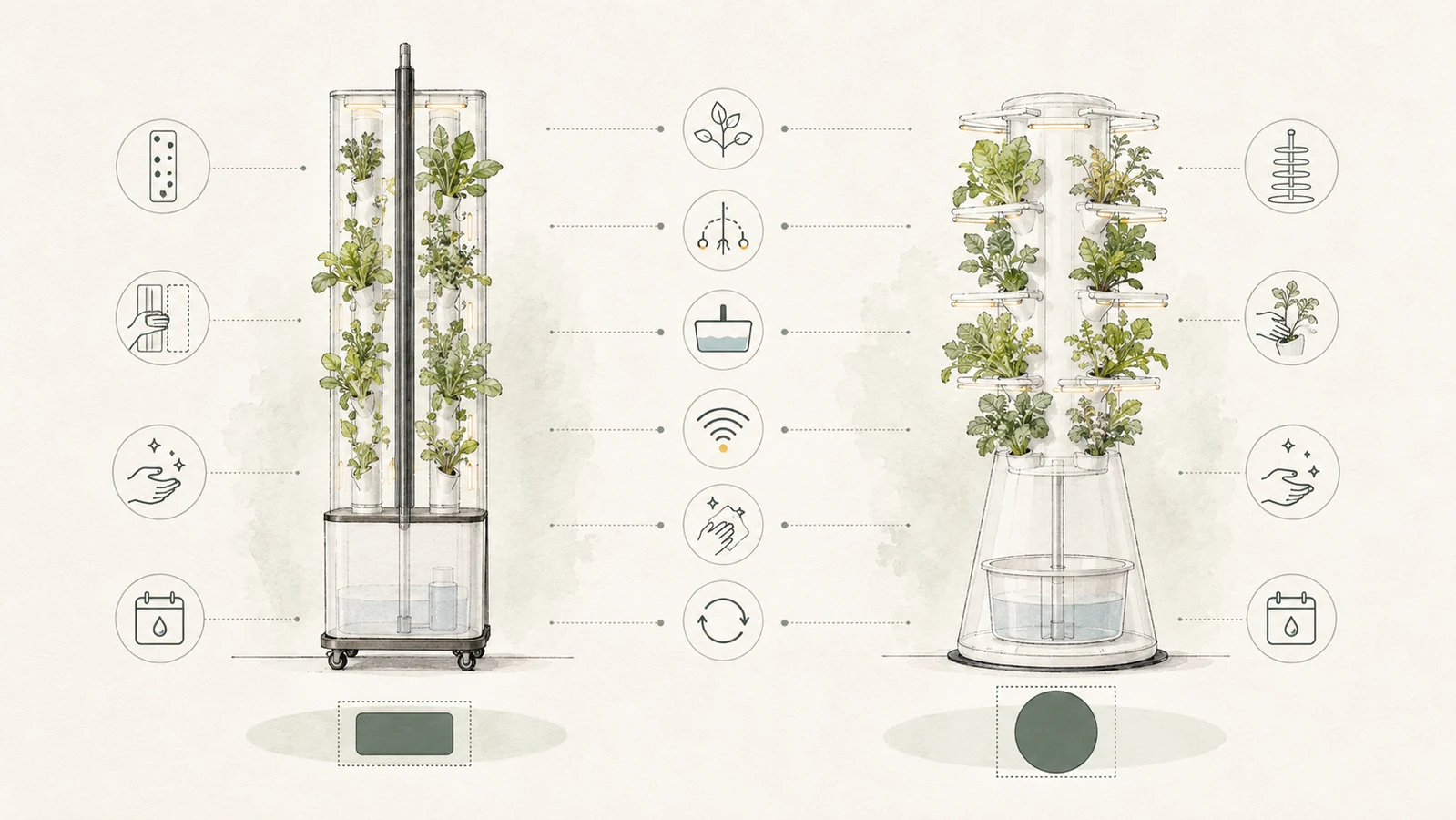
Studio 2 is the more compact and more heavily instrumented design in the official documents reviewed. Gardyn lists 16 plant sites in a 17-by-12-inch, 54-inch-high frame, with water-level, humidity and temperature sensors, an inward-facing camera and 2.4 GHz Wi-Fi. It can operate without a paid membership, although membership changes how much guided monitoring and task support the system provides.
The Farmstand Nook offers 20 nominal plant ports and a larger nine-gallon reservoir. Lettuce Grow documents integrated lights, a pump and an app-enabled Smart Timer, and it makes pH checks, water and nutrient maintenance, and periodic system resets explicit parts of the routine. Official regional pages reviewed for the Nook do not agree on one exact diameter, so confirm the current US assembly manual and measure working clearance rather than relying on a single marketing dimension.
Neither is a defensible “set-and-forget” choice. Both still require plant care, reservoir attention, cleaning and evidence that water is actually circulating. Choose the workflow you are willing to maintain; choose neither when recurrent tank work, connected controls or failure checks do not fit your household.
Comparison decision
| Decision point | Finding |
|---|---|
| Smallest documented base footprint | Studio 2 has the clearer compact-space case: Gardyn lists 17 × 12 inches and 1.4 square feet. Working clearance still needs to be measured. |
| More nominal plant positions and reservoir volume | Nook lists 20 ports and a nine-gallon tank, versus 16 sites and a four-gallon support reference for Studio 2. Those numbers do not establish crop output or unattended duration. |
| More onboard sensing in reviewed documents | Studio 2 lists water-level, humidity and temperature sensing plus an inward camera. The reviewed Nook set documents an app-enabled Smart Timer, not an equivalent onboard sensor-and-camera array. |
| More explicit manual solution-management workflow | Nook documentation makes water, nutrients, pH checks and periodic resets prominent. Studio documentation makes top-offs and tank refreshes prominent and offers optional guided membership. |
| Main risk | Treating automation, port count or reservoir size as proof of low effort, reliability or harvest. None of those outcomes was independently tested here. |
Takeaway: Studio 2 is the more compact and instrumented documentary fit; Nook is the higher-port, larger-reservoir documentary fit. That is not a performance ranking.
Key facts
| Item | Gardyn Studio 2 | Farmstand Nook | Evidence boundary |
|---|---|---|---|
| Nominal plant positions | 16 sites | 20 ports on four levels | Capacity, not simultaneous mature-crop or yield evidence |
| Listed placement | 17 in W × 12 in D × 54 in H; 1.4 sq ft | Less than 4 sq ft; 55 in H; official diameter figures conflict across reviewed regional pages | Base dimensions do not include every service clearance |
| Listed empty weight | 14 lb | 18 lb on reviewed regional product page | Empty weight only |
| Reservoir | 4 gal in Studio help documentation | 9 gal | Volume alone does not establish refill interval |
| Controls | Automated light/water schedules, app and Wi-Fi | Integrated lights, pump and app-enabled Smart Timer | No matched reliability test |
| Sensing in reviewed documents | Water level, humidity, temperature and inward camera | No equivalent onboard array established in the reviewed set | No privacy or data-security assessment |
| Recurring system care | Regular top-offs and at-least-four-week tank refresh | Weekly checks and quarterly reset | Official guidance; actual workload not observed |
Takeaway: The systems differ in footprint, port count, reservoir and control architecture, but both remain active plant-and-reservoir workflows.
Equivalent comparison scenario
This comparison assumes one household is choosing a compact indoor system for mixed herbs and leafy greens. Both systems must fit a level floor location, allow access for filling and cleaning, run integrated lights, circulate nutrient solution and support recurring plant care. The comparison does not assume that every port is filled with a mature large crop, that either system replaces grocery purchases, or that the buyer will use every connected feature.
That matched scenario matters. Comparing Studio 2’s narrow base to Nook’s plant count without including access and cleaning would favor one dimension while hiding another. Comparing a four-gallon tank to a nine-gallon tank without plant size, room conditions and refill behavior would turn volume into an unsupported autonomy claim. The correct question is: which documented workflow is the household more likely to maintain consistently?
Documented specifications: compare what the numbers actually mean
| Criterion | Studio 2 | Nook | What the evidence permits |
|---|---|---|---|
| Plant positions | 16 | 20 | Compare nominal capacity only. Crop form, spacing and harvest stage still matter. |
| Base footprint | Precisely listed as 17 × 12 in and 1.4 sq ft | Officially described as under 4 sq ft; reviewed diameter values conflict | Studio has the more precise checked-date base specification; measure Nook from the current US manual. |
| Height | 54 in | 55 in | Both are similar-height floor systems; allow plant and service clearance above and around them. |
| Reservoir | 4 gal support reference | 9 gal | Nook holds more solution; neither volume predicts days unattended. |
| Integrated lighting | One manufacturer-listed 52 W LED | Integrated LEDs, wattage not established in this reviewed comparison set | No PPFD, uniformity, real-power or crop-response comparison. |
| Empty system mass | 14 lb listed | 18 lb listed on regional official page | Does not include water, plants or working accessories. |
Plant positions are most useful as a layout constraint. A 20-port tower can hold more starts than a 16-site unit, but larger plants may shade neighbors or need pruning and support. The official numbers do not prove that all sites can carry the buyer’s preferred mature crop at once.
Reservoir size is similarly easy to overread. Nook’s nine-gallon tank offers more water volume than Studio’s four-gallon help-center reference, but water use changes with plant mass, temperature, humidity, airflow, light schedule and maintenance practices. Treat reservoir size as a refill-access and handling decision, not a promise of vacation duration.
Automation and connected features
Gardyn documents Studio 2 as a connected, instrumented system. Its current specification table lists water-level, humidity and interior-temperature sensors, one inward-facing camera and a 2.4 GHz Wi-Fi requirement. Gardyn says the system can continue on default lighting and watering schedules without an active membership; membership adds Kelby-guided monitoring and task support. In both modes, the owner still prunes, harvests and maintains the tank.
Lettuce Grow documents Nook with integrated lights, a pump and an app-enabled Smart Timer that can adjust watering and lighting cycles. The reviewed official sources do not establish an onboard camera and environmental-sensor array equivalent to Studio’s. That does not mean Nook is less reliable or less effective; it only means the documented control architectures expose different information and guidance.
Connected features create questions beyond this article’s evidence. No privacy, cybersecurity, app continuity, cloud-dependency or update-policy review was performed. A buyer who does not want a camera or Wi-Fi-connected plant platform should treat that as a separate diligence gate, not assume a favorable answer from the horticultural feature list.
Recurring care: automation is not maintenance removal
| Care area | Studio 2 documentation | Nook documentation | Buyer implication |
|---|---|---|---|
| Water level | Regular top-offs; nonmembers are told to monitor and top off routinely | Weekly water checks and reservoir top-offs | Both need visible tank access and a repeatable household routine. |
| Solution management | Plant-food workflow and tank refresh are documented | Nutrients and pH tools/checks are explicit | Neither is a plain-water appliance. Follow current official instructions; this article does not prescribe chemistry. |
| Deep cleaning/reset | At least every four weeks in the reviewed tank-refresh guide | Quarterly reset in the reviewed Nook guide | Intervals differ in documentation, but actual cleaning effort was not observed or timed. |
| Plant work | Pruning, harvesting and plant replacement remain | Harvesting, replacing seedlings and root/debris management remain | Automation controls equipment, not plant biology. |
| Failure checks | Confirm tank, schedules and irrigation operation | Confirm timer, pump, reservoir and flow path | A running control is not proof that every root zone is receiving water. |
The maintenance intervals are not directly equivalent measurements. They come from each vendor’s own workflow and may reflect different architecture, support philosophy and terminology. Use them to understand the kinds of recurring work, not to declare one system lower maintenance.
Tradeoffs
Gardyn Studio 2
The documented advantages are a narrow footprint, precise published dimensions and a richer set of onboard sensing and camera features. The system can operate without paid membership, but buyers should decide whether they want to self-manage schedules and status or value the additional guided workflow. The four-gallon tank is smaller than Nook’s listed reservoir, which may make handling easier for some households but does not establish how often a particular garden will need water.
The main documentary constraints are the 16-site capacity, 2.4 GHz Wi-Fi requirement for connected operation, camera presence and the distinction between base operation and membership-guided features. No claim is made about camera accuracy, plant diagnosis, app quality, uptime or privacy.
Farmstand Nook
The documented advantages are 20 nominal ports, a nine-gallon reservoir and an included control-and-maintenance package built around integrated lighting, a pump, Smart Timer, nutrients and pH tools. Buyers who prefer an explicit manual routine for solution checks may find that workflow easier to understand before purchase.
The main documentary constraints are a larger stated placement envelope, an explicit pH-management burden and an unresolved exact-diameter conflict across official regional pages. Current US documentation should be checked before committing floor space. No conclusion is made about the Smart Timer’s reliability, app experience, pump service life or the difficulty of chemical handling.
Fit by scenario
| Household priority | More aligned documentary fit | Reason and limit |
|---|---|---|
| Narrowest documented base | Studio 2 | 17 × 12 in and 1.4 sq ft are explicitly listed; still measure access clearance. |
| More nominal planting positions | Nook | 20 ports versus 16 sites; no simultaneous mature-crop or yield promise. |
| More onboard status instrumentation | Studio 2 | Official documents list sensors and a camera; no quality or privacy verdict. |
| Larger listed reservoir | Nook | Nine gallons versus four; no unattended-duration guarantee. |
| Avoid paid guidance membership | Either can remain eligible | Gardyn documents nonmembership operation; Nook documents a free app. Confirm current policies. |
| Avoid recurrent solution and cleaning work | Neither | Both require water, nutrient, plant and cleaning routines. |
| Need proven lowest noise, power or failure rate | Neither established | No matched measurements or reliability test exist. |
Avoid or defer conditions
- Defer both systems when you cannot provide routine tank access, cleaning access and visual checks for water delivery.
- Defer Studio 2 when a camera, 2.4 GHz Wi-Fi or membership-dependent guided features conflict with your connected-device preferences.
- Defer Nook when you do not want an explicit pH-checking and nutrient-management routine.
- Defer a placement decision when the current US manual, dimensions, included components or outlet requirements cannot be confirmed.
- Do not choose either system from port count alone when your intended crops are large, vining or support-intensive.
- Do not treat a vendor harvest-time, yield, “easy,” “automatic” or “no experience” claim as independent evidence.
Neither-fits path
A simpler system may be the better decision when you want fewer connected features, lower solution volume, easier manual inspection or less reliance on proprietary plant holders and app workflows. A basic container, countertop unit or manually monitored hydroponic setup can make the water path and failure points easier to see. That alternative is not automatically cheaper or easier; it simply moves control and maintenance decisions back to the operator.
When the household cannot commit to recurrent tank care, pruning, cleaning and failure checks, a hydroponic tower may be the wrong category. Start with a smaller number of manually watered plants or postpone the purchase until the routine can be tested without a large system.
What we could not verify
- Matched light distribution, real power, noise, temperature, water use or pump performance.
- Assembly time, cleaning time, app usability, camera usefulness, timer reliability or failure recovery.
- Comparative germination, growth rate, harvest mass, taste, nutrient quality or simultaneous mature-crop capacity.
- Current price, promotions, shipping, taxes, membership economics, replacement costs or total ownership cost.
- Current US Nook diameter, every included accessory, warranty applicability or replacement-part availability.
- Privacy, cybersecurity, electrical, water, chemical, food-safety or household-safety conclusions.
Methodology
Root & Photon reviewed 16 current official product, support, policy, government and university-extension sources on July 27, 2026. Product identity and specifications came from Gardyn and Lettuce Grow pages; those statements remain attributed vendor evidence. USDA and University of Minnesota Extension sources supplied the category-level hydroponics boundary.
The systems were compared under the same small-space household scenario using model identity, nominal capacity, placement, reservoir, controls, sensing, connected dependencies, recurring care, replacement evidence and unknowns. The method is non-numeric. Conflicting Nook dimensions were retained rather than averaged or silently resolved. Price and commercial data were intentionally excluded.
No product was purchased or supplied. No assembly, operation, measurement, grow trial, tasting, expert review, privacy assessment or safety review occurred. The page therefore remains E2 sourced and cannot support review, test, benchmark, reliability, yield, efficiency, savings or “best” language.
Sources
- Gardyn Studio product page
- Gardyn Home vs Studio full specifications (manufacturer)
- Gardyn Help Center: Meet your Gardyn Studio
- Gardyn Help Center: Growing without an active membership
- Gardyn Help Center: Tank top-offs
- Gardyn Help Center: Tank refresh guide
- Gardyn Help Center: Studio fill and startup
- Lettuce Grow Farmstand Nook product page
- Lettuce Grow: Meet the Farmstand Nook
- Lettuce Grow: Set up your Farmstand Nook
- Lettuce Grow Help Center: Reset the Farmstand Nook
- Lettuce Grow Farmstand maintenance overview
- Lettuce Grow Farmstand replacement pump
- Lettuce Grow warranty policy
- USDA National Agricultural Library: Hydroponics
- University of Minnesota Extension: Small-scale hydroponics