
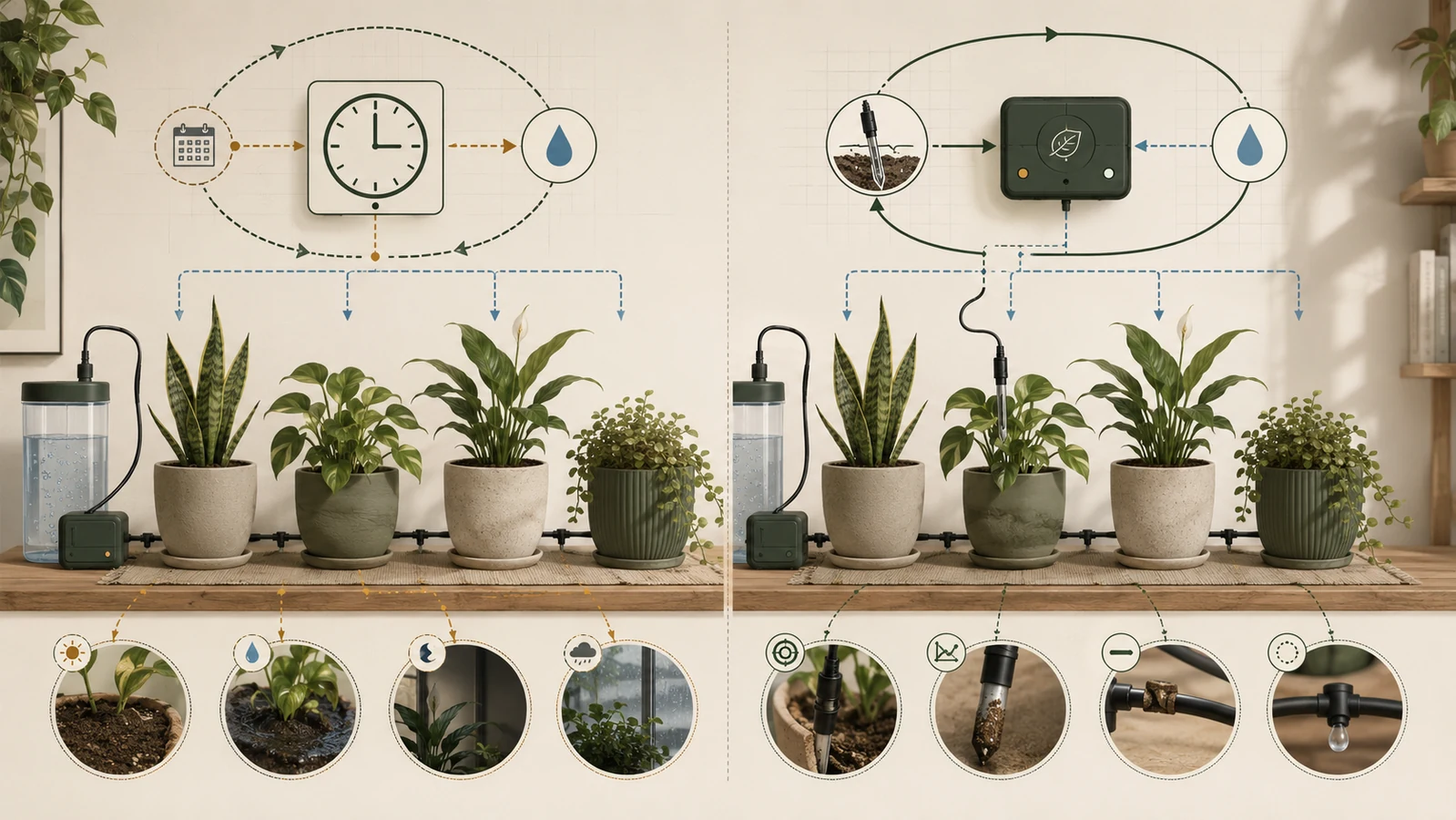
Evidence status: This is a source-based category comparison. Root & Photon did not install, calibrate, operate, measure or grow plants with a timer or moisture-sensor controller for this article. The result is a decision framework, not a product verdict or a plant-watering prescription.
Quick answer
A timer is easier to understand because it repeats a stated start time and duration. A moisture-sensor controller can react to a local reading instead of elapsed time alone. Neither is automatically better for indoor plants.
Choose a timer when the plant group, containers, medium, room conditions and delivery output are stable enough to observe and recheck. Investigate moisture-responsive control when demand changes materially and you can validate sensor type, units, placement, contact, calibration, threshold logic and the separate delivery path.
Do not let either controller make unattended decisions until it has been observed alongside pot weight, medium checks and endpoint delivery. When the evidence conflicts—or the consequence of a wrong decision is unacceptable—use monitoring-only or manual watering.
Moisture-sensor vs timer decision
| Decision point | Finding |
|---|---|
| Stable matched zone | A timer can be the simpler first investigation when demand and delivery have been observed under comparable conditions. |
| Demand changes materially | A moisture-sensor workflow may respond better to dry-down than elapsed time, but only after placement, calibration and threshold evidence pass. |
| Several dissimilar pots | Neither one timer nor one sensor represents every pot. Split the zone or retain individual manual decisions. |
| Uncertain sensor reading | Use monitoring-only mode and corroborate with pot weight or a depth check before controlling water. |
| Unverified delivery path | Neither controller passes. Verify every outlet, wick or root-zone response first. |
| High consequence of error | Use manual watering or a human check rather than granting unattended authority. |
Key facts
- A timer is open-loop: it repeats a programmed event without measuring current root-zone moisture.
- A sensor is local: it estimates a condition in a small sensing volume, not the water status of every root in every pot.
- Calibration and contact matter: medium, salinity, temperature, density, air gaps and placement can change sensor output.
- A threshold is not a plant truth: it is a decision rule that must be justified for the exact crop, medium and setup.
- Control is not delivery: a timer event or sensor trigger does not prove that water reached each root zone.
- Symptoms overlap: wilting and yellowing can occur when a plant is too dry or too wet.
- Manual is not failure: when neither control method can be validated, manual watering is the evidence-led result.
Equivalent comparison boundary
Compare control logic only after the watering architecture is defined. Hold the plant group, pots, medium, room, reservoir, pump or wick, tubing, emitters and observation period constant. Otherwise a “sensor versus timer” result can actually be a comparison of different pumps, outlets, plants or media.
| Field | Timer side | Sensor side | Why it matters |
|---|---|---|---|
| Plant and stage | Same defined zone | Same defined zone | Demand changes with species, size and growth stage. |
| Container and medium | Same pots and mix | Same pots and mix | Dry-down and sensor response depend on physical properties. |
| Delivery path | Same verified outlets | Same verified outlets | Control logic cannot compensate for a blocked or uneven endpoint. |
| Environment | Record light, heat and humidity | Record light, heat and humidity | Changing conditions alter water use and schedule fit. |
| Observation method | Pot weight, depth check and output log | Same checks plus sensor data | Both methods need comparable independent evidence. |
| Failure consequence | Same placement and spill boundary | Same placement and spill boundary | A wrong decision must be judged under the same household consequence. |
Takeaway: Do not compare a basic timer in one setup with a sensor system in another and attribute the entire difference to control logic.
How the two control methods differ
Timer-based control
A timer starts watering at predetermined times for predetermined durations. Its strength is explicitness: the operator can state exactly when an event should occur and how long the actuator should run. That makes the rule easy to inspect and reproduce.
The weakness is that time alone does not observe whether the medium has dried, whether plant demand changed, or whether the prior event delivered correctly. University of Maryland Extension advises watering indoor plants according to need rather than a fixed schedule because potting medium, humidity and temperature affect demand. Utah State University documents the same scheduling problem in a different context: rapidly changing environmental conditions can make programmed irrigation over- or under-supply a crop. The transfer here is limited to the decision principle, not the field or high-tunnel settings.
Moisture-responsive control
A moisture-responsive controller uses a sensor reading, trend or threshold as an input. Depending on the technology, the sensor may estimate volumetric water content, water tension or another proxy. Those quantities are not interchangeable, and the reading is local to the sensing area.
Extension sources emphasize that calibration, medium or soil properties, salinity, temperature, density, direct contact and representative placement can affect usefulness. Oklahoma State University also notes that nearby sensors can disagree in absolute value while still showing recharge and dry-down trends. A graph that looks precise is therefore not proof that the number represents the whole pot.
Responsive control can work under defined conditions. Calibrated research systems have maintained selected substrate states, and a container-nursery mini-lysimeter proof of concept used less irrigation than a daily timer during its eight-week experiment. These results establish feasibility, not a universal household advantage or a product recommendation.
Comparison criteria
| Criterion | Timer-based control | Moisture-responsive control |
|---|---|---|
| Primary input | Clock time and runtime | Sensor reading, trend or threshold |
| Main evidence needed | Observed demand, stable zone and verified output | Sensor type, units, calibration, placement, threshold and verified output |
| Response to changing demand | Requires a human schedule change | Can react to local measured change when the decision rule is valid |
| Interpretation burden | Lower; the rule is explicit | Higher; the reading and threshold need context |
| Spatial representation | One schedule can overgeneralize a mixed zone | One sensor can overgeneralize a mixed zone |
| Common hidden failure | Schedule remains unchanged after demand shifts | Bad placement or calibration drives a confident wrong trigger |
| Monitoring-only use | A timer log can document events | A sensor can log trends without controlling water |
| No-purchase alternative | Manual watering using pot weight, medium checks and a written log | |
Takeaway: Timer control asks whether the schedule stays valid. Sensor control asks whether the measurement and threshold stay valid. Both still ask whether water was delivered.
Tradeoffs
When a timer can be the simpler fit
A timer may fit a small, matched group that has a stable observed dry-down pattern and a delivery path that has already been checked. It is also easier to audit: the operator can see the scheduled events and compare them with pot weight, medium condition and reservoir use.
Its main risk is inertia. A schedule that worked before repotting, seasonal change or plant growth may continue operating after it becomes inappropriate. The remedy is not a universal adjustment percentage; it is an event-driven recheck.
When moisture-responsive control deserves investigation
A sensor may be useful when the interval between needed waterings varies enough that elapsed time is a poor proxy. It can also be used as a monitor before it is allowed to control anything. Logged recharge and dry-down trends can help the operator see whether the zone behaves consistently.
The additional information creates additional duties. The operator needs to know what the sensor measures, where its sensing volume sits, whether the medium requires calibration, how the threshold was selected, how stale or missing data are handled, and whether the reading agrees with direct evidence. Connected alerts and app interfaces do not answer those questions by themselves.
Failure modes
| Failure | Timer exposure | Sensor exposure | Fail-closed response |
|---|---|---|---|
| Demand changed | Old schedule continues | May respond if placement and rule remain valid | Re-establish the zone baseline. |
| Outlet blocked or disconnected | Event still appears to run | Reading may or may not detect the affected pot | Inspect and compare every endpoint. |
| Sensor lost contact | Not applicable | Air gap can create misleading output | Disable automatic triggering and reinstall under exact documentation. |
| Threshold is wrong | Not applicable | Controller repeats a wrong decision consistently | Return to monitoring-only and revalidate. |
| Reading is stale or missing | Timer remains independent | Controller may lack a trustworthy input | Use a documented no-water or human-review fallback, not an invented value. |
| Mixed pots share one zone | One schedule mismatches some pots | One sensor represents only one local condition | Split the zone or return to individual decisions. |
| Symptoms misread | Wilting or yellowing prompts more water even though the medium may be wet | Check root-zone evidence before changing control. | |
| Short trial overinterpreted | One successful period is treated as long-term reliability | Keep seasonal and component-aging uncertainty visible. | |
Validate before automating
- Define one zone. Record plant identities where known, pot sizes, medium, drainage, placement and current manual watering evidence.
- Verify delivery first. Observe or collect output at every endpoint. A controller cannot rescue an unverified delivery path.
- Establish independent observations. Use pot weight and a medium-depth check appropriate to the container. Record disagreements rather than smoothing them away.
- Run the timer baseline. Record start, duration, delivered output, pot response and room conditions. Do not call the result universally transferable.
- Run the sensor in monitoring-only mode. Record units, location, contact, calibration basis and recharge/dry-down trends before enabling a trigger.
- Define the threshold source. A product default is not automatically a plant-specific authority. Keep the threshold unknown until it is justified and observed in the exact setup.
- Resolve conflicts. A dry reading with a heavy, wet pot—or a wet reading with a light, dry root zone—stops automation.
- Change one variable at a time. Do not change threshold, runtime, output and plant grouping together.
- Retain a human fallback. Recheck after plant growth, repotting, moving the sensor, medium change, seasonal change or controller update.
Research studies demonstrate that responsive control is technically possible, but they also show why the setpoint matters. A soilless-tomato experiment found different crop responses under different matric-potential thresholds. That is a reason to validate the decision rule—not a reason to copy the study values into a home container.
Fit by scenario
| Scenario | First path to investigate | Evidence still required |
|---|---|---|
| One stable pot with a known manual pattern | Manual log or simple timer trial | Demand stability and verified delivery |
| Several truly matched pots | Timer with narrow zones | Endpoint parity and event-driven recheck |
| Dry-down interval changes materially | Sensor monitoring before control | Placement, calibration, threshold and conflict rules |
| Several dissimilar pots | Split zones or individual manual decisions | Evidence that any representative pot is actually representative |
| Sensor graph looks precise but calibration is unknown | Monitoring-only | Medium-specific interpretation and independent corroboration |
| Wrong watering could damage the room or plants materially | Human check or manual watering | Separate risk/safety and exact-system review |
Avoid or defer conditions
- Do not automate a mixed plant group merely because the pots are close together.
- Do not use one sensor percentage as a universal threshold across media, pots or plant stages.
- Do not enable automatic control when sensor units, placement, contact or calibration are unknown.
- Do not treat a running pump, timer event or app notification as proof of root-zone delivery.
- Do not respond to wilting or yellowing with more water until the medium and root-zone evidence are checked.
- Do not infer long-term reliability, savings or plant outcomes from a short household trial or a context-specific research result.
- Defer exact product, electrical, plumbing, leak, privacy, security and emergency decisions to their own documentation and review.
Neither-fits path
Automation is not required. Manual watering with a simple log, pot-weight comparison and medium check can be more defensible than an unvalidated controller. A moisture sensor can remain a monitoring instrument rather than a command source. A self-watering reservoir can also be considered as a separate passive architecture when its plant, medium, overflow and refill behavior fit.
When the setup cannot be observed long enough to validate it, reduce the plant group, arrange a human check, or postpone automation. “Unknown” is a decision state, not permission to let the controller guess.
What we could not verify
- No exact timer, moisture sensor, controller, pump, valve, app or watering kit was approved or tested.
- No universal moisture threshold, irrigation interval, runtime or plant preset was established.
- No Root & Photon calibration, outlet measurement, leak test, power-loss test, long-term drift test or grow trial exists.
- No household electrical, plumbing, backflow, leak, mold, food-safety, privacy or emergency conclusion was reviewed.
- No water, energy, labor, cost, yield, reliability, savings, ROI or payback result is supported for home use.
- The primary studies use specific crops, substrates, thresholds and production environments that do not transfer directly to every indoor pot.
Methodology
This article uses E2 sourced evidence from current university-extension guidance and peer-reviewed irrigation research checked on July 27, 2026. The comparison was limited to control logic after a delivery architecture is defined. It separated timer schedule, sensor measurement, threshold rule, actuator delivery and plant/root-zone evidence.
Root & Photon did not purchase, install, calibrate, operate or measure either method and did not run a grow trial. Study results were retained only as context-bound examples. Conflicts, calibration limits, spatial variability and unknown long-term reliability were preserved. Exact products, prices, commercial links, universal thresholds, safety guidance and E3/E4 wording were excluded.
Sources
- University of Maryland Extension — Watering Indoor Plants
- University of Maryland Extension — Drought Stress to Indoor Plants
- University of Maryland Extension — Overwatered Indoor Plants
- University of Maryland Extension — Self-Watering Containers
- Oklahoma State University Extension — Soil Moisture-Sensing Systems for Improving Irrigation Scheduling
- Oklahoma State University Extension — Using Trend Values from Soil Moisture Sensors for Irrigation Decisions
- University of Minnesota Extension — Soil Moisture Sensors for Irrigation Scheduling
- Utah State University Extension — Irrigation Management in High Tunnels
- Nemali and van Iersel — Automated Irrigation in Potted Plants (2006 paper; abstract via ResearchGate)
- McCauley and Nackley — Mini-Lysimeter Irrigation Automation
- Pardossi et al. — Root Zone Sensors for Irrigation Management
- Mahmud et al. — Sensing and Automation in Nursery Production
- Montesano et al. — Tensiometer-Based Irrigation of Soilless Tomato