Evidence status: This alternatives guide uses current official product and support documentation plus government and university-extension sources. Root & Photon did not buy, assemble, operate, measure or grow with Gardyn Studio 2, Farmstand Nook or Personal Rise Garden. The article can compare documented architecture and management fit, but it cannot identify a performance, reliability, yield, safety or value winner.
Quick answer
Do not switch away from Gardyn Studio 2 merely because another product has more planting ports or a different shape. Start by naming the reason Studio 2 does not fit: vertical clearance, nominal capacity, reservoir handling, connected guidance, crop-height limits, recurring maintenance, or a preference for component-level control.
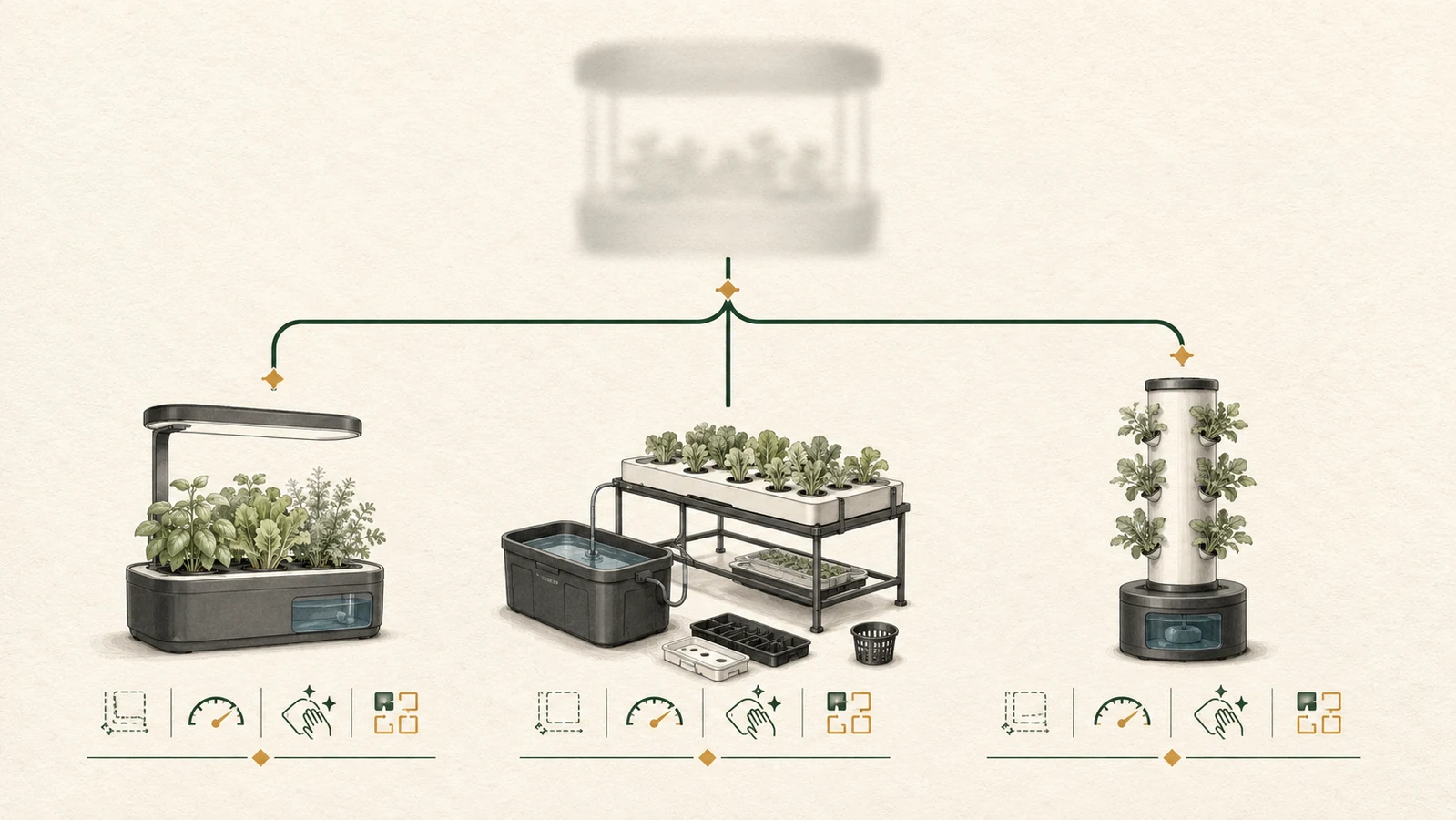
The Farmstand Nook is the closest documented vertical alternative in this bounded comparison. It lists 20 ports and a nine-gallon tank, with integrated lighting, a pump and Smart Timer. Personal Rise Garden is the lower-profile alternative: its official enclosure is 18 inches high, 22 inches wide and 10 inches deep, with an 8-pod tray out of the box and an optional 12-pod configuration intended for smaller plants or microgreens.
A product-neutral deep-water-culture setup is the no-brand alternative. It can make the system boundary more transparent, but it transfers component selection, lighting, root-zone oxygen, monitoring and maintenance decisions to the operator. DIY is not automatically cheaper, simpler, safer or more reliable.
Keeping Studio 2, growing manually or postponing the purchase are valid outcomes. Choose an alternative only when its documented placement, crop form, service dependencies and recurring work fit better than the baseline.
Alternatives decision
| Decision point | Finding |
|---|---|
| Keep the baseline | Keep Studio 2 when its 17-by-12-inch base, 54-inch height, 16 nominal sites, four-gallon tank and connected monitoring match the space and routine. |
| Switch to another vertical integrated system | Consider Farmstand Nook when 20 nominal ports, a larger nine-gallon tank and its timer/pump maintenance workflow fit better. These features do not prove more harvest or less work. |
| Switch to a lower-profile integrated system | Consider Personal Rise Garden when a countertop-height format and small-herb/green crop boundary matter more than tall vertical capacity. |
| Choose a no-brand path | Consider DIY deep-water culture when you accept component-level responsibility for reservoir, aeration, plant support, light and monitoring. |
| Choose neither | Use manual growing or defer when placement, crop form, recurring workload, connected-service preference or failure consequence remains unresolved. |
Takeaway: The strongest alternative is the one that changes the specific constraint causing Studio 2 not to fit. There is no universal replacement.
Key facts
| Path | Documented identity | Material distinction | Evidence boundary |
|---|---|---|---|
| Gardyn Studio 2 | 16 sites; 17 × 12 × 54 in; four-gallon tank; 52 W rated LED; sensors, camera and app | Narrow vertical baseline with the richest onboard sensing in this set | Official specifications, not independent performance evidence |
| Farmstand Nook | 20 ports on four levels; 55 in high; nine-gallon tank; integrated lights, pump and Smart Timer | More nominal ports and a larger listed reservoir in another vertical format | Regional official documentation requires current US confirmation |
| Personal Rise Garden | 18 × 22 × 10 in; 8-pod tray out of box; optional 12-pod tray; 30 W rated light | Lower-profile countertop format with a 12-in crop-height boundary | Not a direct capacity equivalent and not a crop-outcome promise |
| DIY deep-water culture | Product-neutral category defined by reservoir, aeration, support, light and monitoring functions | More component-level control and responsibility | No build recipe, cost, reliability or safety conclusion |
| Manual or defer | No automation purchase | Retains direct observation or delays commitment | A valid outcome when central fit evidence is missing |
Takeaway: Compare architectures and recurring work before comparing logos or plant-site counts.
Baseline and switching reason
Gardyn Studio 2 is the baseline, not a generic symbol for every smart garden. Its official documentation describes a narrow 17-by-12-inch base, a 54-inch height, 16 nominal plant sites, a four-gallon tank, a 52-watt rated light, water-level and environmental sensors, an inward camera and 2.4 GHz Wi-Fi. Some guided features depend on membership, while the system can still operate without an active paid plan.
Those facts create a useful switching checklist. Do you need a lower profile? More nominal sites? A larger reservoir? Fewer camera/sensor features? A different style of app guidance? More direct component control? Or is the real problem that no automated nutrient-solution system fits your routine? A product is not an alternative merely because it is sold in the same category; it should solve the specific mismatch.
Bounded candidate universe
This guide intentionally considers only three alternative paths. Farmstand Nook represents another compact vertical integrated system. Personal Rise Garden represents a lower-profile integrated countertop system. DIY deep-water culture represents a product-neutral, no-brand route. This is not proof that they are the only options in the market.
The bounded set prevents a common research error: collecting many product names while comparing different generations, crop claims, regional bundles and evidence quality. Adding another exact product would require a new current identity check, equivalent official documentation, explicit inclusion criteria and a re-frozen package.
Compare the same household job
| Criterion | What to record | What not to infer |
|---|---|---|
| Placement | Base dimensions, total height, crop clearance, refill access and cleaning access | A smaller base automatically fits the room or is easier to service |
| Crop form | Mature height, spread, support need and whether neighboring plants will be shaded | Every nominal port can hold a mature crop at once |
| Water handling | Reservoir volume, refill path, drain/clean path and consequence of a missed task | A larger tank guarantees more unattended days |
| Control layer | Timer, sensors, camera, app, membership and manual steps | More connected features prove better plant outcomes |
| Recurring work | Water, nutrients, pH where applicable, pruning, harvesting, root/debris removal and deep cleaning | Integrated lighting and pumping make the system maintenance-free |
| Evidence | Current manual/support page, market, checked date, conflicts and unknowns | Official marketing equals independent test evidence |
Takeaway: A valid alternative changes an identified constraint while preserving the complete-system functions your plants still need.
Option categories
Farmstand Nook: another vertical integrated path
Lettuce Grow documents 20 ports arranged across four levels, integrated LED lighting, a pump, a Smart Timer and a nine-gallon tank. This changes nominal capacity and solution volume relative to Studio 2. It also exposes a different recurring-care workflow: official support makes nutrient and pH tools, pump/timer operation and periodic reset work visible.
Nook is not a defensible switch when the only argument is “20 is greater than 16.” Port count does not establish simultaneous mature-crop capacity, harvest mass or easier maintenance. The reviewed regional official page must also be confirmed against current US documentation before relying on exact dimensions or bundle contents.
Personal Rise Garden: a lower-profile integrated path
Rise lists the Personal Garden as 18 inches high, 22 inches wide and 10 inches deep, with a 30-watt rated light, Wi-Fi/app guidance and manual nutrient delivery. It ships with an 8-pod tray and can use a 12-pod tray for smaller plants or microgreens. Rise support describes a 12-inch crop-growth space and warns that larger plants can shade neighbors or reach the light.
This path makes sense when vertical height is the central mismatch and the intended crops are compatible with the lower canopy. It is not a direct substitute for 16 or 20 tall-system sites. The buyer should accept its manual nutrient steps and documented deep-cleaning routine rather than assuming a countertop format means less work.
DIY deep-water culture: a no-brand path
University Extension describes deep-water culture as one of the simpler small-scale hydroponic categories, but a complete setup still needs water and nutrients, root-zone oxygen, plant support, lighting and maintenance. A DIY route lets the user select and inspect those components directly.
That flexibility is also the burden. Compatibility, reservoir sizing, aeration, support, light placement and monitoring do not disappear when a branded enclosure is removed. This page supplies no parts list, build dimensions, nutrient recipe, electrical instruction or cost estimate. DIY is an architecture choice, not a guaranteed bargain.
Fit and tradeoffs
| Switching reason | Potentially aligned path | Condition and limitation |
|---|---|---|
| Need more nominal vertical planting positions | Farmstand Nook | Twenty ports may fit the plan, but crop spacing and recurring solution work still govern practical use. |
| Need a lower total height | Personal Rise Garden | Countertop format helps only when the intended plants fit the 12-inch growth envelope. |
| Prefer fewer proprietary system-level decisions | DIY DWC | You gain component choice and also assume component compatibility, monitoring and maintenance. |
| Value sensors, camera and narrow floor footprint | Keep Studio 2 | The baseline may already fit; membership and connected-feature preferences still require review. |
| Do not want nutrient-solution, cleaning or failure checks | Manual or defer | None of the hydroponic paths removes recurring plant and reservoir work. |
| Need proven lowest cost, power, noise or failure rate | Insufficient evidence | No matched prices, measurements or reliability protocol exist in this E2 package. |
When not to switch
- Do not switch when Studio 2 already fits the measured placement, crop form and recurring-care routine.
- Do not switch for plant-site count alone. Nominal positions are not harvest, yield or mature-crop evidence.
- Do not switch because an app, sensor or camera is described as “smart.” Connected features are workflow tools, not biological validation.
- Do not switch to Nook until current US dimensions, included components and support requirements are confirmed.
- Do not switch to Personal Rise Garden when the intended crop regularly exceeds its documented growth envelope.
- Do not switch to DIY when you do not want component-level decisions, monitoring and troubleshooting responsibility.
- Do not make the decision from temporary price, promotion, shipping or membership economics; those inputs were not researched here.
A non-ranked shortlist method
| Question | Evidence to record | Fail-closed outcome |
|---|---|---|
| Why does Studio 2 not fit? | One specific constraint, not a vague desire for something “better” | Keep the baseline until the switching reason is clear |
| Does the alternative fit the space? | Current dimensions plus plant, refill and cleaning clearance | Defer when current documentation or measurement is missing |
| Do intended crops fit? | Mature height, spread and support need | Remove the option when crop form conflicts with the enclosure |
| Can the routine be maintained? | Water, nutrients, pH where applicable, pruning, cleaning and inspection tasks | Choose manual or defer when recurring work is unacceptable |
| Are connected dependencies acceptable? | Wi-Fi, app, camera, membership or timer dependence | Remove or narrow the option when the service model does not fit |
| Are central facts current? | Exact model, market, manual/support date and unresolved conflicts | Use `insufficient evidence`; do not guess |
Neither-fits path
A manually watered container, a smaller nonconnected hydroponic setup or delaying the purchase may fit better than any candidate. That path is especially reasonable when the household cannot provide recurrent reservoir care, cannot tolerate a leak or missed pump event, does not want connected services, or has not yet defined crop size and harvest goals.
Neither-fits is not a recommendation to abandon indoor growing. It keeps the decision reversible and prevents an evidence gap from being converted into a product choice.
What we could not verify
- Matched assembly, operation, cleaning time, app usability, camera usefulness or failure recovery.
- PPFD distribution, real power, noise, water use, temperature or component service life.
- Comparative germination, growth rate, mature-crop capacity, yield, taste or produce quality.
- Current prices, promotions, shipping, taxes, memberships, replacement parts or total ownership cost.
- Market completeness: other alternatives may exist outside this bounded candidate universe.
- Privacy, cybersecurity, electrical, chemical, food-safety or household-safety conclusions.
Methodology
Root & Photon reviewed 16 current official product/support, government and university-extension sources on July 27, 2026. Exact-product facts remain attributed to Gardyn, Lettuce Grow and Rise Gardens. USDA and University of Minnesota Extension sources define the product-neutral hydroponics boundary.
The method first froze Studio 2 as the baseline and then admitted one direct vertical integrated alternative, one lower-profile integrated alternative and one no-brand category. Each path was assessed with the same factors: placement, crop form, water handling, control layer, recurring work, evidence conflicts and neither-fits conditions. The method is non-numeric and produces no ranking.
No product was purchased or supplied. No assembly, operation, measurement, grow trial, tasting, expert review, price research, privacy assessment or safety review occurred. The page remains E2 sourced and cannot support “review,” “tested,” “best,” reliability, yield, efficiency, savings or E3 language.
Sources
- Gardyn Studio 2 product page
- Gardyn Home vs Studio full specifications (manufacturer)
- Gardyn Studio overview
- Gardyn Tank Refresh Guide
- Gardyn membership support
- Farmstand Nook product page
- Farmstand Nook specifications
- Farmstand Nook assembly guide
- Farmstand Nook reset guide
- Lettuce Grow Help Center
- Personal Rise Garden product page
- Personal Garden cleaning guide
- Rise membership page
- Personal Garden plant compatibility
- Small-scale hydroponics
- Hydroponics