
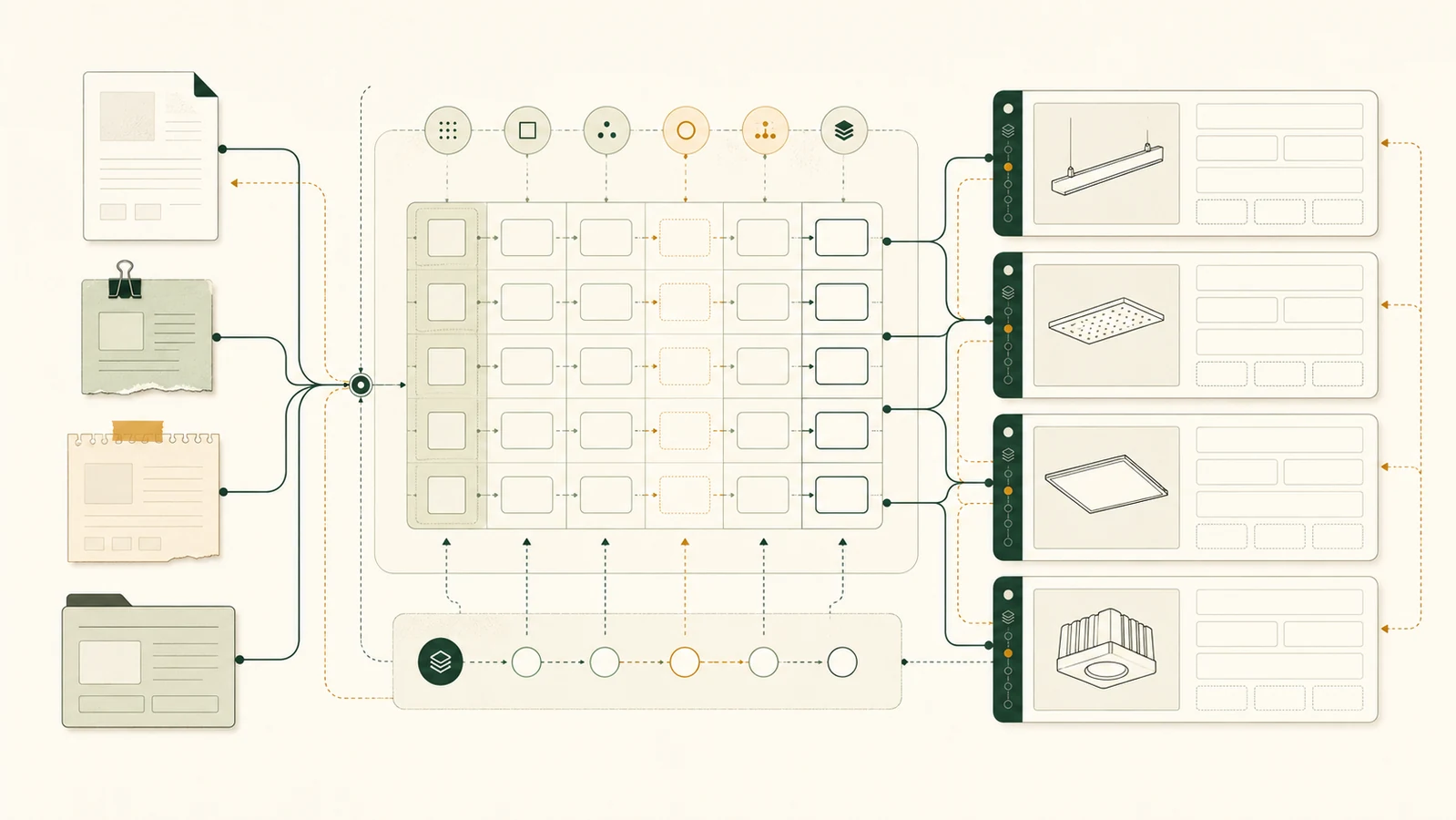
Evidence status: This is a six-record, source-traceable pilot database with a published schema, null-value policy, deterministic fixtures and a Python reference validator. It does not contain Root & Photon product measurements, a complete market survey or independent verification of manufacturer performance.
Quick answer
A useful grow-light specification database should make it easy to see not only the numbers, but also where each number came from, which exact model it belongs to, when the source was checked and what the source did not report. This pilot release normalizes six official product records while leaving missing fields blank rather than filling them from retailers, formulas or another model generation.
The database can help you compare reported input power, photosynthetic photon flux (PPF), photon efficacy (PPE), dimensions, coverage wording and controls. It cannot tell you which light performs best in your room. Coverage labels are not equivalent, point or plane photosynthetic photon flux density (PPFD) claims are not integrated PPF, and an arithmetic consistency check is not a laboratory test.
How to interpret this database
| Decision point | Finding |
|---|---|
| Use it for | Finding source-traceable reported fields and visible missing data for six exact models. |
| Do not use it for | Declaring a performance winner, choosing a crop target, or treating a coverage label as a measured uniformity map. |
| Strongest control | Exact model, official URL, checked date, field-level nulls and deterministic schema validation. |
| Largest limitation | The product values are manufacturer-reported and were not independently measured by Root & Photon. |
Takeaway: Use this pilot to inspect documentary fields and missing-data limits; it does not identify a product winner.
Key facts
| Item | Evidence-based finding |
|---|---|
| Release | Version 1.1.0; original six-record research baseline July 27, 2026; three qualified source successors captured October 18 and reviewed October 19, 2026. |
| Canonical format | JSON records under a versioned schema; CSV is a convenience export. |
| Numeric fields | Reported W, µmol/s and µmol/J only when present in the exact identified manufacturer document. |
| Missing data | JSON null and blank CSV cell; no imputation. |
| Validation layer | Schema tests, invalid fixtures, duplicate-ID detection and a limited PPF arithmetic flag. |
| Evidence ceiling | Method validation, not product testing or a reproducible market-wide benchmark. |
Takeaway: A complete-looking row is less trustworthy than an honestly incomplete row whose provenance and limitations are visible.
Database scope
This release is a bounded pilot, not a market census. The six records were selected to exercise different data conditions: three pages report power, PPF and PPE together; two report power and efficacy but not integrated PPF; one provides only a minimal set of structured fields in the captured text. That variation is useful for testing whether the database preserves missing evidence instead of smoothing it away.
The pilot includes AC Infinity IONBOARD S24, HLG 100 Rspec, Spider Farmer SF1000, Mars Hydro TS 1000, VIVOSUN AeroLight A100 and ViparSpectra XS1500 Pro. Inclusion is not a recommendation, ranking, endorsement or statement about availability. It means only that an identified manufacturer page or manual supports a bounded documentary record; source context and limitations stay attached to that record.
Standards and program pages establish the terminology and diligence context. ANSI/ASABE S640 covers definitions and descriptions of radiation metrics used for plant growth, while S642.1 covers measurement and testing methods. The DesignLights Consortium maintains a horticultural lighting program and an active HORT V4.0 requirement set. Those references help define what a careful record should say, but they do not turn every manufacturer field into an independently verified measurement.
Field definitions
Numeric normalization is deliberately narrow. Power is stored in watts, PPF in micromoles per second and PPE in micromoles per joule. Each value keeps its source ID and checked date. The database does not convert watts into photon output, lumens into plant-light metrics or one PPFD value into integrated PPF.
| Field | Stored form | Interpretation limit |
|---|---|---|
| Input power | Positive number in W, or null | Reported electrical input; not a claim about crop response. |
| PPF | Positive number in µmol/s, or null | Integrated reported photon flux; not a canopy distribution map. |
| PPE | Positive number in µmol/J, or null | Reported photon efficacy; not a whole-room energy result. |
| PPFD claim | Qualified text | Kept with stated height or condition; not made equivalent to PPF. |
| Coverage | Qualified text | Core, maximum, vegetative and flowering labels remain distinct. |
| Controls | Qualified text | No compatibility, privacy, reliability or automation conclusion. |
Takeaway: A field is comparable only when its quantity, unit, definition, model and condition are sufficiently aligned.
Six pilot records
The table below is a reading view of the canonical JSON release. It intentionally exposes “Not reported” cells. Those cells prevent a missing official value from being replaced with a calculated or secondary-source value that would look equally authoritative.
| Exact model | Power | PPF | PPE | Coverage wording | Record state |
|---|---|---|---|---|---|
| AC Infinity IONBOARD S24 | 220 W | Not reported | 2.65 µmol/J | 2 × 4 ft | included with missing fields |
| Horticulture Lighting Group HLG 100 Rspec | 95 W | 220 µmol/s | 2.41 µmol/J | 2 × 2 ft flowering; 3 × 3 ft vegetative | included |
| Spider Farmer SF1000 | 100 W | 249.21 µmol/s | 2.5 µmol/J | 2 × 2 ft core; 3 × 3 ft maximum | included |
| Mars Hydro TS 1000 | 150 W | 343 µmol/s | 2.3 µmol/J | 2 × 2 ft flower; 2.5 × 2.5 ft vegetative; 2.5 × 2.5 ft maximum, separately labeled on the US iControl bundle page | included with qualified coverage |
| VIVOSUN AeroLight A100 / AeroLight 100W | 100 W | Not reported | 2.75 µmol/J | 2 × 2 ft | included with missing fields |
| ViparSpectra XS1500 Pro | 150 W | Not reported | Not reported | Not reported | included minimal record |
Takeaway: The rows with more fields are not automatically better products; they are only more complete records under this schema.
Why coverage stays as text
Coverage labels can hide material differences. One page may use “core” and “maximum,” another may separate vegetative and flowering footprints, and another may give only one nominal area. The release preserves those phrases instead of converting every label into square feet and presenting the result as equivalent. A buyer who needs uniform canopy light still needs a suitably documented map or direct measurement for the intended height and area.
Why PPFD stays separate from PPF
PPFD describes photon flux density at a location or over a measurement plane. PPF is an integrated photon-flux quantity. A single center value at a stated distance cannot be substituted for an integrated PPF value. For that reason, the AC Infinity and VIVOSUN PPFD claims remain condition-qualified text, while their PPF fields remain null in this release.
Missing-data policy
The database uses one rule for every model: missing evidence remains missing. JSON uses null; the CSV export uses a blank cell. Zero is reserved for a real reported zero and is not accepted by the numeric schema for power, PPF or PPE.
| Situation | Database action | Why |
|---|---|---|
| PPE and power exist, PPF absent | Store PPF as null | Calculated PPF would no longer be the manufacturer’s reported field. |
| Retailer lists a missing dimension | Do not import it | The release is bound to official product sources. |
| Different regional pages disagree | Keep the selected market page and flag the conflict | Averaging or choosing silently would erase provenance. |
| PPFD lacks a full method | Retain qualified text | The number is not safely comparable as a normalized performance field. |
| Coverage uses different stage labels | Preserve original wording | Core, maximum, vegetative and flowering labels are not equivalent. |
Takeaway: Keep missing or differently defined fields visible; do not substitute another measurement or model.
Arithmetic consistency check
When an official page reports power, PPF and PPE together, the reference validator calculates expected PPF = power × PPE. It then compares the constructed value with reported PPF. A relative difference of 12% or less receives a “within review tolerance” flag; a larger difference requires editorial review. The 12% threshold is a project triage rule, not an industry tolerance and not evidence that either number is accurate.
| Record ID | Power × PPE | Relative difference from reported PPF | Flag |
|---|---|---|---|
| glspec-ac-infinity-ionboard-s24-20260727 | Not computable | Not computable | not computable |
| glspec-hlg-100-rspec-20260727 | 228.950 µmol/s | 3.91% | within review tolerance |
| glspec-spider-farmer-sf1000-20260727 | 250.000 µmol/s | 0.32% | within review tolerance |
| glspec-mars-hydro-ts1000-20260727 | 345.000 µmol/s | 0.58% | within review tolerance |
| glspec-vivosun-aerolight-a100-20260727 | Not computable | Not computable | not computable |
| glspec-viparspectra-xs1500-pro-20260727 | Not computable | Not computable | not computable |
Takeaway: Three records are mechanically checkable and fall inside the project review threshold; three are not computable because the official source does not provide every required field. Neither result is a product verdict.
Validation cases
The release includes six valid fixtures based on the six canonical records and eight invalid fixtures. Invalid cases cover a malformed record ID, blank brand, malformed source ID, non-HTTPS URL, non-ISO date, negative power, zero efficacy and an unauthorized top-level price field. A dataset-level test also rejects duplicate record IDs.
| Fixture group | Count | Expected result | Observed result |
|---|---|---|---|
| Valid exact-model records | 6 | Accepted without filling nulls | PASS |
| Invalid record fixtures | 8 | Rejected with a readable validation error | PASS |
| Duplicate-ID dataset | 1 | Rejected | PASS |
| Arithmetic consistency | 6 | Three within threshold; three not computable | PASS |
These tests validate the software behavior against frozen fixtures. They do not reproduce a manufacturer’s laboratory measurement. Reaching a reproducible product-performance claim would require a versioned source capture or raw report, applicable test method, equipment, conditions, uncertainty and independent reproduction that are outside this release.
How to use the output
Start with the exact model and market source. Then check whether the field you need is present, whether its definition matches the competing record and whether a condition changes its meaning. A missing field should become a diligence question, not a reason to assume a product is worse. A reported field should remain attributed to the manufacturer unless an independent measurement exists.
For a purchase decision, this database is one input. You would still need a crop and area requirement, a representative light-distribution method, the current manual, voltage and control compatibility, operating-cost assumptions and any applicable safety review. Those decisions belong to the relevant guides and future measured work, not to this normalized specification release.
Before you buy: Save the exact model page and date, list the fields your decision actually needs, and treat any blank or non-equivalent field as unresolved rather than filling it from a different source.
What we could not verify
- Independent accuracy of any manufacturer-reported power, PPF, PPE, PPFD, coverage, dimension or control field.
- A complete current United States grow-light market or a representative statistical sample.
- Full raw test reports, uncertainty budgets or model-generation histories for every record.
- Whether every product is currently listed on a qualified-products program.
- Current price, stock, shipping, warranty application or replacement-part availability.
- Real canopy uniformity, output at a buyer’s height, power draw, thermal behavior, noise, reliability, crop response or safety.
- Structured PPF/PPE/dimension fields for ViparSpectra XS1500 Pro in the captured official page text.
Methodology
Data and method files: Download the six-record data, schema and reference validator (ZIP, release 1.1.0).
We reviewed current standards/program scope pages, NIST unit-formatting guidance and six exact official product pages on July 27, 2026. Each record stores exact brand, model, market context, source URL, checked date, reported fields, state and limitations. Numeric fields accept only positive values explicitly shown by the source. Missing values remain null. PPFD, coverage, spectrum, voltage and control fields remain qualified text where definitions or conditions differ.
The canonical JSON release is validated against a versioned schema and frozen valid/invalid fixtures. A Python reference implementation checks identifiers, required fields, HTTPS URLs, ISO dates, positive numeric values, duplicate IDs and the limited power–PPF–PPE arithmetic relation. The method and fixtures passed locally. No product was purchased, installed, operated, measured or grown under by Root & Photon. Manufacturer fields therefore remain official-source claims, and the page-level evidence does not reach E4 reproducibility.
The original research baseline is July 27, 2026. A source-access update captured on October 18 and reviewed on October 19, 2026 uses the HLG 100 Rspec manufacturer manual (edition August 28, 2023; historical documentation), Spider Farmer’s official UK SF1000 specification table (regional documentary context, without US plug or package equivalence), and Mars Hydro’s US TS1000+iControl bundle (SKU TS-1000+MH-Controller43). The bundle is not evidence of equivalence to the historical standalone SKU TS-1000-2510: its separately labeled vegetative coverage is 2.5 × 2.5 ft, and the old 2.3 × 2.3 ft label is not carried forward. Mars Hydro’s 2026 TS-series article supplies series-level Bluetooth/MarsPro context only; exact iConnectu compatibility and inclusion for the historical standalone SKU remain unverified. These are manufacturer documentary claims, not measured performance or current availability findings.
Sources
- ANSI/ASABE S640 — Quantities and Units of Electromagnetic Radiation for Plants
- ASABE standards keyword index — S640 and S642
- ANSI/ASABE S642.1 SEP2025 scope page
- DLC Horticultural Lighting Program and HORT V4.0
- Writing with SI units
- IONBOARD S24 official product page
- HLG 100 Rspec manufacturer manual — edition August 28, 2023 (historical documentation)
- Spider Farmer SF1000 — official UK specification table (regional documentary record)
- Mars Hydro TS 1000 + iControl — official US bundle specification and separate coverage labels
- VIVOSUN AeroLight A100 official product page
- ViparSpectra XS1500 Pro official product page
- NIST SP 330 Appendix 1 — unit-symbol conventions
- Mars Hydro 2026 New TS Series — manufacturer article; series-level Bluetooth context only