Evidence status: This is a source-based troubleshooting workflow built from current university-extension guidance. Root & Photon did not inspect a plant or root system, measure light, moisture, pH, electrical conductivity, dissolved oxygen, nutrients, temperature or pests, and did not test a corrective action. The page helps you collect evidence and choose a branch; it does not diagnose a disease, deficiency or pest and does not prescribe treatment.
Quick answer
When an indoor herb seems to have stopped growing, do not begin by adding fertilizer or changing every part of the setup. First define what “stopped” means over a stated period: no new leaves, little stem extension, weak or spindly growth, slow recovery after harvest, flowering instead of leaf production, or active decline.
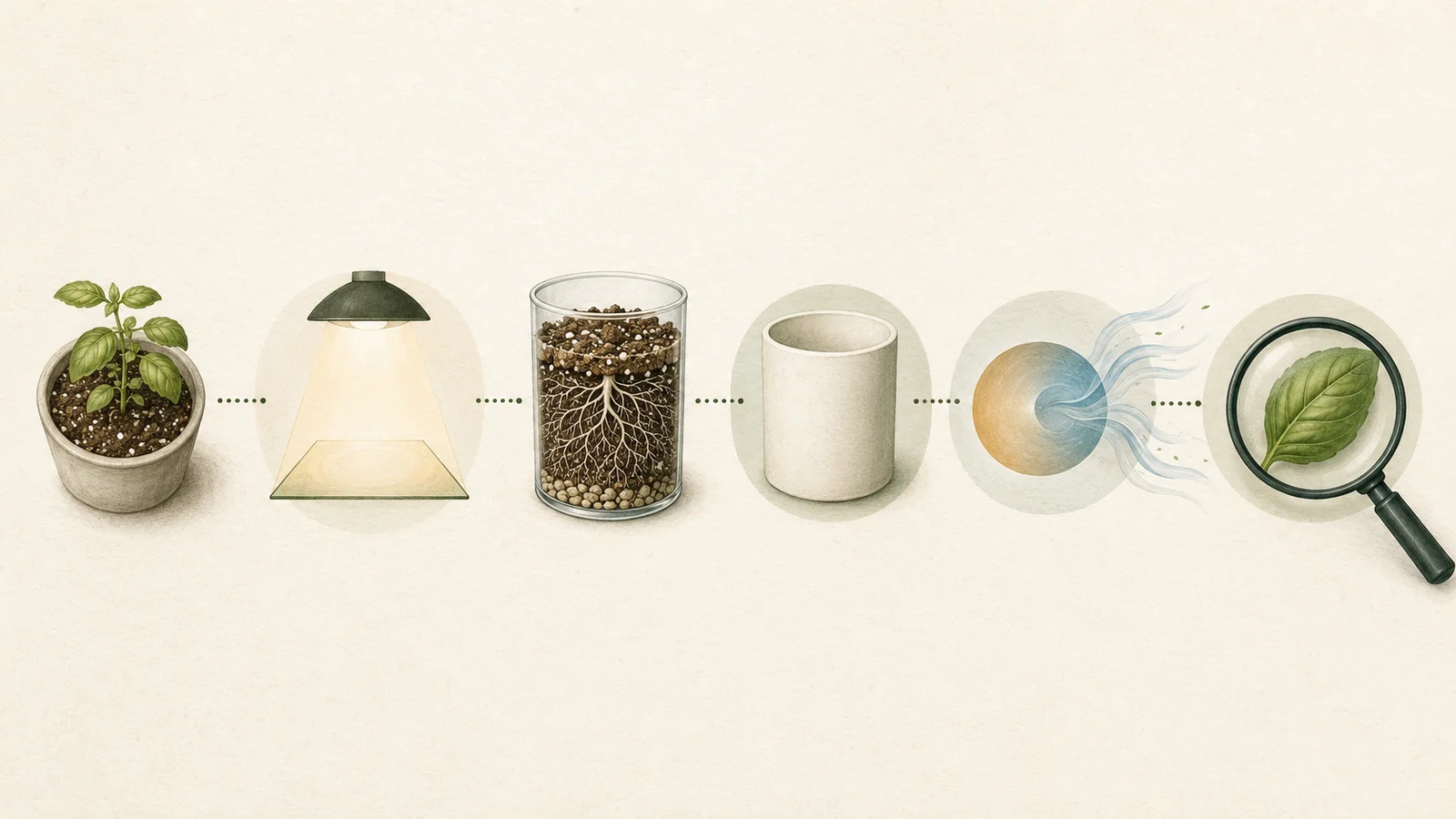
Then record the herb and its stage, the actual light at its leaves, the root-zone context, temperature and placement, nutrient or salt changes, direct pest signs, and anything that changed shortly before the slowdown. Separate herbs in potting mix from herbs in hydroponic systems before interpreting water, roots or nutrient evidence. The strongest next step is the smallest reversible check supported by the observations—not the most dramatic possible cause.
If the plant is collapsing, has rapidly spreading lesions, foul or mushy roots, severe visible pest signs, or continues to decline despite ordinary-care checks, stop experimenting and seek help from a local extension service or qualified plant professional.
Troubleshooting workflow summary
| Decision point | Evidence-based next step |
|---|---|
| Observation | Describe the missing or reduced growth over a defined interval instead of writing only “not growing.” |
| Crop and stage | Record species, age, annual/biennial/perennial lifecycle, flowering or seed-stalk changes, and recent harvest. |
| Light | Record placement, obstruction, distance, hours, season and supplemental-light schedule; do not rely on “bright room.” |
| Root zone | Choose the container-media or hydroponic branch before interpreting water, roots, nutrients or meter readings. |
| Recent change | Compare the slowdown with moves, repotting, pruning, harvest, lighting, nutrient, reservoir or temperature changes. |
| Action | When no red flag is present, log one reversible ordinary-care check and observe before changing another variable. |
Key facts
- Slow growth is not a diagnosis: light, root-zone water or oxygen, temperature, nutrients or salts, pests, lifecycle and recent changes can produce overlapping patterns.
- Herb identity matters: annual, biennial and perennial herbs do not share one growth rhythm, harvest response or seasonal pattern.
- “Bright” is not a measurement: leaf-level placement, obstruction, duration and season are more useful than a room label.
- Water use changes with the environment: lower light and cooler conditions can reduce water use, so a schedule that once worked may no longer match the plant.
- Root-zone branches differ: potting mix requires different evidence from a hydroponic reservoir or water-culture root zone.
- More fertilizer is not neutral: deficiency, excess, antagonism and salt accumulation can overlap with non-nutrient causes.
- Direct pest signs matter: visible insects, wax, honeydew or residue are stronger evidence than stunting alone.
- One change preserves learning: changing several variables together makes it difficult to identify what mattered.
Takeaway: A useful troubleshooting record turns “my herb stopped growing” into a dated set of observations that can support or weaken each branch.
Define what “not growing” means
Choose a comparison interval and describe what changed. A plant can produce no new leaves, extend stems slowly, make smaller leaves, become thin and spindly, fail to recover after a harvest, flower instead of producing leafy growth, or show active decline. Those are different observations.
Photographs from the same angle can help establish whether the canopy changed. A ruler or fixed reference can document stem extension without claiming laboratory precision. Count new leaves only when the same definition is used each time. Note whether older leaves remain stable, whether new growth is distorted, and whether the plant is simply growing more slowly than it did in a different season.
Do not compare two different species as though they should grow at the same rate. Parsley has a biennial lifecycle; dill can shift toward flowering; rosemary may make little new growth during low-light, cool winter conditions. Those crop-specific examples show why identity and stage belong at the start of the workflow.
Build an evidence log before choosing a cause
| Field | What to record | Why it changes interpretation |
|---|---|---|
| Plant identity | Herb, variety if known, age, stage and whether it is annual, biennial or perennial. | Expected growth, flowering and seasonal behavior differ. |
| Observed change | What stopped or slowed, the date noticed, and the comparison interval. | A defined observation is testable; a vague symptom label is not. |
| Growing method | Potting mix, other soilless medium, passive hydroponics or active hydroponics. | Root-zone evidence and failure modes differ. |
| Light context | Window or fixture, placement, obstruction, hours, season and recent changes. | Light affects growth form and water use. |
| Root-zone evidence | Drainage, media pattern, pot mass, visible roots, reservoir condition, circulation or aeration evidence. | Water quantity alone does not describe root access to water and oxygen. |
| Inputs | Water source, nutrient or fertilizer product role, label-based use, and any recent concentration or product change. | Deficiency, excess, salt and source-water branches can overlap. |
| Environment | Placement near glass, vents or drafts; temperature trend; humidity or circulation changes. | Room conditions can change even when the plant stays in one pot. |
| Direct signs | Visible pests, wax, honeydew, residue, lesions, odor, root texture or rapid collapse. | Direct signs can justify identification or escalation; stunting alone cannot. |
Check crop, stage and recent harvest
Ask whether the observation is compatible with the herb’s lifecycle. An annual moving toward flowering, a biennial producing a seed stalk, or a perennial slowing in winter may need a different interpretation from a young vegetative plant that has stopped making new leaves.
Record how much was harvested and where cuts were made. Harvest removes leaf area, and species differ in how they regrow. A parsley plant harvested from outer stalks is not equivalent to one with only the leaf tops removed. Dill can be harvested for foliage until flower clusters open, after which the plant’s priority changes. These examples are not universal pruning instructions; they are evidence that recent harvest and stage belong in the record.
If the plant was recently moved indoors, transplanted or repotted, note the date. A change in light, temperature, humidity and root disturbance may occur at the same time, so the move should not be reduced to one assumed cause.
Check the light evidence
Indoor-herb guidance consistently treats light as crop- and placement-dependent. Inadequate light can be associated with thin or spindly growth, smaller leaves and reduced aroma. Parsley and dill provide crop-specific examples of spindlier indoor growth under lower light.
Record what the leaves actually experience. Include the window direction, nearby buildings or trees, blinds, distance from the glass, hours of direct and bright indirect light, season, and any grow-light schedule. When supplemental light is used, identify the exact fixture and setting only as documentation; do not infer useful plant light from wattage, color wording or room brightness.
Also record whether plants crowd or shade one another. Rotate or rearrange only when that ordinary-care check is supported by uneven growth evidence and no product or safety decision is required. This page does not set a universal PPFD, DLI, lux, fixture distance, window orientation or runtime.
Light and watering cannot be reviewed independently. Lower light can reduce water use, so continuing an old watering schedule after a seasonal or placement change may create a new root-zone pattern.
Split the root-zone branch: container media or hydroponics
| Evidence field | Container media or soilless mix | Hydroponic root zone |
|---|---|---|
| Water evidence | Media condition at more than the surface, pot mass, drainage pattern and whether water wets the root ball. | Reservoir level and change, water delivery, circulation or aeration evidence appropriate to the system. |
| Root evidence | Roots at drainage holes, dense encircling roots, water bypass or a dry center can support a pot-bound branch. | Root access to both water and oxygen is a functional requirement; one normal reading cannot prove the whole root zone is adequate. |
| Nutrient evidence | Product and label history, frequency, visible residue, media age and any recent fertilizer change. | Complete nutrient-program identity, source water, pH/EC context, temperature, dissolved-oxygen context and recent reservoir changes. |
| Do not infer | A fixed calendar, one surface reading or foliage appearance does not prove the water diagnosis. | EC does not identify each nutrient, and a pH or EC number does not by itself diagnose the growth limit. |
Container-media branch
Confirm that the container drains and that the media pattern matches the observation. Prolonged dryness can reduce growth, but persistent wetness can also impair root-zone function. Species differ: some herbs are allowed to dry slightly between waterings, while others should not dry completely. That is why a universal interval is not defensible.
Look for direct pot-bound evidence. Dense roots, roots emerging from drainage openings, or water that runs through quickly while the center remains dry can justify a root-crowding branch. Do not diagnose root disease from leaf appearance alone.
Hydroponic branch
A hydroponic root zone has to deliver water, oxygen and nutrients. Depending on the system, circulation, aeration, water level, root support and solution management can be separate functions. Record the system type and what changed rather than treating “hydroponic” as one condition.
pH, electrical conductivity, dissolved oxygen, solution temperature, alkalinity and source-water ions can influence nutrient availability. Electrical conductivity is a proxy for total dissolved ions; it cannot confirm that every nutrient is balanced. This article does not provide targets, meter-selection advice, calibration steps, nutrient recipes or pH-adjustment procedures. Those belong to a separately reviewed workflow.
Check temperature, humidity and placement
Record the plant’s placement relative to windows, doors, heating vents, cooling airflow and other sources of rapid change. A windowsill can be bright but cold. A room can be warm but very dry. Basil is more cold-sensitive than many other herbs, while rosemary can slow substantially in cool, low-light winter conditions. Those are crop-specific examples, not a single temperature rule.
Humidity and circulation should be considered together. Very dry air can be associated with drying foliage, while persistently humid, poorly ventilated conditions create a different set of concerns. Avoid turning either observation into a disease conclusion. Record the pattern and any recent environmental change.
Check nutrient and salt evidence without diagnosing a deficiency
Plants require essential nutrients, but slow growth does not identify the missing or excessive element. Light, root condition, water, temperature and pests can overlap with nutrient patterns. Nutrient interactions can also reduce availability even when fertilizer has been supplied.
For container herbs, record the exact fertilizer or nutrient product, the label-based use history, media age, water source and any visible white residue on the media or container. High soluble salts can be associated with reduced growth, stunting and root injury, but residue does not prove which product or correction is appropriate.
For hydroponic herbs, verify the complete program role before assuming that one component supplies every required nutrient. Record source-water context and recent nutrient or reservoir changes. Do not add more fertilizer, switch products or adjust pH/EC merely because growth is slow; those actions require evidence and, where chemicals or meters are involved, a separately qualified workflow.
Look for direct pest or lesion evidence
Inspect new growth, stem junctions, leaf undersides, the media surface and the outside of the pot. Cottony white wax, visible insects, honeydew or dark sooty residue are direct observations that can support a pest-identification branch. Mealybug feeding can be associated with stunting, but stunting by itself does not identify mealybugs.
Small dark flies around moist organic media may be fungus gnats. Adult fungus gnats are generally harmless to indoor plants; their presence can instead be evidence of persistently moist media. Do not treat an adult gnat as proof that it caused the growth slowdown.
This page stops at observation and escalation. It does not recommend pesticides, fungicides, biological controls or home remedies. For edible herbs, exact pest identification and label-compliant guidance require an appropriate extension or qualified source.
Compare the slowdown with recent changes
Build a simple timeline. Include moves, repotting, transplanting, pruning, harvest, flowering, lighting changes, a new timer, seasonal window changes, fertilizer or nutrient changes, reservoir replacement, source-water changes, temperature shifts and the first direct pest sign.
A change that occurred shortly before the slowdown deserves investigation, but timing alone does not prove causation. It can also expose two changes that happened together—for example, moving a plant indoors may alter light, temperature, humidity and watering demand at once.
Run one reversible check at a time
When no stop condition is present, choose the smallest ordinary-care check that is supported by the evidence. Examples include correcting an obvious documentation mismatch, restoring a previously known placement, separating crowded plants when shading is directly observed, or updating the observation log before acting. Do not use this rule to improvise chemical, pesticide, electrical or disease treatment.
| Log field | Entry | Decision rule |
|---|---|---|
| Evidence | State the direct observation or documented mismatch. | Do not act from a generic cause list alone. |
| One check | Name one reversible ordinary-care change. | Exclude chemicals, pesticides, wiring, unverified nutrient changes and multiple simultaneous adjustments. |
| Date and window | Record when the check began and the crop-appropriate period you will observe. | Do not promise a universal recovery time. |
| What changed | Record new leaves, growth form, root-zone evidence, pest signs or continued decline. | Keep photographs or measurements comparable. |
| Next disposition | Continue observing, reverse the check, collect missing evidence or escalate. | Do not stack another change before interpreting the first unless the plant is declining rapidly. |
Important limitation: “One change at a time” is an attribution rule, not a treatment protocol. It does not authorize pesticide use, nutrient dosing, pH adjustment, root cutting, electrical work or any other elevated intervention.
Know when to stop and escalate
Stop the ordinary-care experiment and seek appropriate help when the plant is collapsing; decline is rapid; lesions are spreading; roots are foul, mushy or extensively damaged; direct pest signs are severe; multiple plants are affected in a pattern you cannot explain; or the plant continues to decline despite basic evidence checks.
Bring the evidence log, photographs, herb identity, growing method, recent changes, product labels and any existing water or solution records to a local extension service or qualified plant professional. That information is more useful than a guessed diagnosis.
What we could not verify
- The species, variety, age, stage or prior care of any reader’s herb.
- The actual light distribution or daily light received at any placement.
- Media moisture, root condition, pot-bound state, reservoir function or dissolved oxygen.
- Water chemistry, pH, electrical conductivity or individual nutrient concentration.
- A nutrient deficiency, toxicity, disease or pest affecting a specific plant.
- The effect of any corrective action, product, fertilizer, light, meter or treatment.
- A universal target, recovery time, harvest outcome or yield.
Methodology
Root & Photon reviewed current university-extension sources covering indoor herbs, crop-specific parsley, dill and rosemary behavior, indoor light, container drainage and root crowding, drought and soluble-salt evidence, indoor plant differential diagnosis, pest signs, small-scale hydroponics and nutrient-solution context. Claims were split into observable evidence, qualified crop examples, differential inferences and explicit exclusions.
The article retains E2 sourced status. No plant or product access, root inspection, light or moisture measurement, pH/EC test, grow trial, treatment trial or specialist diagnosis was performed. Numeric targets and operational chemical procedures were excluded because their crop, system, source-water, meter and reviewer requirements are outside this package.
Sources
- Penn State Extension — Growing Herbs Indoors. Checked July 26, 2026.
- University of Maryland Extension — Growing Herbs in Containers and Indoors. Checked July 26, 2026.
- University of Minnesota Extension — Lighting for indoor plants and starting seeds. Checked July 26, 2026.
- University of Minnesota Extension — Growing herbs in home gardens. Checked July 26, 2026.
- University of Minnesota Extension — Growing parsley in home gardens. Checked July 26, 2026.
- University of Minnesota Extension — Growing dill in home gardens. Checked July 26, 2026.
- Illinois Extension — Growing Herbs in Containers. Checked July 26, 2026.
- Illinois Extension — Rosemary. Checked July 26, 2026.
- University of Maryland Extension — Pot-Bound Indoor Plants. Checked July 26, 2026.
- University of Maryland Extension — Drought Stress on Indoor Plants. Checked July 26, 2026.
- University of Maryland Extension — Fertilizer Toxicity or High Soluble Salts in Indoor Plants. Checked July 26, 2026.
- University of Maryland Extension — Diagnose Indoor Plant Problems. Checked July 26, 2026.
- University of Maryland Extension — Mealybugs on Indoor Plants. Checked July 26, 2026.
- University of Maryland Extension — Fungus Gnats. Checked July 26, 2026.
- University of Minnesota Extension — Small-scale hydroponics. Checked July 26, 2026.
- University of Missouri Extension — Hydroponic Nutrient Solutions. Checked July 26, 2026.
- Penn State Extension — Hydroponics Systems and Principles of Plant Nutrition: Essential Nutrients, Function, Deficiency, and Excess. Checked July 26, 2026.