
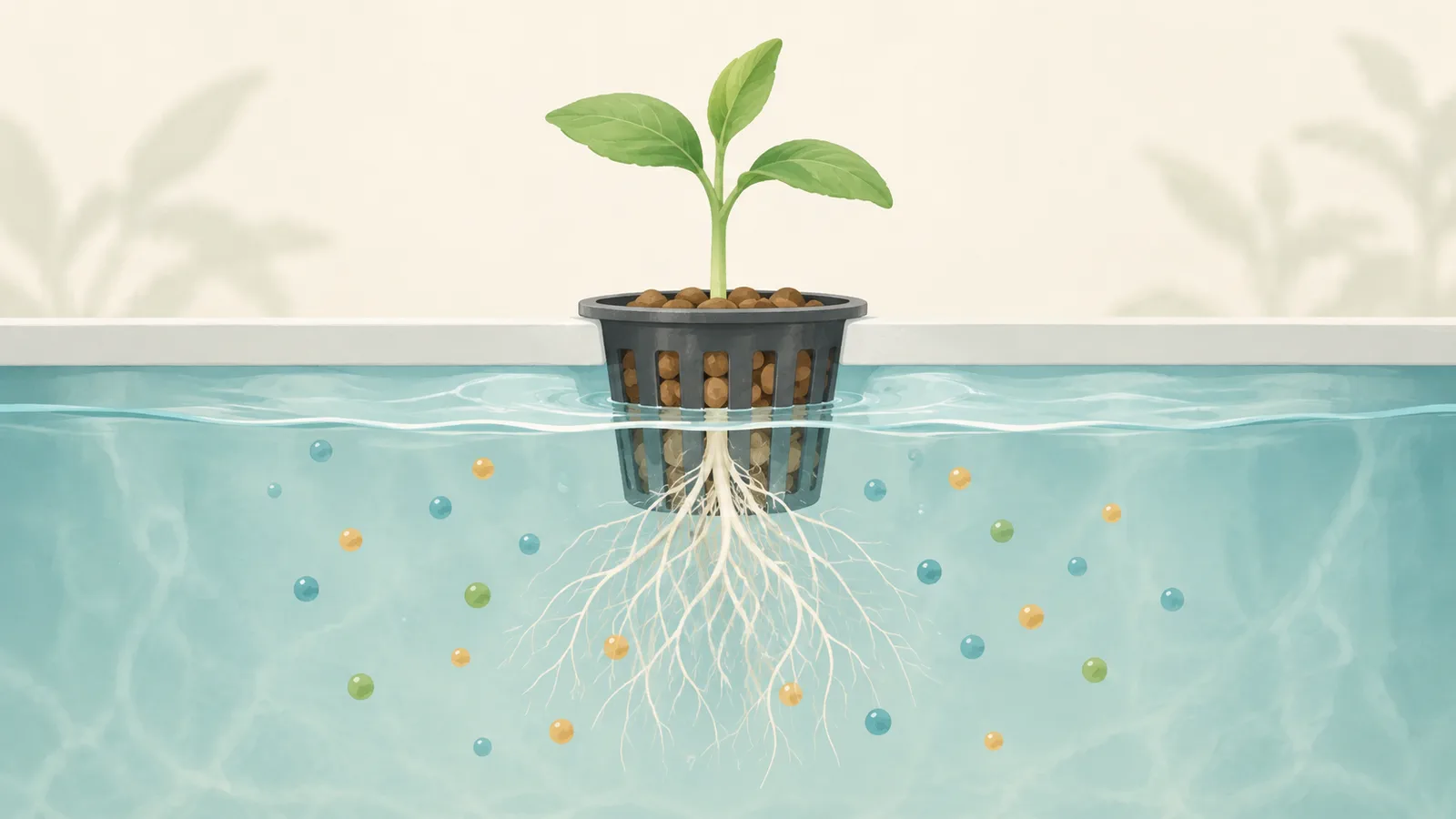
Evidence status: This is a source-based guide to interpreting U.S. hydroponic fertilizer labels and program documents. Root & Photon did not buy, mix, measure, apply, or grow with any nutrient product. The named products are non-ranked label examples, not recommendations, and this page does not provide dosing, chemical-handling, deficiency-correction, pH, or electrical-conductivity instructions.
Quick answer
Start with the exact product and its role in the full nutrient program—not with the largest three-number grade. The grade shows guaranteed percentages of nitrogen, phosphate expressed as P2O5, and potash expressed as K2O. It does not, by itself, tell you whether the product supplies every essential nutrient, whether it is a base nutrient or a supplement, what companion parts are required, or whether the program fits your crop, water, and system.
A useful label review asks five questions: What is this exact product? What does its guaranteed analysis include beyond N-P-K? What role does it play in the program? Which companion products or current documents are required? What crop, system, and source-water evidence is still missing? If any of those answers is unavailable, defer the choice rather than filling the gap with a universal ratio or a guessed dose.
Label-reading workflow summary
| Decision point | Evidence-based finding |
|---|---|
| Exact identity | Record the product name, form, market, current label or technical page, net contents, and checked date. |
| Guaranteed analysis | Read N-P2O5-K2O plus separately guaranteed calcium, magnesium, sulfur, and micronutrients. |
| Program role | Classify the container as a base nutrient, supplement, crop-specific component, or one part of a multi-part program. |
| Context | Check the crop, stage, hydroponic system, source water, and companion components named by current documentation. |
| Unknowns | Do not infer completeness, finished-solution concentration, compatibility, or performance from grade numbers alone. |
Key facts
- Plants need more than N, P, and K: university-extension sources describe 17 essential nutrients; the macro/micro distinction refers to required amount, not importance.
- The second and third grade numbers are oxide-basis guarantees: they are available phosphate as P2O5 and soluble potash as K2O, not direct elemental P and K percentages.
- Guaranteed analysis is broader than the grade: calcium, magnesium, sulfur, micronutrients, nutrient forms, and derived sources may appear elsewhere on the label.
- Program role matters: a base nutrient, supplement, and crop-specific component can all be sold for hydroponics while answering different needs.
- Water and crop context remain separate evidence: label numbers do not account for minerals already in the source water or prove a crop-specific finished solution.
- Electrical conductivity is not an ingredient list: it indicates total dissolved-ion load but does not confirm that every individual nutrient is present at a target concentration.
- Labels do not prove outcomes: a guaranteed analysis does not establish yield, flavor, shelf life, reliability, deficiency, or universal suitability.
Takeaway: Treat the label as a controlled identity and composition record, then connect it to the complete program and the reader’s actual crop, system, and water evidence.
Start with identity and program role
Before comparing nutrient numbers, identify exactly what the container is. Record the product name, liquid or dry form, current label or official technical page, market, package size, and the date the information was checked. A similar name, older label, different concentration, or regional version may not be interchangeable.
Then classify the product’s role. A base nutrient is intended to provide a broad foundation. A supplement adds selected nutrients to another program. A crop-specific component may be designed around a particular crop but still require one or more companion products. A multi-part program distributes the complete plan across separate containers or bags.
This role check prevents a common comparison error: placing a 2-0-0 supplement beside a 3-2-4 base nutrient and a dry 8-15-36 crop component as though the three grades describe competing complete solutions. They do not. They describe different exact products with different documented jobs.
Read the three-number grade correctly
In U.S. fertilizer labeling, the three numbers are conventionally stated in this order:
total nitrogen (N) – available phosphate (P2O5) – soluble potash (K2O)
Each number is a percentage by weight in the product. A 3-2-4 label therefore guarantees 3% total nitrogen, 2% available phosphate expressed as P2O5, and 4% soluble potash expressed as K2O. It does not directly state 2% elemental phosphorus or 4% elemental potassium. Penn State’s hydroponic calculation guidance treats that distinction explicitly when converting a fertilizer grade into elemental nutrient concentrations.
The grade also does not reveal how much product will be used in a finished solution, how concentrated the final solution will be, or whether that solution fits a crop. A higher grade can describe a more concentrated dry component, while a lower grade can describe a liquid base or supplement. Comparing only the three numbers removes the form, program role, application concentration, water, and crop from the decision.
Read the whole guaranteed analysis
The guaranteed analysis can list more than the three primary grade values. Depending on the product and applicable rules, it may include forms of nitrogen, calcium, magnesium, sulfur, iron, manganese, zinc, copper, boron, molybdenum, and other guaranteed nutrients. It may also identify the materials from which those nutrients are derived.
| Label field | What it can establish | What it cannot establish alone |
|---|---|---|
| Brand and exact product | The object whose composition and directions are being documented. | That a sibling product, old formulation, or regional label is identical. |
| N-P2O5-K2O grade | Guaranteed primary nutrient percentages by product weight. | Elemental P/K, final solution concentration, completeness, or crop fit. |
| Secondary nutrients | Guaranteed calcium, magnesium, sulfur, or other listed values. | That unlisted nutrients are present at useful levels. |
| Micronutrients | Which micronutrients are guaranteed and sometimes their form. | Availability under every pH, water source, or crop condition. |
| Derived-from statement | The named source materials behind guaranteed nutrients. | Independent performance, outcome, or superiority. |
| Directions and program documents | The manufacturer’s intended context, companion parts, and product-specific use. | A universal prescription that transfers to every crop and system. |
Use these fields together. A grade without the rest of the guaranteed analysis can hide a meaningful calcium, magnesium, or micronutrient distinction. A micronutrient list without the program role can still leave the reader unsure whether the container is a complete base or only one component.
Check the complete program, not one container
Penn State describes complete fertilizers, fertilizer programs, and element-by-element recipes as different ways to build a hydroponic nutrient solution. University of Minnesota notes that dry hydroponic products may arrive as multiple components because nutrients differ in physical properties and program design. Missouri Extension explains that some formulations are separated because concentrated ingredients can become incompatible.
For a buyer, the practical lesson is documentation, not chemistry instruction. Ask:
- Is this the base nutrient or a supplement?
- Does the current program require a second or third component?
- Does the manufacturer identify a specific crop or growth stage?
- Is the product documented for the intended hydroponic system and water type?
- Are the current label and companion documents available for the exact market?
If the program requires companion components, compare the complete program—not the most prominent container. Missing companion-product identity is an unresolved dependency, not a zero-cost or optional assumption.
Add crop, system, and water context
A fertilizer label describes the product. It does not fully describe the reader’s nutrient solution. Penn State and University of Minnesota both treat crop requirements as specific enough that recipes or programs differ among crops. Water can already contribute calcium, magnesium, sodium, chloride, alkalinity, or other dissolved materials. Those inputs may affect what a qualified recipe or program must add.
Electrical conductivity can help show total dissolved-ion concentration, but Missouri Extension cautions that it does not confirm the concentration of each nutrient. A current water or nutrient-solution test is required for element-by-element back-add decisions in Penn State’s recirculating DWC calculator. That is a much higher evidence step than reading a product label.
For this buyer guide, record the water source and whether a recent test exists. Do not infer missing minerals from “tap,” “filtered,” or “reverse osmosis” labels alone. Do not turn a product’s directions into a universal crop target. Operational pH, EC, mixing, and adjustment belong to a separately reviewed workflow.
Use exact label examples carefully
The examples below show why role and guaranteed analysis must be read together. They are official-page facts checked on July 26, 2026. They are not a recommendation set, performance comparison, price survey, or statement that the three products are equivalent alternatives.
| Exact example | Official-page guaranteed analysis | Documented role | Decision lesson |
|---|---|---|---|
| Botanicare Pure Blend Pro Grow | 3-2-4; calcium 1.0%; magnesium 0.5% | One-part base nutrient | A lower three-number grade can coexist with separately guaranteed secondary nutrients. |
| Botanicare Cal-Mag Plus | 2-0-0; calcium 3.2%; magnesium 1.2%; iron 0.1% | Supplement | The grade does not make a supplement a complete nutrient program. |
| Greenway Biotech Lettuce Fertilizer | 8-15-36; listed micronutrients; no calcium by design | Crop-specific component with separate calcium context | A high dry grade and micronutrient list can still require another program component. |
Manufacturer pages may also contain outcome, dosing, or promotional claims. This article admits only exact composition and program-role facts needed to teach the label workflow. It does not adopt claims about yield, flavor, shelf life, deficiency correction, or comparative performance.
Apply selection criteria
A label-informed shortlist should answer these criteria before a product is considered eligible:
- Exact identity: current product, form, market, package size, and dated label or official document.
- Primary grade: N-P2O5-K2O interpreted correctly.
- Whole guaranteed analysis: secondary nutrients, micronutrients, forms, and derived sources recorded without invention.
- Program role: base, supplement, crop-specific component, or other clearly documented role.
- Companion parts: every required component identified.
- Crop and system: the current documentation covers the intended crop and hydroponic context, or the gap remains visible.
- Water evidence: source-water assumptions are identified; advanced adjustment is not guessed from the label.
- Operational boundary: current directions exist, but this article does not rewrite them as a universal recipe.
Follow a decision process
1. Define the intended program
Name the crop, stage, system, reservoir approach, and source water. The goal is not to calculate a recipe here; it is to prevent a label from being evaluated without the context it is supposed to serve.
2. Capture the exact label
Save the current official label or technical page and its checked date. Record net contents and form, but keep price and availability outside this article.
3. Decode grade and guaranteed nutrients
Transcribe the grade and every separately guaranteed nutrient. Keep oxide-basis P2O5 and K2O terminology intact rather than silently converting or relabeling it.
4. Classify the role and dependencies
Find the exact statement that identifies the product as a base, supplement, complete fertilizer, crop component, or part of a named program. List companion products as dependencies, not optional extras.
5. Preserve unknowns
Record missing crop coverage, water evidence, compatibility documents, current directions, or label version. A documented unknown is more useful than a confident but unsupported conclusion.
Fit by scenario
- First home system with a documented complete program: prioritize a clear current label, explicit program role, complete companion list, and crop/system documentation.
- Known multi-part program: evaluate all parts together and retain each exact guaranteed analysis.
- Supplement under consideration: verify the baseline program and the evidence for needing the supplement before treating it as eligible.
- Crop-specific dry component: verify what it supplies, what it intentionally omits, and which companion components the current documentation requires.
- Unknown or variable source water: keep advanced nutrient adjustment deferred until appropriate water evidence and a qualified method are available.
Avoid or defer conditions
Defer the choice when the exact label is unavailable, the product role is unclear, a required companion part is unidentified, the crop/system context is unsupported, or the only evidence is a retailer summary or promotional claim. Also defer when the decision depends on diagnosing a plant symptom, changing pH or EC, combining concentrated products, or calculating element-by-element additions without the required test and review.
Avoid any comparison that ranks products by the largest N-P-K numbers, calls one formula “complete” without a full program check, or treats a stated rate as universally transferable. Those shortcuts erase the variables that determine whether a nutrient program is actually defined.
Build a non-ranked shortlist
| Field | Candidate A | Candidate B | Required evidence |
|---|---|---|---|
| Exact identity and date | Record | Record | Current official label or technical page |
| Grade and whole analysis | Record | Record | N-P2O5-K2O plus all guaranteed nutrients |
| Program role | Record | Record | Base, supplement, crop component, or other exact role |
| Companion components | Record or unknown | Record or unknown | Complete current program documentation |
| Crop/system coverage | Supported or unknown | Supported or unknown | Exact current documentation |
| Water/test dependency | Record | Record | Reader evidence; no assumption |
| Decision state | Eligible or defer | Eligible or defer | No ranking until equivalent evidence exists |
This worksheet intentionally has no score or winner. Its job is to remove candidates with missing identity, program, crop, system, or water evidence before any later cost or performance evaluation.
What we could not verify
- Root & Photon did not obtain, mix, apply, measure, or compare any nutrient product.
- No finished-solution concentration, pH, EC, crop response, deficiency, yield, flavor, shelf-life, reliability, or safety result was validated.
- The three named examples do not form a complete product universe.
- No price, retailer, inventory, value, savings, or commercial-program status was checked.
- Florida law is one state example; this package did not perform a fifty-state legal review.
- Manufacturer pages can change after the checked date and require revalidation before later publication or maintenance.
Methodology
We reviewed current U.S. government, state-law, fertilizer-control, university-extension, and exact official manufacturer pages. Scientific and label-interpretation claims are owned by government or extension sources. Manufacturer pages are used only for exact guaranteed-analysis and program-role examples checked on July 26, 2026. Promotional outcome claims, dosing instructions, prices, reviews, and retailer information were excluded.
The January 2026 archived edition of the Missouri guide was checked in the university’s MOspace repository on September 21, 2026; it is used for general principles, not as confirmation of current numerical recommendations.
The article separates fertilizer grade, guaranteed analysis, nutrient-source statements, product role, program dependencies, crop/system context, and water evidence. It remains at E2 sourced evidence. A later operational nutrient workflow would require its own measurements, calibration method, chemical-handling evidence, reviewer gates, and validation.
Sources
- USDA National Agricultural Library: Hydroponics — checked July 26, 2026
- Penn State Extension: Hydroponics Systems and Principles of Plant Nutrition: Essential Nutrients, Function, Deficiency, and Excess — checked July 26, 2026
- Penn State Extension: Hydroponics Systems: Nutrient Solution Programs and Recipes — checked July 26, 2026
- Penn State Extension: Hydroponics Systems: Calculating Nutrient Solution Concentrations Using the Two Basic Equations — checked July 26, 2026
- Penn State Extension: Water Testing — checked July 26, 2026
- Penn State Extension: Fertilizer Calculator — checked July 26, 2026
- Clemson Cooperative Extension: Reading A Fertilizer Label — checked July 26, 2026
- Association of American Plant Food Control Officials: AAPFCO Home Page — checked July 26, 2026
- Florida Senate: 2025 Florida Statutes 576.031 — Labeling — checked July 26, 2026
- Florida Senate: 2025 Florida Statutes 576.011 — Definitions — checked July 26, 2026
- University of Minnesota Extension: Small-scale hydroponics — checked July 26, 2026
- University of Missouri Extension: Hydroponic Nutrient Solutions (January 2026 archive in MOspace) — checked July 26, 2026
- Botanicare: Pure Blend Pro Grow — checked July 26, 2026
- Botanicare: Cal-Mag Plus — checked July 26, 2026
- Greenway Biotech: Lettuce Fertilizer 8-15-36 — checked July 26, 2026