
Evidence status: This is a source-based buyer guide. Root & Photon did not install, operate, measure, stress-test, purchase or grow plants with an automatic watering system for this article. Category fit remains conditional on the exact plant, medium, pot, room and tested setup.
Quick answer
Choose an indoor automatic watering approach by starting with the plant and root zone, not the timer or app. Record each plant’s medium, pot, drainage behavior, current water-use pattern, location and acceptable spill consequence. Then decide whether you are trying to reduce routine work, cover a bounded absence, stabilize one self-watering container, or distribute water to several similar pots.
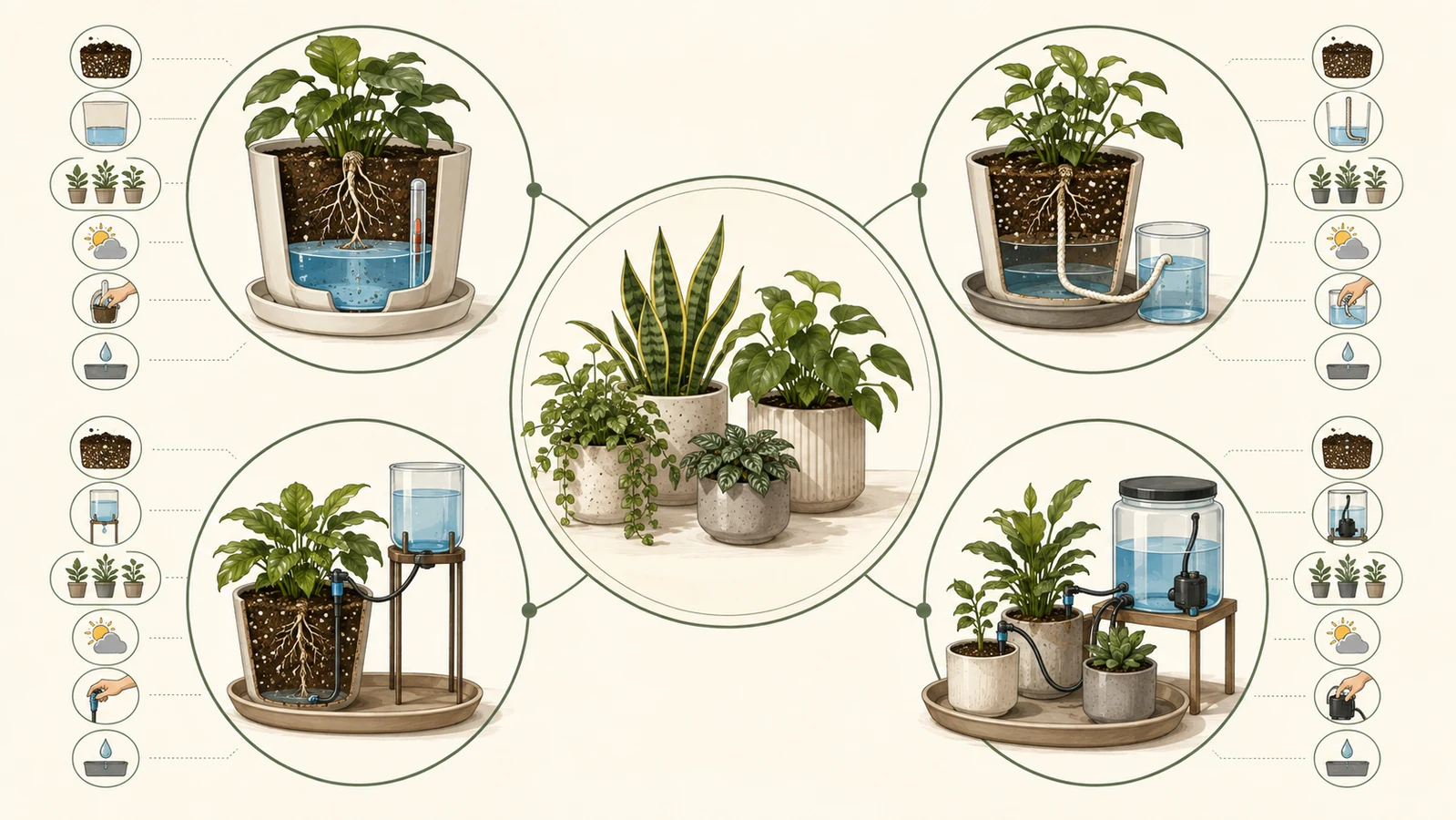
Four product-neutral categories deserve separate consideration: a reservoir planter, a wick or capillary arrangement, gravity-fed drip, and pumped reservoir drip. Each can fit a real use case, and each can fail in a different way. A timer can switch a system on, but it cannot prove that water reached every root zone or that the schedule remains appropriate after plants, pots or room conditions change.
Before relying on any option, run it under ordinary conditions, compare delivery at every endpoint, inspect root-zone wetting and the surrounding surface, and keep a manual or human-check fallback. When no option can be tested within your leak, maintenance or access limits, manual watering is a valid result.
Automatic-watering decision
| Decision point | Finding |
|---|---|
| One compatible container | Investigate a reservoir planter when its medium, overflow and refill path can be observed and tested. |
| Simple temporary support | Investigate a wick or capillary arrangement when the wick-medium combination can be tested without persistent saturation. |
| Several matched pots without a pump | Investigate gravity-fed drip only when each outlet, connection and unintended drainage path is visible. |
| Several zones or greater distribution flexibility | Investigate pumped reservoir drip when pump, power, tubing, clog and empty-reservoir failures are acceptable and inspectable. |
| Pressurized household connection | Defer until exact product documentation and locally applicable water-connection controls are available. |
| No testable low-consequence setup | Use manual watering, reduce the plant group, or arrange a plant sitter. |
Key facts
- Plant need is not a timer setting: watering demand changes with plant, growth stage, medium, pot, light, temperature and humidity.
- Symptoms are not a controller: wilting and yellowing can occur when a plant is too dry or too wet.
- Delivery needs proof: a running pump, full reservoir or wet saucer does not establish even root-zone watering.
- Zones should be compatible: group plants only when their demand and container behavior are similar enough for one delivery pattern.
- Every category retains work: refill, inspection, cleaning, plant observation and rechecking do not disappear.
- Absence duration is not a guarantee: observed consumption can inform a plan, but changing room conditions and plant growth can change demand.
- Unknown is not pass: unresolved leak, clog, dry-run, siphon, power or salt behavior stays unknown until tested or documented.
Define the watering job before choosing hardware
Write one sentence that describes what the system must do. Useful examples are: “reduce midweek watering for three similar foliage plants,” “cover a seven-day absence after a successful test,” or “keep one container supplied from a lower reservoir.” A goal such as “never water again” cannot be validated and invites hidden assumptions.
Next, inventory the exact plants and containers. Record plant identity where known, growth stage, current placement, medium, pot size and material, drainage or overflow path, and how the pot feels or weighs before and after ordinary watering. University extension guidance emphasizes that watering frequency changes with these variables. That is why a fixed schedule cannot be transferred automatically from one pot to another.
Check whether water actually enters the root ball. A pot-bound root mass can let water pass quickly around or through a container while the center remains dry. Conversely, a medium that stays saturated can lose root-zone air. Automatic delivery can repeat either error more consistently, so root-zone behavior belongs in the pre-purchase decision.
Selection criteria
| Criterion | Evidence to collect | Fail-closed result |
|---|---|---|
| Plant and medium fit | Observed drying pattern, medium behavior, drainage and known plant requirements. | Do not share a zone when needs conflict or remain unknown. |
| Scale | Number of pots, distance between them and whether one or several zones are required. | Reject a layout that cannot reach every pot without unstable routing. |
| Absence or routine goal | Actual intended period and a prior test under comparable conditions. | Do not convert reservoir volume into an untested duration promise. |
| Leak consequence | Reservoir size, connection count, placement, catch surface and visibility. | Defer when ordinary failure could cause unacceptable damage. |
| Delivery verification | Observed or collected output at each endpoint and root-zone wetting. | A timer or pump sound alone is not a pass. |
| Maintenance | Refill, cleaning, line/wick inspection, filter work and recheck triggers. | Reject a routine the operator cannot realistically maintain. |
| Failure recovery | How to notice and stop an empty reservoir, clog, disconnection, unintended drainage or power loss. | Choose manual watering or a smaller scope when failure is not observable. |
Takeaway: Convenience matters only after the plant, delivery and failure-consequence fields clear. A feature-rich option with unresolved hard fields is not a stronger shortlist candidate.
Option categories
Reservoir planter
A self-watering planter typically places growing medium above a lower water reservoir. Water moves upward through a wicking interface, and an overflow defines the reservoir’s high-water level. This can reduce refill frequency for one compatible plant-container-medium system and keeps the water path relatively compact.
Investigate this category when one pot can be evaluated independently and the reservoir, fill point and overflow are visible. Do not assume that “self-watering” means the medium can never remain too wet, that roots will use water at a constant rate, or that the reservoir covers a stated number of days in every room.
Wick or capillary arrangement
A separate reservoir can feed a pot through a wick or capillary surface. The category can be simple and pump-free, but the result depends on the wick, vertical relationship, medium, pot geometry and plant demand. A wick that moves too little water can leave the root ball dry; one that moves too much can keep the medium persistently wet.
Use a visible test period and inspect the medium at more than one depth. Do not treat a wet wick as proof that the whole root zone is receiving an appropriate amount.
Gravity-fed drip
Gravity-fed drip uses a reservoir and pressure difference to feed one or more outlets without a powered pump. It may fit a small matched group when the reservoir is stable, connections are secure, outlets can be compared, and any unintended siphon or continuing drainage is observable.
This guide does not provide reservoir elevation, tubing diameter, emitter-flow or construction instructions. Those values are system-specific, and a design that appears simple can still drain unevenly or continue flowing after the intended period.
Pumped reservoir drip
A pumped reservoir can distribute water to several containers and support separate zones or emitters. It also adds a pump, power source, timer or controller, tubing, connectors, possible filters and more endpoints to inspect. Pump operation does not prove that every emitter delivered the same amount.
Investigate this category when the operator accepts active hardware and can verify each outlet, maintain lines or filters, monitor reservoir level, and recognize power, dry-run, clog or disconnection failures. Exact product manuals and tests are still required before making reliability or power-loss claims.
Tap-connected or pressure-fed systems: defer by default
Systems connected to a household water source create additional documentation and local-control questions. Exact product requirements, connection suitability and applicable backflow or plumbing rules are outside this article. Do not improvise those controls from a category guide.
Build compatible watering zones
A zone should contain plants whose water demand, pot size, medium behavior and delivery method can be managed together. Physical proximity is not enough. A small fast-drying pot and a large moisture-retentive pot may need different delivery even when they sit on the same shelf.
Begin with the smallest defensible zone. One reservoir planter is one zone. A wick arrangement can be one zone per pot until testing supports a shared reservoir. For drip, compare output at each endpoint and keep high-demand or materially different containers separate. As plants grow or are repotted, reconsider the grouping.
Verify delivery before relying on it
- Establish the manual baseline. Record when each pot normally needs water and how the root zone behaves after a thorough watering.
- Install the proposed arrangement early. Do not first activate it at departure.
- Run a visible delivery test. Collect or compare output at each drip endpoint; for wick or reservoir systems, observe medium moisture at more than one location and depth.
- Inspect the surrounding surface. Look for continuing drainage, disconnected tubing, overflow, unstable reservoirs or water outside the intended path.
- Observe a full ordinary cycle. Record actual test duration, room conditions, reservoir change and plant response without calling it a controlled experiment.
- Repeat after material changes. Recheck after plant growth, repotting, media changes, moved emitters, new tubing, changed light or temperature, or a longer absence.
A catch-container comparison is useful for drip endpoints because it makes output differences visible. This article does not import an agricultural uniformity threshold as a universal indoor pass rule. The goal is to detect material mismatch and investigate it before plants depend on the system.
Compare failure modes
| Failure mode | What to observe | Selection implication |
|---|---|---|
| Empty reservoir | Actual reservoir change during the test and whether low level is visible. | Do not rely on an untested duration or hidden tank. |
| Blocked wick or emitter | Dry endpoint, intermittent flow, uneven collection or medium that does not wet. | Require accessible inspection and maintenance. |
| Disconnected or leaking line | Water outside the intended path or standing water when the pump is off. | Reduce connections or defer when consequence is unacceptable. |
| Unintended siphon or drainage | Flow that continues beyond the intended cycle. | Do not rely until the exact cause and system behavior are resolved. |
| Pump, timer or power failure | No flow, wrong cycle or a pump operating without usable water. | Retain a human check or choose a passive/manual path. |
| Persistent saturation | Medium stays wet, pot remains heavy, or ordinary drainage/overflow is blocked. | Change category or plant-medium pairing; do not increase automation blindly. |
| Salt or mineral buildup | Deposits on medium, container or delivery parts. | Include water-quality and maintenance unknowns; no chemical treatment is prescribed here. |
| Water bypasses the root ball | Fast drainage with a dry center or a pot-bound root mass. | Resolve container/root-zone behavior before automating. |
Decision process
- Write the exact job and intended absence or routine period.
- Inventory plant, medium, pot, drainage and room conditions.
- Create the smallest compatible watering zones.
- Eliminate categories that fail pump, connection, spill, access or maintenance constraints.
- Map every reservoir, wick, emitter, tube, connection, overflow and powered component.
- Test every endpoint under ordinary conditions before relying on it.
- Record pass, fail or unknown for each hard field.
- Choose among the remaining categories by preference only after the hard fields clear.
Fit by scenario
| Scenario | First category to investigate | Main evidence still needed |
|---|---|---|
| One plant, bounded footprint and low connection tolerance | Reservoir planter | Medium compatibility, overflow, refill access and observed reservoir use. |
| Short-term support for one or a few pots without powered hardware | Wick or capillary arrangement | Wick-medium delivery, saturation behavior and stable reservoir placement. |
| Several similar pots and a preference to avoid a pump | Gravity-fed drip | Endpoint output, continuing-drainage behavior, connection stability and catch plan. |
| Several zones or adjustable endpoint delivery | Pumped reservoir drip | Pump/timer behavior, output comparison, reservoir level, clog and power-loss response. |
| Very low spill tolerance or no pre-use test opportunity | Neither category yet | Manual watering, a smaller plant scope or a trusted plant sitter. |
Takeaway: “First to investigate” is not a product recommendation. It identifies the mechanism most aligned with the stated constraints while leaving exact evidence gates visible.
Avoid or defer conditions
- The plant, medium or container does not have a stable manual-watering baseline.
- One zone combines plants or pots with materially different water behavior.
- The reservoir, overflow, tubing, outlets or surrounding surface cannot be inspected.
- The setup cannot be tested before the intended absence.
- A product’s pump, timer, power-loss, dry-run, siphon or leak behavior is central but undocumented.
- The plan depends on household plumbing, backflow, electrical installation, building suitability or chemical treatment guidance not supplied by an applicable authority.
- Maintenance work exceeds the operator’s realistic routine.
Build a non-ranked shortlist
| Field | Status | Evidence |
|---|---|---|
| Plant-medium-pot fit | Pass / fail / unknown | Manual baseline and tested root-zone behavior. |
| Zone compatibility | Pass / fail / unknown | Similar demand, pot behavior and delivery needs. |
| Delivery verified | Pass / fail / unknown | Observed or collected output at every endpoint. |
| Absence/routine period tested | Pass / fail / unknown | Actual duration and comparable conditions. |
| Failure consequence acceptable | Pass / fail / unknown | Reservoir, connections, catch surface, access and fallback. |
| Maintenance fits | Pass / fail / unknown | Refill, cleaning, inspection and recheck plan. |
| Exact-product unknowns resolved | Pass / fail / unknown | Current manual and direct validation when material. |
Do not add scores until every hard field is resolved, and do not convert the table into a “best” ranking. Unknown stays unknown. When two categories clear the hard gates, preferences such as compactness, pump avoidance, number of zones or ease of inspection can decide which one to test first.
Neither-fits path
Automatic watering is not required for a successful indoor plant setup. Manual watering can be the better fit when plant needs differ, spill consequence is high, the operator cannot inspect connections, or no comparable pre-use test is possible. Other valid outcomes include reducing the number of plants, moving plants into fewer compatible containers, changing the absence plan, or arranging a person to check them.
What we could not verify
- A universal reservoir volume, wick material, emitter flow, runtime, watering interval or absence duration.
- Reliability, leak frequency, dry-run tolerance, siphon behavior, power-loss behavior or failure detection for any exact product.
- Current product prices, availability, warranty performance, replacement parts, app behavior or privacy practices.
- One watering category that is best for every plant, medium, pot, room or household.
- Root & Photon installation, measurement, failure testing, plant observation or grow-trial results.
Methodology
We used current university-extension sources for indoor watering need, container drainage, self-watering reservoirs, drip zoning, emitter placement, inspection, clogging, overwatering, salt buildup, pot-bound root behavior and vacation planning. We separated category mechanisms from exact-product behavior and treated outdoor or agricultural irrigation guidance only as evidence for general delivery and inspection principles.
Search results were used to identify buyer language and content gaps, not to support material claims. No retailer, affiliate, product-roundup or marketplace statement was used as evidence. We did not test hardware, measure flow, inspect a room or validate a plant outcome. The result is an E2 source-based selection workflow with explicit unknowns, not a safety approval, product ranking or reliability report.
Sources
- University of Maryland Extension — Watering Indoor Plants
- Oklahoma State University Extension — Houseplant Care
- University of Maryland Extension — Self-Watering Containers
- University of Maryland Extension — Growing Vegetables in Containers and Salad Tables
- Iowa State University Extension — Using Drip Irrigation in the Garden
- Colorado State University Extension — Drip Irrigation for Home Gardens
- Rutgers NJAES — Drip Irrigation Inspection Checklist
- University of Maryland Extension — Irrigation System Check-ups
- Utah State University Extension — Overwatering
- University of Maryland Extension — Overwatered Indoor Plants
- University of Maryland Extension — Mineral and Fertilizer Salt Deposits on Indoor Plants
- University of Florida IFAS Extension — Vacation Plant Care
- University of Maryland Extension — Pot-Bound Indoor Plants