Evidence status: This is a source-based window-light decision guide. It combines current university-extension guidance with controlled basil and lettuce research. Root & Photon did not measure a reader’s window, grow a crop for this article, or validate a universal list of “low-light edibles.”
Quick answer
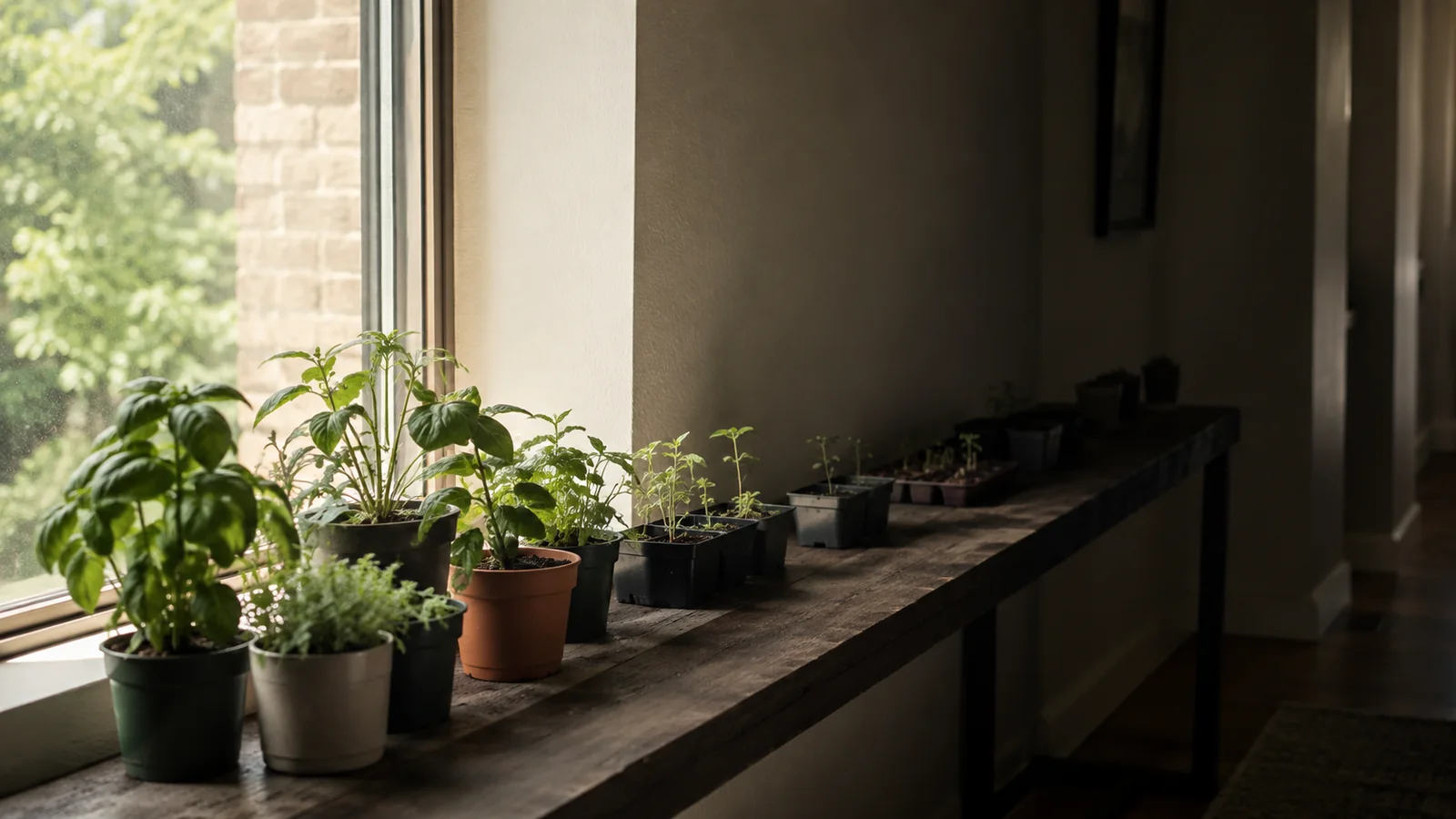
Some edible plants can be maintained or harvested indoors without a grow light when the crop, growth stage, window and expectations line up. A bright, unobstructed south- or southwest-facing window is the strongest no-purchase starting point. Established herbs and selected short-cycle leafy crops are more plausible candidates than vegetable seedlings or fruiting crops.
The phrase low light is not a useful promise by itself. Window light changes with orientation, obstructions, distance, weather and season. A crop can stay alive yet still become spindly, produce small leaves, lose aroma or fail to deliver the harvest you expected. University extension guidance also warns that ordinary window light is seldom enough for sturdy vegetable seedlings.
Before buying anything, define what success means, screen the actual window for a week, identify the crop and stage, and compare the situation with crop-specific evidence. Investigate supplemental light only when placement, season, crop choice or a shorter harvest stage cannot solve a material shortfall.
Window-light decision
| Decision point | Finding |
|---|---|
| More plausible | A source-qualified herb or leafy crop, an established plant or short harvest stage, a bright unobstructed window, and acceptance of slower or smaller output. |
| Weak candidate | Most vegetable seedlings, long indoor transplant production, repeated high-output harvests, or fruiting-crop expectations without crop- and window-specific evidence. |
| Main uncertainty | The reader’s actual daily light at the canopy is unknown unless it is observed or measured across representative days and seasons. |
| Switching trigger | Persistent stretching, leaning, pale growth, long internodes, smaller leaves or reduced aroma after placement and crop-stage checks. |
| Evidence boundary | This guide does not prove that a named crop will succeed in a particular window and does not recommend a grow-light product. |
Key facts
- Define success first: keeping a plant alive, taking an occasional leaf harvest, producing repeated harvests, raising a sturdy transplant and fruiting are different tasks.
- Judge the canopy, not the room: orientation, shading and distance can make two “bright rooms” very different for a plant.
- Separate crop stage: an established herb can be more forgiving than a seedling that must remain compact for weeks.
- Do not use hours alone: daily light depends on intensity and duration; research also shows that the way light is distributed across the day can affect growth.
- Use symptoms as recheck signals: stretching or pale growth can indicate a shortfall, but they do not prove light is the only cause.
- Keep the no-purchase path open: repositioning, seasonality, delaying the crop or choosing a shorter harvest stage may solve the problem without equipment.
Start with the no-purchase question
The baseline is the setup you already have: one crop, one stage, one intended outcome and one actual window. The decision is not whether grow lights are generally useful. It is whether this specific plant task can be met without supplemental light.
Write down the intended result before you assess the window:
- maintain an established plant;
- take an occasional herb cutting;
- produce repeated leafy harvests;
- raise compact seedlings for transplant;
- or support flowering and fruiting.
This prevents a survival-only result from being mistaken for productive success. Controlled indoor-gardening research on basil found materially different growth responses across tested daily light integrals, while lettuce studies found that daily light, cultivar and the PPFD–photoperiod combination all mattered. Those studies do not tell you what your window delivers, but they show why “the plant is still alive” is too weak a decision standard.
What “low light” does and does not mean
Human vision adapts to dim rooms, so a location can look bright while delivering relatively little plant-usable light. University of Minnesota Extension describes indoor light with plant-oriented bands and places its low-light category around 50–150 µmol m−2 s−1. The same source says low light is not sufficient for starting seeds indoors.
That range is useful as an attributed extension category, not as a universal edible-crop target. Edible plants differ by species, cultivar, stage and intended harvest. A momentary intensity reading is also incomplete. Daily light integral, or DLI, adds photosynthetic light across the day. Research with basil, lettuce and mizuna shows that both the amount accumulated and the way it is delivered can affect growth.
Important limitation: Do not convert a direct-sun-hour rule, a phone brightness reading or one midday observation into a universal DLI claim. This article provides a screening workflow, not a measurement or crop prescription.
Screen the actual window
Use a seven-day log before changing the setup. Seven days is an editorial workflow chosen to capture ordinary variation; it is not a scientifically validated minimum.
- Record orientation. Note whether the window faces north, east, south, west or an intermediate direction. An unobstructed south-facing window generally offers the highest natural indoor light, but orientation is only a starting point.
- Record obstructions. Include trees, buildings, balconies, overhangs, blinds, screens and deep window recesses.
- Record the plant position. Measure the approximate distance from the glass and note whether the whole canopy receives similar light.
- Log direct-sun periods and weather. Record when direct sun reaches the plant, when it leaves, and whether clouds or shading changed the pattern.
- Repeat on representative days. A single clear day should not stand in for a week, and a summer observation should not be presented as a winter guarantee.
- Keep the success definition beside the log. A window that maintains chives may still be inadequate for compact tomato seedlings or a repeated lettuce harvest.
Takeaway: The log does not prove adequacy. It replaces the vague label “bright window” with a documented scenario that can be compared with crop- and stage-specific guidance.
Match the crop and stage
Established herbs
Herbs do not share one light requirement. Penn State Extension lists lemon balm, chives and cilantro among herbs that tolerate lower light than several other common indoor herbs. It also warns that herbs below their preferred light conditions can become thin and spindly, form smaller leaves and lose aroma.
Species-specific extension pages add qualified examples. Parsley can be grown indoors in a bright location, but lower light may make it spindly. Dill can be grown indoors when it receives enough light, while low indoor light can make it taller and thinner. Chives can be grown in a bright, sunny indoor location. These are evidence leads, not a ranked “best low-light herbs” list.
Vegetable seedlings
Seedlings are a weak no-light default. University of Maryland Extension says natural light from a typical window is seldom enough for strong vegetable-seedling growth; stems often stretch and lean toward the light. The source notes that acceptable growth can occur in unusually favorable south-facing bay windows or sunrooms, so the conclusion is conditional rather than absolute.
Microgreens and baby greens
A shorter harvest stage can reduce the duration of the commitment, but it does not erase the light requirement. Maryland Extension says a sunny window may suffice for microgreens in some cases while also stating that they generally grow best under grow lights. The page notes that lettuce, arugula, mustards and Asian greens can grow acceptably under less-than-ideal light, but it does not guarantee a home-window harvest.
Fruiting expectations
Warm-season fruiting crops are poor candidates for a generic low-light promise. Outdoor container guidance asks for substantially more direct sun for warm-season crops than for cool-season leafy crops. That outdoor rule should not be copied into an indoor prescription; it is useful because it demonstrates that edible-crop demand is not uniform.
No-purchase and supplemental-light options
| Option | Best fit | Main tradeoff | Stop or reconsider when |
|---|---|---|---|
| Bright-window trial | Source-qualified herb or leafy crop; established plant; limited harvest expectation. | Growth may be slower, smaller or more seasonal than expected. | The plant repeatedly stretches, leans or loses quality after placement checks. |
| Seasonal window growing | A window that is adequate only during the brighter part of the year. | The crop calendar must follow the window rather than the reader’s preferred date. | Shorter days or changed shading materially reduce the documented light period. |
| Shorter harvest stage | Microgreens or baby greens where an authoritative source supports the crop and stage. | Short cycle does not guarantee adequate light or target yield. | Emergence is weak, growth is persistently stretched, or the crop cannot meet the defined harvest standard. |
| Relocate, delay or grow outdoors | The crop is seasonal, the current window is obstructed, or the household can use a brighter legal and appropriate location. | The plant may not remain in the preferred room or season. | The alternative creates a different environmental or household constraint. |
| Investigate supplemental light | A material shortfall remains after crop, stage, placement and season have been checked. | Introduces equipment, setup, operating-cost and evidence questions outside this article. | The buyer has not yet defined the plant task, lit area or evidence needed to compare fixtures. |
Takeaway: Supplemental light is one option category, not the automatic conclusion. The no-purchase alternatives remain valid when they fit the crop and household better.
Fit and tradeoffs by scenario
Occasional herb harvest from a bright window
This is the strongest no-light scenario in the article when the herb has source-qualified tolerance and the reader accepts modest, seasonal output. A documented south or west window may justify a trial. Keep the claim narrow: the evidence supports trying a defined scenario, not guaranteeing productivity.
Seedling production for transplant
This is usually a poor fit. The task requires compact, sturdy growth over a defined period, and extension sources repeatedly identify ordinary window light as inadequate. A favorable sunroom or bay window may be an exception, but it should be demonstrated rather than assumed.
Repeated leafy harvests
The decision depends on crop, stage, season and harvest expectation. Controlled studies show that DLI and its delivery affect leafy-crop growth, but those treatments cannot be transferred directly to a household window. A reader who needs predictable repeated harvests should treat an unmeasured window as uncertain.
Fruiting crop in a low-light room
This is outside the article’s positive fit set. The package does not contain a source that justifies a productive fruiting-crop promise for a generic low-light room. Reframe the plan around a brighter season/location or investigate a separately approved supplemental-light setup.
When not to buy a grow light yet
- The crop and intended stage have not been chosen.
- “Success” still means only that the plant remains alive.
- The plant is several feet from a potentially useful window and placement has not been tested.
- Blinds, exterior shade or seasonal obstructions have not been documented.
- A shorter harvest stage or seasonal growing plan would meet the actual goal.
- The problem might be watering, root condition, temperature, nutrition or pests rather than light alone.
- The reader is about to use a universal wattage, distance or runtime rule without fixture- and crop-specific evidence.
Before you buy: Complete the seven-day window log, define the crop and success standard, and write down the specific shortfall that supplemental light would need to solve.
Signals that the trial is missing its goal
Recheck the setup when you observe persistent leaning, stretching, long internodes, pale growth, smaller leaves, reduced aroma or leaf drop. These signs are compatible with insufficient light, but they are not specific diagnoses. Record what changed, inspect the whole plant and keep other causes in the differential.
Low-light plants can also use water more slowly. Do not add water on a fixed calendar simply because growth is slow. Check the growing medium and follow source-qualified crop care rather than trying to “compensate” for light with more water or fertilizer.
What we could not verify
- The PPFD or DLI at any reader’s window.
- The transmission of a specific pane, screen, blind or glazing system.
- The effect of the reader’s latitude, exterior obstructions, weather and season.
- The exact cultivar, plant history, root condition or competing stress.
- A universal list of edible crops that will produce useful harvests in every low-light room.
- A guaranteed harvest, flavor, nutrient, yield or recovery outcome.
- Any grow-light product, price, wattage, hanging distance, runtime or savings claim.
Methodology
This article uses E2_sourced evidence. Root & Photon reviewed university-extension guidance for indoor lighting, herbs, seedlings, microgreens and container vegetables, plus peer-reviewed controlled-environment studies on basil, lettuce and mizuna. The current citations include a public author summary of the lettuce research, not its full journal article. The original source review was completed on July 25, 2026; the replacement author summary was checked on September 15, 2026.
Extension hour and light-band guidance remains attributed to its publisher and context. Controlled-environment DLI studies are used to explain why daily light amount, delivery and cultivar matter; they are not treated as home-window trials. Conflicting-looking guidance was reconciled by separating crop, stage, environment and success definition. The seven-day window log is an editorial screening method, not an experimentally validated minimum.
No product was accessed, no window or plant was measured, no crop was grown, and no horticultural specialist reviewed a reader-specific setup. The evidence level therefore remains E2_sourced.
Sources
- University of Minnesota Extension: Lighting for indoor plants and starting seeds
- University of Maryland Extension: Growing Herbs in Containers and Indoors
- Penn State Extension: Growing Herbs Indoors
- University of Minnesota Extension: Growing parsley
- University of Minnesota Extension: Growing dill
- University of Minnesota Extension: Growing chives
- University of Maryland Extension: Care of Vegetable Seedlings
- University of Maryland Extension: Growing Microgreens and Baby Greens Indoors
- University of Maryland Extension: Growing Vegetables in Containers
- HortTechnology: Growth and Photosynthetic Capacity of Basil Grown for Indoor Gardening under Constant or Increasing Daily Light Integrals
- OptimIA research highlights by Kelly and colleagues: Lettuce growth, daily light integral, PPFD and photoperiod (PDF)
- Agronomy: Increasing Growth of Lettuce and Mizuna under Sole-Source LED Lighting Using Longer Photoperiods with the Same DLI
- Frontiers in Plant Science: Lowering target DLIs following days with excessive lighting