Evidence status: This is a source-based room-assessment and shortlist method. Root & Photon reviewed university-extension guidance, an ASPCA plant-toxicity database and Poison Control guidance. We did not measure a reader’s room, validate a phone app, inspect a plant or approve a named “low-light” plant list.
Quick answer
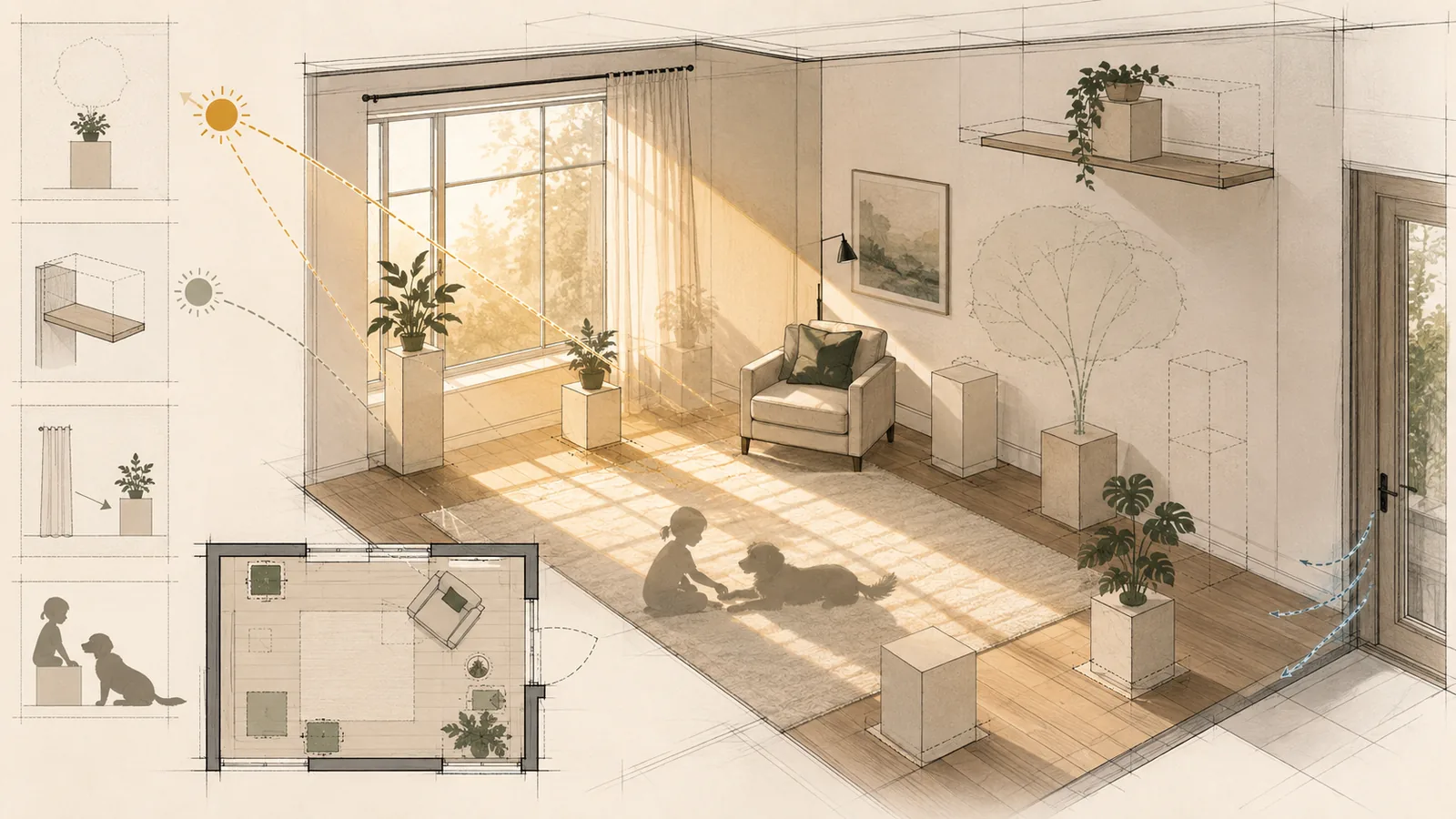
Choose the room before you choose the houseplant. Record the exact position where the plant would sit, not just the window direction or the impression that the room is “bright.” Note obstructions, distance from glass, direct-sun periods, seasonal change, drafts, temperature, humidity, shelf space, mature plant form and whether pets or children can reach the location.
Then compare that room record with plant-specific guidance. A broad label such as low light is not enough: university-extension sources use different numerical bands, and a plant that tolerates dim conditions may still grow slowly, stretch, lose leaves or fail to flower. A phone app can help compare one position with another, but its reading is approximate unless the device and method have been validated.
This article deliberately does not publish a list of recommended plants. A named candidate should enter the shortlist only after its botanical identity, light requirement, mature size and growth habit, temperature and humidity needs, and applicable pet or child risks have been checked. When no candidate clears that screen, changing the location or deferring the purchase is a valid result.
Room-first selection summary
| Decision point | Finding |
|---|---|
| Start here | Define one exact plant position and document its light, space and household constraints. |
| Useful evidence | Repeated readings or observations at the same position, with source-attributed plant requirements. |
| Weak evidence | A room-wide label, one midday reading, a common name, or a seller’s unqualified “low light” badge. |
| Candidate gate | Botanical identity, light, mature form and applicable pet/child risk must be resolved before inclusion. |
| Neither-fits path | Change the location, reduce the desired footprint, choose a nonliving alternative or defer the purchase. |
| Evidence boundary | No room, app, meter, plant or household exposure was tested by Root & Photon. |
Key facts
- Use one exact position: a desk by a window can be many times brighter than another part of the same room.
- Keep light bands attributed: extension sources do not use one identical universal definition of low light.
- Record time and season: one reading does not describe the whole day or year.
- Screen the whole household: mature form, drafts, temperature, humidity, pets and children can disqualify a location even when light is plausible.
- Verify identity: common plant names can overlap; candidate review should retain a scientific name when possible.
- Accept “no fit”: a good method may end with no plant purchase rather than a forced recommendation.
Start with the location, not the plant list
Popular searches often begin with “best low-light houseplants.” That order hides the most important unknown: what does low light mean at the exact place where the plant will live?
University of Minnesota Extension advises determining the quality and hours of natural light before choosing a plant. University of Maryland Extension adds that curtains, screens, weather, season, trees, buildings, window cleanliness and the type of glass can change the light that reaches leaves. Illinois Extension shows that distance from a window can move a location through several light categories even when the compass direction stays the same.
Create a location card before researching candidates:
- room and exact surface or floor position;
- window direction and approximate distance from glass;
- exterior and interior obstructions;
- periods of direct sun and diffuse daylight;
- season and recent weather;
- nearby HVAC outlets, radiators, cold glass or door drafts;
- available width, depth and height;
- pet and child access;
- the appearance or growth goal: compact foliage, trailing form, height, or flowering.
Takeaway: “North-facing room” or “bright indirect light” is a clue, not a decision. The candidate must match the recorded position.
Compare source-specific light bands
The numerical categories below come from different extension pages. They are useful for understanding why labels vary, not for creating a new universal threshold.
| Source | Low-light example | Context and limitation |
|---|---|---|
| University of Minnesota Extension | 50–250 foot-candles; its page also presents a plant-light band of 50–150 µmol m−2 s−1. | An extension category for indoor plants; not a universal species threshold. |
| University of Maryland Extension | 25–100 foot-candles. | Category paired with example locations and plants; exact room conditions still matter. |
| Illinois Extension | 75 foot-candles in its general guideline examples. | The same page shows how window direction and distance change the category. |
| University of Florida IFAS Extension | 25–100 foot-candles at midday. | The page calls low/medium/high generalizations rather than scientific terms. |
Do not average these numbers. Keep the publisher, unit, time of day and measurement position attached to any reading. Also keep the plant’s own source-specific requirement attached to the candidate. A match is more defensible when both sides of the comparison are traceable.
Important limitation: Foot-candles and lux are weighted to human vision. They can support room comparisons, but this article does not convert them into PPFD or DLI and does not claim that one threshold predicts performance for every houseplant.
Measure or observe the exact position
A handheld light meter can make the comparison more repeatable. University of Florida IFAS Extension also notes that phone apps are often adequate for approximating changes in light, while accuracy varies by device and method. That makes an app suitable for a rough relative screen—not proof that a candidate receives a specified amount of plant-usable radiation.
- Choose the plane. Hold the meter or phone where the main leaf surface would be, facing the light in the same way each time.
- Keep the position fixed. Record distance from glass and height above the floor or shelf.
- Take repeated observations. Include morning, midday and later-day conditions on more than one representative day.
- Separate direct sun. Note when direct sun reaches the location rather than blending it with diffuse daylight.
- Save the method. Record device/app, unit, date, weather and any curtains or screens.
- Plan a seasonal recheck. Trees, sun angle and day length can change the result.
This is a household decision log, not a validated measurement protocol. The value comes from using the same method consistently and keeping uncertainty visible.
Selection criteria that survive the evidence check
1. Light fit
Require a current, credible source for the exact species or candidate group. “Tolerates low light” should be treated as a tolerance statement, not a guarantee of dense growth, retained variegation or flowers. University of Minnesota Extension notes that lower-light plants often grow more slowly, while University of Maryland Extension describes spindly growth and fewer flowers as possible low-light effects.
2. Mature form and space fit
Record mature spread, height, trailing or climbing habit, support needs and whether leaves will obstruct a walkway. Do not use the nursery-pot footprint as the mature footprint. If reliable candidate dimensions are unavailable or conflict, the candidate remains unresolved.
3. Temperature and humidity fit
A location near cold glass, a radiator or an HVAC outlet can fail even when the light looks suitable. Illinois and Maryland extension guidance treats temperature and humidity as separate growth constraints. The article does not impose one universal range; the candidate’s documented needs must match the room.
4. Pet and child access
Use the exact botanical identity. The ASPCA maintains species-level toxic and non-toxic plant records and warns that common names can overlap. Its guidance also states that “non-toxic” does not mean “no problem,” because ingestion of plant material can still cause an upset.
For children, Poison Control advises correct plant identification and keeping risky houseplants out of reach. This page is a pre-purchase screen, not an emergency guide. An actual exposure requires current Poison Control or professional guidance rather than an article checklist.
5. Care capacity
Low light often means slower growth and slower water use. The reader must be willing to adjust observation and watering to actual medium conditions rather than a fixed calendar. High-humidity or draft-sensitive candidates may be poor fits for a dry or unstable room even when light is acceptable.
A room-first decision process
- Freeze the location card. Do not change the intended position halfway through candidate research.
- Choose the success definition. Decide whether the goal is simply maintained foliage, compact growth, retained variegation, trailing coverage or flowers.
- Document light. Use repeated observations or readings at the exact position and preserve units and method.
- Set the non-light constraints. Space, drafts, temperature, humidity, pet/child access and maintenance tolerance.
- Admit candidates one at a time. Require botanical identity and traceable light/care sources.
- Reject unresolved candidates. Unknown toxicity, mature size or light requirement is not a pass.
- Build a non-ranked shortlist. Retain only candidates that clear every material constraint.
- Select a monitoring plan. Keep the original location record so changes after placement can be compared with the baseline.
Takeaway: The process does not need to produce a winner. “No candidate clears the screen” is a valid and useful result.
Build a non-ranked shortlist
| Field | Required evidence | Reject or defer when |
|---|---|---|
| Botanical identity | Scientific name or sufficiently precise identity from a credible plant source. | Only a broad common name is available or multiple species share it. |
| Light fit | Source-attributed requirement that can be compared with the room record. | The only evidence is an unqualified “low light” seller label. |
| Mature form | Credible size, habit and support information. | The mature footprint conflicts with the shelf, walkway or furniture. |
| Environment | Candidate-level temperature, humidity and draft tolerance. | The room has unresolved cold glass, HVAC, heat or humidity conflict. |
| Pets | Current species-level toxicity lookup when pets have access. | Identity is uncertain, toxicity is unresolved, or access cannot be controlled. |
| Children | Correct plant identity and a placement/access plan. | Known irritant/toxic risk conflicts with reachable placement or identity is uncertain. |
| Care capacity | Watering/monitoring needs fit the reader’s routine. | The candidate needs conditions the household cannot maintain or monitor. |
Do not score candidates unless the criteria, evidence and weights are separately approved. For this article, every retained candidate is simply eligible for further consideration. None is declared best.
Fit by scenario
Unobstructed lower-light window, plant close to glass
This can support a shortlist when repeated observations align with the candidate’s documented low-light tolerance and there is no cold-glass or draft conflict. Expectations should focus on foliage maintenance rather than dense growth or flowering unless candidate-level evidence says otherwise.
Room center several feet from a window
This is a weaker scenario. Extension examples show that distance can reduce the category substantially. A room-center placement should not inherit the window’s label. Measure or observe the exact position before adding candidates.
Office-like space with long artificial-light hours
Duration may help, but fixture output, spectrum, distance and schedule remain unknown. Ordinary room lighting is not automatically equivalent to a horticultural setup. Use the location record and candidate-specific evidence; do not assume “lights on all day” is sufficient.
Household with a curious pet or young child
The candidate pool may be much smaller. The exact species, access route and residual ingestion risk matter. A high shelf is not automatically a complete control for a climbing cat, trailing vine or falling pot. Unknown safety status should end the candidate’s admission, not become a guessed pass.
Avoid conditions and the neither-fits path
Avoid or defer a candidate when:
- its identity is only a common name;
- its light claim cannot be traced to a credible source;
- the room record contains only one reading or a visual impression;
- the mature plant conflicts with available space or access;
- temperature, humidity or drafts remain unresolved;
- pet or child risk cannot be checked for the exact species;
- the desired result requires dense growth or flowers but the candidate is documented only as tolerant of low light;
- the reader would need to change several care variables at once to keep it going.
When no candidate fits, choose among these neutral alternatives:
- use a brighter existing position;
- reduce the desired mature footprint;
- change the decorative goal from a living plant to a nonliving object;
- improve access control only when the household can verify it;
- defer the purchase until a seasonal recheck or a better room becomes available;
- investigate supplemental plant lighting in a separate evidence-controlled workflow.
Before you buy: Complete the location card and candidate-admission table. Do not buy a plant whose identity, light fit, mature form or household-risk screen remains unknown.
Monitor after placement without turning symptoms into a diagnosis
Keep the original room record and note changes in growth direction, stem spacing, leaf color, leaf drop, scorch and moisture use. Low-light stress can be associated with spindly growth or fewer flowers; abrupt stronger light can scorch leaves. These observations justify rechecking the setup, but they do not prove one cause.
When moving a plant into stronger spring or summer light, acclimate gradually. University of Minnesota Extension suggests a gradual move over one to two weeks for stronger window light, especially toward south- or west-facing exposure. Candidate-specific guidance still controls.
Change one ordinary care variable at a time when practical and record the date. If symptoms are severe, rapidly progressive, associated with an exposure, or outside ordinary houseplant care, use a current extension, Poison Control or appropriate professional resource rather than diagnosing from this page.
What we could not verify
- The light history, window transmission or seasonal trajectory of any reader’s room.
- The accuracy of a particular phone, app or handheld meter.
- A validated lux-to-PPFD or DLI conversion for this room-selection task.
- The botanical identity, mature size, habit, toxicity or care fit of any named candidate.
- Whether a high shelf, barrier or placement will prevent access in a specific household.
- Long-term performance, flowering or retained variegation in a reader’s care.
- A universal low-light threshold or a list of plants guaranteed to thrive in dark rooms.
Final recommendation
Use the room-first process as a filter, not as a shopping list. The strongest candidate is the one whose exact identity and documented requirements match the exact position, available space, household access and care capacity. When the evidence is incomplete, defer the candidate. A narrower shortlist—or no purchase—is more defensible than forcing a plant into a room based on a vague label.
Methodology
This article uses E2_sourced evidence. Root & Photon reviewed current university-extension sources on indoor light, measurement, low-light effects, seasonal acclimation, temperature and humidity; the ASPCA plant-toxicity database and pet-ingestion guidance; and Poison Control prevention and identification guidance. Sources were checked on July 25, 2026.
Source-specific foot-candle and plant-light bands were preserved separately rather than averaged into a new threshold. Phone-app use remains approximate. Pet and child concerns were limited to pre-purchase identity and access screening; no candidate was labeled safe. The article intentionally omits a species list because no candidate completed the required botanical light, mature-form and household-risk fact-check.
Root & Photon did not measure a room, validate a device, inspect a plant, run a placement trial or obtain specialist review. Evidence remains E2_sourced. Methodology precedes the final source list, and the body ends at the Sources section.
Sources
- University of Minnesota Extension: Lighting for indoor plants and starting seeds
- University of Maryland Extension: Lighting for Indoor Plants
- Illinois Extension: Houseplant Lighting
- University of Florida IFAS Extension: Light for Houseplants
- University of Maryland Extension: Low Light Impacts on Indoor Plants
- University of Minnesota Extension: Spring houseplant care
- Illinois Extension: Houseplant Care
- University of Maryland Extension: Temperature and Humidity for Indoor Plants
- ASPCA Animal Poison Control Center: Toxic and Non-Toxic Plants
- ASPCA: Are Succulents Safe to Have Around Pets?
- Poison Control: My child ate a piece of a calla lily!