Evidence status: This page is an E2 source-based decision tool. No Root & Photon system access, grow trial, measurement or reliability test exists.
Quick answer
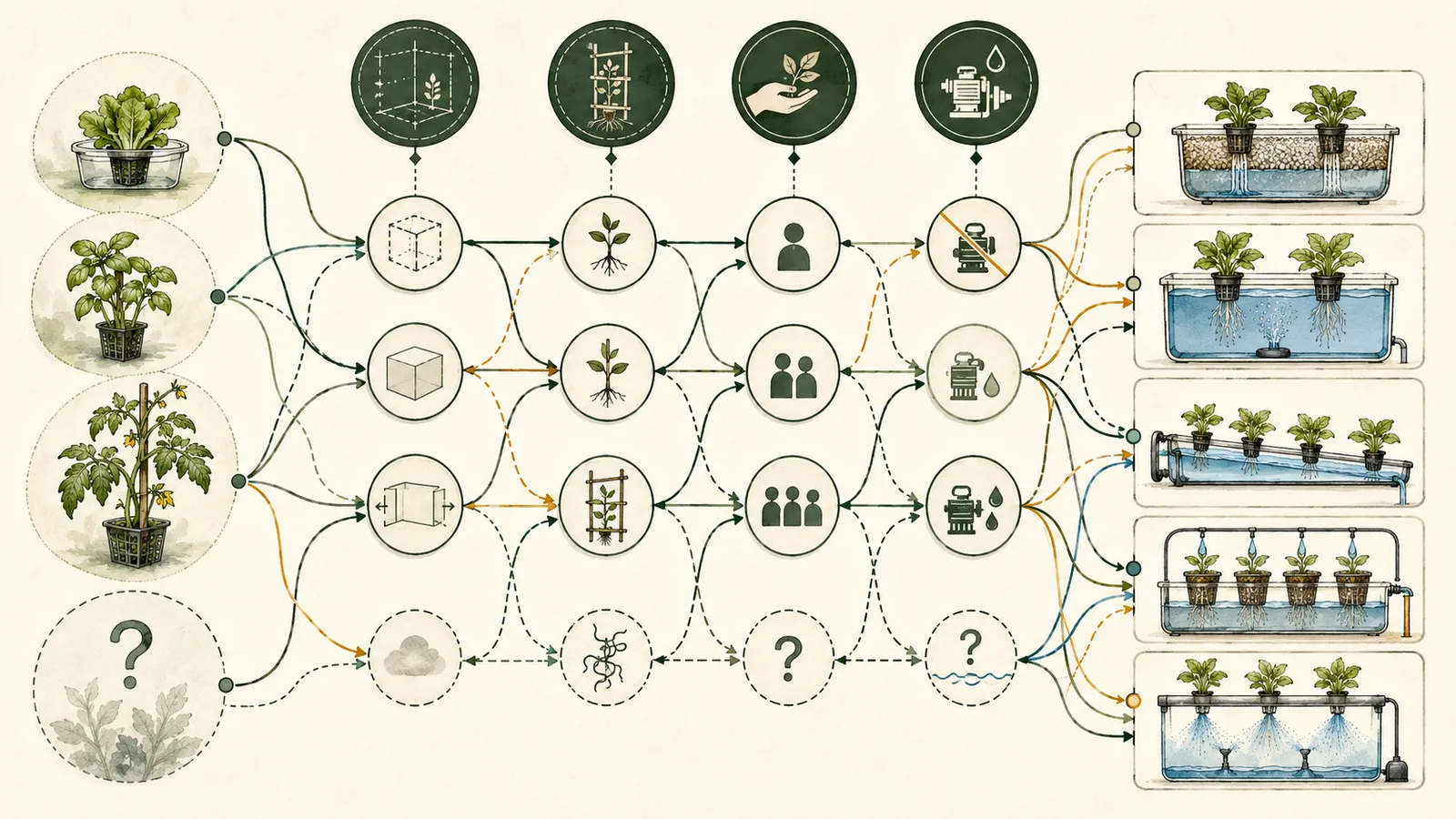
Quick answer: Choose a hydroponic system only after you define the crop form, expected mature size, support requirement, available layout, maintenance tolerance, pump dependence and the strength of your crop-specific evidence. This selector screens five architectures in a fixed order. It does not name a winner, recommend a product or guarantee that a crop will perform.
Quick verdict
| Decision point | Finding |
|---|---|
| Prerequisites | Choose a hydroponic system only after you define the crop form, expected mature size, support requirement, available layout, maintenance tolerance, pump dependence and the strength of your crop-specific evidence. |
| Expected result |
The tool applies disclosed routing rules to eight inputs and returns every system in the same order: wick, deep water culture (DWC), nutrient film technique (NFT), drip with substrate sites and aeroponics. A route may be plausible, conditional, a poor fit or insufficient evidence. “Plausible” means “worth verifying against exact crop and system documents,” not “recommended.” |
| Stop condition | Resolve the displayed gap before selecting a design. Do not force the route; change a real constraint or gather new evidence. |
| Evidence boundary | The selector is an evidence screen. Its internal score is not a biological probability, a performance rating or a ranking. |
Key facts before you choose a route
| Decision point | Evidence-based meaning |
|---|---|
| Architecture | Describes how solution reaches roots and how roots are supported. It does not prove crop compatibility. |
| Crop evidence | An exact-crop source is stronger than a broad category source. Missing evidence forces an insufficient-evidence result. |
| Plausible | A candidate route whose exact crop, cultivar, stage, support, root zone and operating documents still require verification. |
| Conditional | A route with a material evidence or constraint gap that must be resolved before selection. |
| Poor fit | The entered constraints conflict with the retained evidence; it is not proof that no design could ever work. |
Takeaway: The output narrows research. It does not replace crop-specific horticultural guidance or a complete-system review.
The eight inputs that control the route
| Input | What to record | Why it changes the route |
|---|---|---|
| Crop form | Leafy/herb, compact fruiting, large fruiting/vining, root/bulb/tuber, propagation or unknown. | Different forms create different support, root-space and cycle demands. |
| Cycle length | Short, medium, long or unknown. | Long cycles increase root, support and maintenance exposure. |
| Mature scale | Compact, medium, large or unknown. | Use expected mature size rather than seedling size. |
| Support need | Low, moderate, high or unknown. | The delivery system does not automatically support stems, vines or fruit. |
| Layout | Simple container, horizontal channel/raft, individual substrate sites, vertical or no preference. | Layout and delivery architecture are related but not identical. |
| Maintenance tolerance | Low, medium or high. | Channels, emitters and mist systems add inspection points. |
| Pump-dependency tolerance | Avoid, acceptable or high. | Passive wick, aerated DWC and recirculating systems have different dependencies. |
| Crop-source status | Exact crop, category-level or not verified. | This is a hard cap on the strongest result. |
What each system category means
USDA’s hydroponics resources define the broader soil-free production context. The category-level distinctions below come primarily from current university-extension documentation.
| System | Delivery/root-zone pattern | Constraint the selector emphasizes |
|---|---|---|
| Wick | Capillary movement through a wick or medium. | Low pump dependence, but passive delivery and plant-demand limits. |
| DWC | Roots are held in or above a nutrient solution. | Reservoir volume, aeration and plant support remain separate requirements. |
| NFT | A shallow recirculating film moves through channels. | Short-crop evidence, channel layout, plumbing, pump and regular inspection. |
| Drip with substrate sites | Lines or emitters deliver solution to individual media-supported sites. | Emitter/line maintenance, substrate properties and external crop support. |
| Aeroponics | Suspended roots receive nutrient mist in a chamber. | Short-cycle delivery controls and high operating-dependency tolerance. |
The University of Minnesota’s small-scale hydroponics guide documents leafy greens in NFT and tomatoes or strawberries in drip-to-substrate contexts. The UF/IFAS lettuce guide also separates short-cycle NFT/raft examples from longer-cycle crops that need more root and shoot space. Those examples support routing questions, not a universal chart.
Use the crop-to-system selector
Choose the closest documented option for every field. When a material input is unknown, select “unknown” or “not yet verified” rather than guessing.
How to interpret the output
| State | What it means | Next action |
|---|---|---|
| Plausible route to verify | The entered constraints do not conflict with the retained route evidence. | Verify exact crop, stage, architecture, support, root-zone and operating documents. |
| Conditional route | A source or constraint gap remains. | Resolve the displayed gap before selecting a design. |
| Poor fit | The current inputs conflict with the retained evidence. | Do not force the route; change a real constraint or gather new evidence. |
| Insufficient evidence | The crop evidence gate is not met. | Find an authoritative exact-crop or defensible category source. |
Important limitation: Light, water quality, nutrient program, pH, electrical conductivity, temperature, humidity, disease pressure and product design are outside this selector. A routed architecture can still fail those separate gates.
How the software was checked
The same frozen fixtures run through a Python reference model and the browser JavaScript model. Eight valid cases cover leafy/passive, leafy/channel, compact fruiting, large vining, propagation, root-crop, missing-source and category-evidence scenarios. Eight invalid cases verify that missing or unsupported inputs fail closed.
| Check | Result | Evidence boundary |
|---|---|---|
| Python valid fixtures | 8/8 pass | Rule execution only |
| Python invalid fixtures | 8/8 fail closed | Input validation only |
| JavaScript valid/invalid fixtures | Exact parity with Python | Cross-language consistency only |
| Horticultural validation | Not performed | No crop response, system operation or outcome was tested |
What we could not verify
- No universal crop-to-system compatibility database was approved.
- No exact crop or cultivar list is activated.
- No Root & Photon system access, grow trial, measurement or reliability test exists.
- Root, bulb and tuber routes remain highly dependent on exact root-zone and harvest-space evidence.
- The selector does not model plant count, spacing, light distribution, nutrient targets, water quality or failure timing.
- No product, price, retailer, availability, affiliate, safety, yield, savings, ROI or payback conclusion is supported.
Methodology
This page is an E2 source-based decision tool. We reviewed current government, university-extension and university research/extension sources, retained architecture and crop-context limitations, converted those boundaries into disclosed fixed-order rules, and tested identical valid and invalid fixtures in Python and JavaScript. Agreement between code implementations does not upgrade the page to E3 validation. The selector is refreshed when a controlling source, crop category, system definition, evidence cap or rule changes materially.
Sources
- USDA National Agricultural Library — Hydroponics
- University of Minnesota Extension — Small-scale hydroponics
- Oklahoma State University Extension — Hydroponics
- UF/IFAS Extension — Growing Lettuce in Small Hydroponic Systems
- Oklahoma State University Extension — Aquaponics
- Oklahoma State University Extension — Building a Vertical Hydroponic Tower
- Oklahoma State University Extension — Soilless Growing Mediums
- Oklahoma State University Extension — Electrical Conductivity and pH Guide for Hydroponics
- Cornell Controlled Environment Agriculture — Crop resources
- Cornell Controlled Environment Agriculture — Strawberry runner propagation for DWC
- University of Minnesota Extension — Lighting for indoor plants and starting seeds