Evidence status: This is a source-based comparison of two indoor lettuce workflows. Root & Photon did not grow, measure, taste, inspect, harvest, price, or test lettuce in either method. Published comparisons use different cultivars, scales, light, climates, nutrient treatments, energy boundaries, and reporting bases, so this page does not name a universal winner.
Quick answer
Choose between container media and hydroponics by matching the method to one defined lettuce task, not by asking which label is “better.” Hold the lettuce type, stage, canopy area, light, study period, and harvest goal as constant as practical. Then compare the root-zone work you are willing and able to perform.
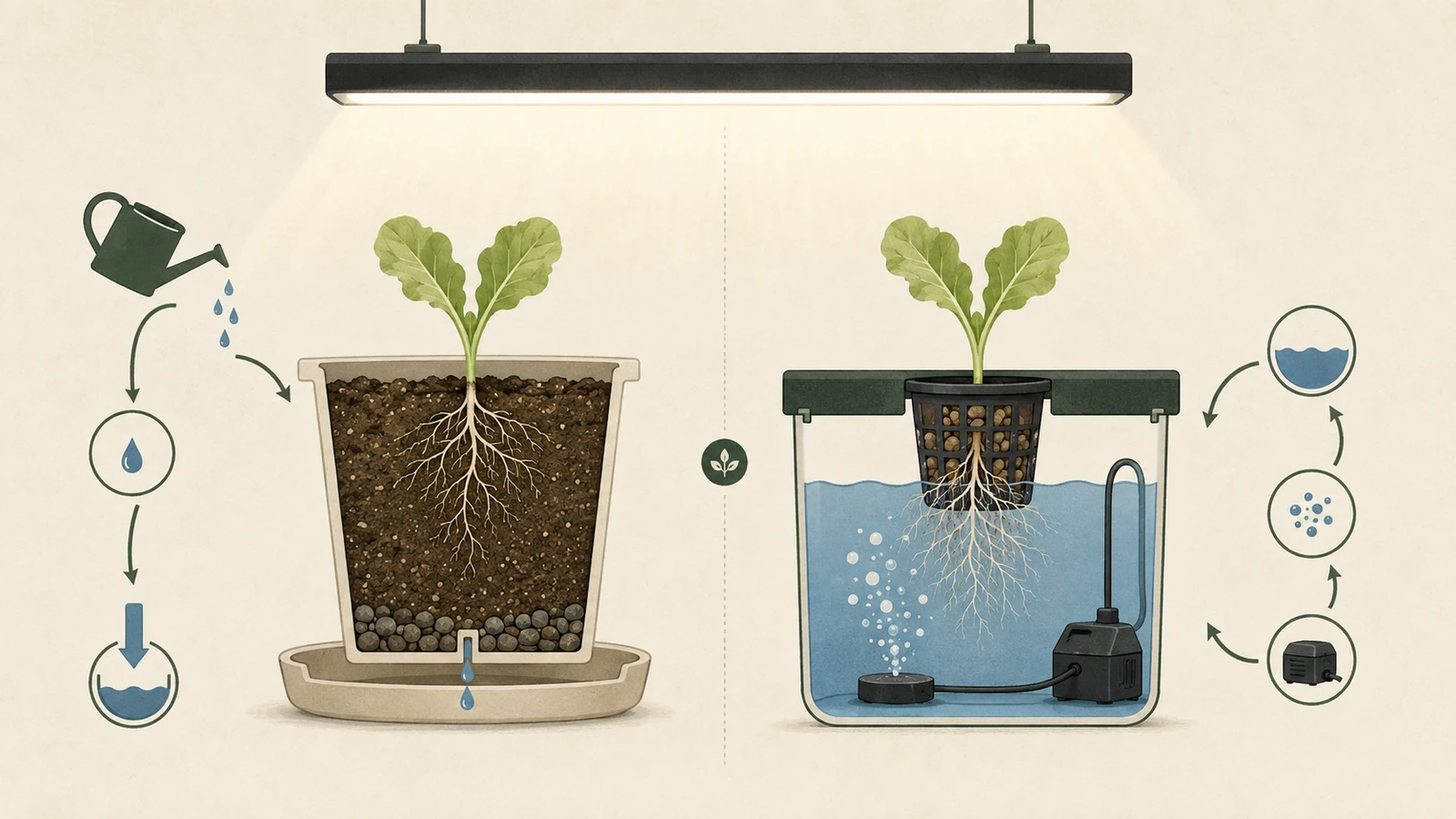
A container-media setup concentrates the work in pot selection, drainage, aerated media, moisture, and fertility. A hydroponic setup moves that work into nutrient-solution identity, source water, reservoir level, plant support, root oxygen or circulation where the selected system requires it, and any active-component dependencies. Both methods still need adequate light, an appropriate temperature context, clean materials, observation, and a realistic harvest goal.
Container media is often the simpler fit for a reader who wants fewer active root-zone components and accepts media watering and drainage checks. Hydroponics can be the better workflow fit for a reader who wants a water-based system and is willing to document and maintain its solution and components. Neither method is a strong choice when the planned location lacks adequate light or when service, cleanup, and monitoring access are unresolved.
Comparison decision
| Decision point | Container media | Hydroponics |
|---|---|---|
| Root-zone medium | Aerated, well-drained container media that holds enough moisture. | Water-based nutrient solution, sometimes with a support substrate. |
| Primary recurring evidence | Media moisture, drainage, root-space, fertility record, and container condition. | Solution level and identity, source water, nutrient-program record, support, oxygen or circulation, and component state. |
| Infrastructure profile | Can be largely passive, but still needs drainage and regular observation. | Can be passive or active; some designs depend on pumps, aeration, circulation, or timers. |
| Strongest fit condition | You prefer a familiar container workflow and can manage watering and drainage. | You accept solution management and the exact dependencies of the chosen system. |
| Defer when | Media, drainage, watering access, or light is unresolved. | System identity, solution program, water, monitoring, cleanup, or light is unresolved. |
Key facts
| Item | Evidence-based finding |
|---|---|
| “Soil” indoors | For a container, this usually means an appropriate potting or soilless container medium, not unmodified garden soil. |
| Hydroponics | Plants receive water and nutrients from a solution rather than soil; support substrate may still be present. |
| Shared growth controls | Cultivar, stage, light, temperature context, sanitation, plant count, study period, and harvest basis affect both methods. |
| Yield and resource claims | Published results depend on the exact scale, climate, system, energy boundary, water accounting, and harvest unit. |
| Quality and nutrition | Different studies report different outcomes by compound, moisture basis, cultivar, nutrient treatment, and protocol. |
| Food safety | A soil or hydroponic label alone does not establish a simple safety hierarchy. |
Takeaway: Decide from a matched task and a complete maintenance boundary. A method label cannot substitute for the actual light, root-zone, monitoring, and harvest conditions.
Build a matched comparison before judging the methods
Start with one sentence that defines the task. For example: “Compare the same loose-leaf lettuce at the same transplant stage, under the same fixture and schedule, in the same shelf area, for the same number of days, with the same baby-leaf harvest goal.” That sentence is more important than a score.
| Shared field | What to record | Why it matters |
|---|---|---|
| Lettuce identity | Type or cultivar, seed lot if known, and starting stage. | Cultivars and stages can respond differently. |
| Light | Natural-light contribution, fixture, setting, schedule, canopy plane, and distribution evidence. | A better light cannot be credited to the root-zone method. |
| Comparison unit | Same plant count, canopy area, or another explicit unit. | Prevents more plants or more area from masquerading as method performance. |
| Time and harvest | Start date, study period, harvest stage, and whether mass is fresh or dry. | Output and composition change with time and reporting basis. |
| Environment | Placement, temperature context, airflow, and major recent changes. | Shared environmental differences can dominate the comparison. |
| Losses and exclusions | Failed starts, replacements, spills, resets, or unusable harvest. | Ignoring losses can bias workload and output. |
Perfect matching may not be possible in a home. When it is not, write down the mismatch. “Hydroponics used a larger canopy area” or “the container sat closer to the window” is useful evidence; silently treating those conditions as method effects is not.
Understand the container-media branch
Container-grown lettuce needs a medium that supports roots while retaining enough moisture and allowing air and excess water to move. University extension guidance warns that unmodified garden soil can drain and aerate poorly inside a container. The practical branch is therefore a container-media system, even when people casually call it “soil.”
Record the container’s usable volume, drainage path, media identity, whether the media includes fertility, how moisture is checked, and where drained water goes. Containers can dry quickly, but frequency depends on size, material, location, crop, media, season, and plant development. This page does not convert those variables into a calendar rule.
The branch can be relatively passive: there may be no reservoir pump or nutrient-solution loop. That does not make it automatic. Uneven wetting, poor drainage, shrinking media, limited root space, forgotten fertility, and inaccessible runoff can all create work or uncertainty. The fit question is whether the reader prefers and can sustain that evidence routine.
Understand the hydroponic branch
Hydroponics replaces soil with a water-based nutrient solution, but it does not mean “lettuce in plain water.” A system also needs plant support, a way for roots to access oxygen, suitable light, and a nutrient program that fits the crop and source-water context. Some designs use net pots and substrate; some are passive; others use aeration, circulation, channels, pumps, or timers.
Record the exact system category, reservoir volume, solution and companion-part identity, source water, plant support, intended water level, root-oxygen method, active components, cleaning/reset access, and the observations the operator will log. This page does not supply a nutrient recipe, pH or electrical-conductivity target, mixing order, or chemical-adjustment procedure.
An active system can centralize water and nutrient management, but it can also create component and interruption dependencies. A passive system avoids some powered components but still has water-level, root-zone, nutrient, support, and sanitation questions. “Hydroponic” is a category; the exact design owns the workload.
Compare the decision criteria
| Criterion | Container-media questions | Hydroponic questions |
|---|---|---|
| Space and access | Can the pot, runoff path, and watering access remain usable as leaves expand? | Can the reservoir, plants, tubing or support, and service path remain accessible? |
| Root-zone evidence | How will you check moisture, drainage, compaction, root space, and media condition? | How will you check solution level, root access, support, oxygen or circulation, and component state? |
| Nutrient evidence | What fertility is already in the media, and what does the exact label say? | What is the exact nutrient program, companion structure, source water, and recorded use? |
| Failure visibility | Can you see drainage, waterlogging, drying, or media changes early? | Can you detect level, flow, aeration, pump, timer, or solution problems before plants decline? |
| Cleanup and reset | Where will media, runoff, roots, and the container be handled? | Where will solution, reservoir, supports, roots, and components be drained or cleaned? |
| Documentation burden | Container, media, watering observations, fertility, and harvest basis. | System, water, nutrient program, solution observations, component state, and harvest basis. |
| Cost and resource evidence | Dated container, media, input, light, water, loss, and replacement records. | Dated system, nutrient, light, water, energy, component, loss, and replacement records. |
Review the tradeoffs without inventing a winner
Container-media tradeoffs
The branch can use familiar materials and fewer active root-zone components. It may also hide important differences inside the word “soil”: media structure, drainage, starting fertility, rewetting behavior, container volume, runoff access, and how quickly it dries. A reader who dislikes reservoir records may still be comfortable checking media moisture and drainage; another may find variable watering harder to manage than a documented solution system.
Hydroponic tradeoffs
The branch can make solution level and system components more visible and can fit compact or repeatable layouts. It also requires the reader to understand the exact design, nutrient program, source water, support, root-oxygen method, and any active dependencies. A system that centralizes solution management may reduce some repetitive watering tasks while adding monitoring, cleaning, component, and interruption work.
Evidence tradeoffs
Published comparisons do not resolve the home decision by themselves. A modeled Arizona comparison found lower water demand and higher yield for hydroponics together with much higher energy demand. Other studies report cultivar-, nutrient-, season-, moisture-basis-, or metric-specific quality differences. Those findings are useful as warnings about incomplete boundaries, not as inputs to a universal score.
Fit by scenario
| Reader scenario | Stronger starting path | Reason and check |
|---|---|---|
| Wants a familiar pot workflow | Container media | Start here when drainage, media, watering access, fertility information, and runoff handling are clear. |
| Wants a water-based learning system | Hydroponics | Start here when the exact system, nutrient program, source water, support, monitoring, and cleanup plan are clear. |
| Cannot tolerate active-component dependence | Container media or a documented passive hydroponic design | Verify the real design; “hydroponic” does not always mean powered, and “soil” does not mean automatic. |
| Needs highly visible root-zone records | Depends on the operator | Choose the branch whose moisture or solution evidence you can observe and log consistently. |
| Has limited cleanup access | Neither until resolved | Both methods create water, roots, plant debris, and reset work. |
| Has uncertain indoor light | Neither until light is documented | Changing the root-zone method does not repair an inadequate or unknown canopy-light scenario. |
Avoid or defer conditions
- Avoid a container-media start when the container has no workable drainage, the media identity is unknown, runoff cannot be managed, or watering access is unreliable.
- Avoid a hydroponic start when the system category, nutrient program, source water, root-support method, monitoring routine, or interruption response is unknown.
- Avoid comparing outcomes when the two branches use different lettuce, light, plant counts, area, study periods, harvest stages, or loss accounting.
- Avoid resource claims without direct water, energy, input, replacement, loss, and harvest records for the exact home setup.
- Avoid quality, nutrition, taste, or safety claims based on the method label alone.
When neither method fits
Defer the project when the only available site has unresolved light, excessive heat, unstable access, no acceptable water or runoff path, no place to clean or reset the system, or no realistic monitoring routine. A smaller, better documented project is preferable to a larger comparison whose basic conditions cannot be observed.
Also defer the comparison when its real purpose is to prove yield, nutrition, safety, sustainability, savings, or payback. Those questions require a separate protocol, a complete boundary, direct data, and the relevant review. This E2 page does not produce those results.
Use the decision worksheet
- Write the matched lettuce task: identity, stage, plant count or area, light, period, and harvest goal.
- Record the physical site, service path, cleanup route, and water consequence.
- Complete the container-media fields: container, drainage, media, moisture method, fertility information, and reset plan.
- Complete the hydroponic fields: system, reservoir, nutrient program, source water, support, oxygen or circulation, active components, and reset plan.
- Mark every unknown. Do not score an unknown as zero effort, zero cost, zero risk, or zero loss.
- Choose the method whose full routine you can sustain. When both fit, start with the one that produces clearer evidence for you.
- Reassess after a defined period using the same harvest and loss basis. Do not convert one home result into a universal method verdict.
Important limitation: This workflow does not provide a nutrient recipe, pH or electrical-conductivity target, food-safety procedure, electrical instruction, product recommendation, price, or expected harvest.
What we could not verify
- The light, temperature, source water, media, nutrient program, system design, skill, and cleanup constraints of any reader’s home.
- A universal indoor lettuce yield, growth rate, water use, energy use, labor requirement, cost, quality, nutrition, taste, shelf life, or safety result for either method.
- The current price, availability, reliability, service life, or fit of any container, medium, nutrient, pump, timer, kit, or other product.
- A direct Root & Photon grow trial, measurement, tasting, root inspection, harvest, or matched comparison.
Methodology
Root & Photon reviewed U.S. government and university-extension material for hydroponic definitions, small-scale system functions, lettuce, containers, media, watering, and indoor light. We then reviewed peer-reviewed comparisons that examined resource use, growth, composition, texture, microbial profiles, cultivar, solution temperature, season, and cultivation system. The January 2026 Missouri nutrient-solutions guide was checked in the university’s MOspace archive on September 22, 2026 for general source-water and solution-management context only; the historical copy does not verify current numerical guidance.
We used those sources to build a matched-scenario decision framework. We did not average unlike studies, assign a biological score, infer household performance, or turn an official or academic example into a prescription. Manufacturer, price, retailer, affiliate, direct-use, measurement, grow-trial, nutrition-winner, safety, and sustainability claims were excluded.
Sources
- USDA National Agricultural Library — Hydroponics
- University of Minnesota Extension — Small-scale hydroponics
- University of Minnesota Extension — Growing lettuce, endive and radicchio in home gardens
- Illinois Extension — Growing Vegetables in Containers
- Illinois Extension — Soil for Container Gardens
- Illinois Extension — Watering Container Gardens
- Oregon State University Extension — No yard? Grow vegetables in containers
- University of Minnesota Extension — Lighting for indoor plants and starting seeds
- University of Missouri Extension — Hydroponic Nutrient Solutions (January 2026 archived edition in MOspace)
- Barbosa et al. — Comparison of Land, Water, and Energy Requirements of Lettuce Grown Using Hydroponic vs. Conventional Agricultural Methods
- Siomos et al. — Quality and Composition of Lettuce Grown in Soil and Soilless Culture
- Differential Metabolic Responses of Lettuce Grown in Soil, Substrate and Hydroponic Cultivation Systems
- Lei and Engeseth — Comparison of growth characteristics, functional qualities, and texture of hydroponically grown and soil-grown lettuce
- Mohammad et al. — Comparative microbial analyses of hydroponic versus in-soil grown Romaine lettuce obtained at retail
- Gumisiriza et al. — Soilless urban gardening and lettuce response to hydroponics in Uganda
- Nutrient Solution Temperature Affects Growth and Brix of Seventeen Lettuce Cultivars in NFT
- Soilless Cultivation System, EC, and Growing Season on Baby-Leaf Lettuce
- USDA NAL — Safe production of leafy greens in recirculating hydroponic systems