
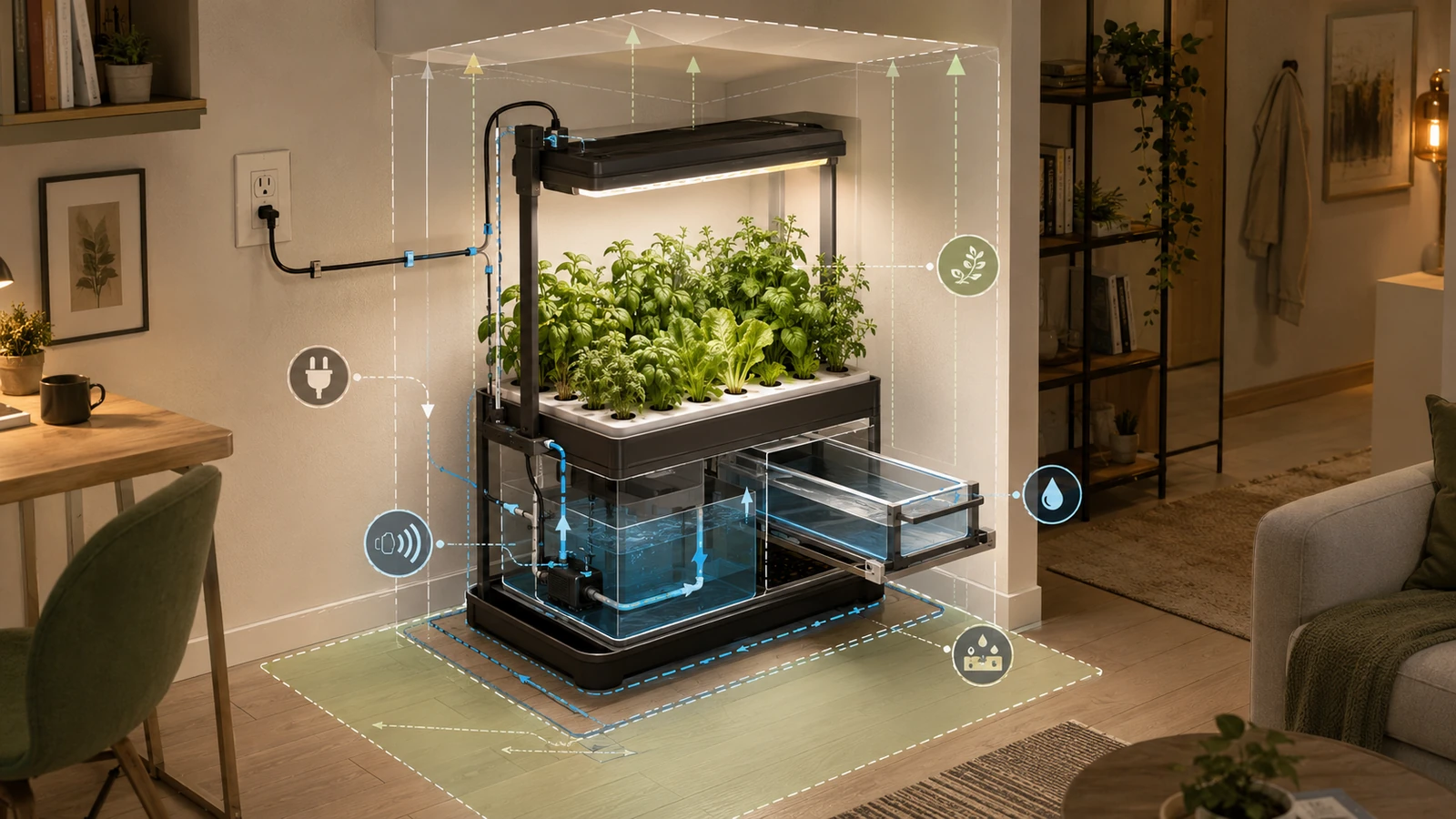
Evidence status: This is a source-based apartment-fit workflow. Root & Photon did not inspect a room, review a lease, assemble a system, measure sound, test a spill, verify an electrical installation, or grow plants in any product for this article.
Quick answer
A suitable apartment hydroponic candidate is not automatically the smallest-looking or most automated one. It is the complete system whose exact footprint, plant-and-light height, service access, water path, powered components and recurring maintenance fit the location you actually have.
Start by measuring the site and writing down hard constraints. Then compare exact documentation for each candidate. Treat sound, leak probability, long-term reliability and building rules as unknown until you have evidence for the exact model and placement. A product page can prove dimensions or wattage; it cannot prove that a system will be quiet, leak-free or suitable for every apartment.
When the evidence does not clear a hard constraint, defer the candidate. A passive setup, a smaller non-hydroponic method, or waiting for a better location can be a better result than forcing an active system into an unsuitable space.
Apartment-fit workflow
| Decision point | Evidence-based action |
|---|---|
| Site | Measure width, depth and available height at the exact location. |
| Complete envelope | Add the mature plant, light position and access needed for filling, inspection and cleaning. |
| Water path | Map the tank, fill point, pump, tubing, drain, return and level indicator when present. |
| Sound | Identify pumps, fans and cycles; require exact evidence when the household is sound-sensitive. |
| Power and light | Record exact watts, adapter, cable arrangement, timer behavior and light envelope without giving installation advice. |
| Routine | List refill, monitoring, crop care and between-round cleaning before deciding that a system is manageable. |
Key facts
- Use exact dimensions: “countertop” and “compact” are not measurements.
- Include plants and access: the product body is only part of the installed envelope.
- Active hardware changes the diligence: pumps, fans, tubing and returns add dependencies to verify.
- Noise is model-specific: the reviewed official pages did not provide a comparable sound-pressure dataset.
- Water interfaces matter: record every fill, tank, hose, channel, drain and return that exists.
- Filled mass matters: include the mass of solution, container, equipment, plants and anything carried during service; empty product weight is not enough.
- Moisture is a building constraint: the water path must be inspectable and ordinary wetting must be manageable without turning this guide into remediation advice.
- Automation does not remove maintenance: refill, crop care, monitoring and cleaning remain.
- Documentation has limits: published watts and dimensions do not prove electrical, building or lease suitability.
Measure the site and service envelope
Measure the exact location rather than the room in general. Record usable width, depth and height. Then identify anything that reduces that volume: shelves above, cabinet doors, curtains, heat sources, walkways, pets, children, or the need to move the system for cleaning.
Do not stop at the equipment dimensions. Add the expected plant envelope, adjustable light height, trellis or support, and the space your hands or a container need for refilling and cleaning. Official examples reviewed for this article ranged from narrow countertop bodies to a multi-level stand. Those pages prove only that exact models differ; they do not define a typical apartment footprint.
| Field | Record | Why it matters |
|---|---|---|
| Equipment footprint | Exact width and depth | Eliminates candidates that do not physically fit. |
| Installed height | Base, light, support and mature plant envelope | Prevents the light or plant from colliding with the room. |
| Fill access | Opening, cap, lid or tank-removal path | Shows whether routine refilling is practical. |
| Cleaning access | Space to remove, drain and carry applicable parts | Tests the real between-round workflow. |
| Filled mass | Solution volume converted to mass, plus container, equipment and plants | Prevents empty-weight specifications from hiding the serviced load; it does not establish structural suitability. |
| Cable path | Exact cable and adapter arrangement | Documents the layout without assuming installation suitability. |
Map system dependencies
A passive deep-water system can avoid circulation hardware, but it still needs a reservoir, plant support, nutrient-solution management, light and recurring inspection. Active NFT, drip or ebb-and-flow systems may add a pump, tubing, channels, drains or returns. Integrated countertop products bundle some of these functions and may add reminders or automated light schedules.
Write the dependency list for the exact candidate. A label such as “smart,” “self-growing,” “DWC” or “NFT” does not tell you whether a specific setup needs one powered component or several, how many water connections it has, or which tasks remain manual.
Screen sound evidence, not sound adjectives
Pumps and fans are moving components worth investigating in a sound-sensitive home, but their presence alone does not establish what a person will hear. Placement, mounting, water level, component condition and room acoustics can change the experience. This package found no comparable sound-pressure dataset across the reviewed official pages.
Ask for evidence tied to the exact model and operating cycle. A manufacturer statement, independent measurement under disclosed conditions, or a return/test opportunity can reduce uncertainty. An unsupported word such as “quiet” should not clear a hard household constraint.
When no credible evidence is available, mark sound as unknown rather than assuming zero. A passive method may deserve investigation when avoiding active circulation hardware is a priority, but it still needs a valid crop, oxygen and maintenance plan from appropriate sources.
Map the water path
Draw the water route before selecting a location. Depending on the category, the path may include a fill point, tank or reservoir, pump, hose, emitter, channel, drain, return line and water-level indicator. The purpose is not to predict a leak. It is to make every interface visible so the household can decide whether the arrangement is inspectable and manageable.
Official support for one integrated example documents a four-liter tank, a fill-level indicator and refill timing that varies with the plant and growth stage. That does not create a universal interval. It shows why the exact refill path and unattended-time assumptions belong in the shortlist record.
Also estimate filled mass. USGS reports that one U.S. gallon of water at 70°F weighs about 8.329 pounds. Use the exact solution volume, then add the container, equipment, plants and any load carried during service. This arithmetic is a screening input, not a shelf, cart, floor or structural-suitability verdict.
EPA guidance treats unintended indoor moisture as a condition to control and wet materials as something to dry promptly. In this guide, that evidence means the water path and ordinary-response plan must be feasible at the chosen location. It does not become mold-remediation, health, building-repair, spill-cleanup or emergency guidance.
This article does not provide plumbing, mold-response, spill-cleanup or emergency instructions. A candidate should be deferred when the reader cannot reconcile its water path with the apartment, lease, building and household constraints that apply.
Check power and light documentation
Record every powered component and its exact documentation: light input, pump or fan, adapter, cable length, timer behavior and whether continuous power is required. Official pages in the research sample published different light wattages and cable arrangements. Those values belong to exact models, not the entire category.
Also record the light’s installed height and the crop/plant envelope. A system can fit the counter while its mature plants or raised light do not fit the available height. Natural room brightness is not a substitute for source-qualified crop and stage evidence.
Published watts, adapters or cables do not establish circuit, outlet, wet-location, lease or building-code suitability. ESFI documents that ground-fault circuit interrupters are intended to interrupt leakage current and are used where water may contact electrical products, but that does not validate an exact apartment installation. Record the evidence and route unresolved questions to applicable documentation or qualified local review; this guide gives no outlet, circuit, extension-cord, wiring or installation instructions.
Budget the maintenance workload
List the recurring tasks before calling a system manageable. Depending on the category, these may include checking water level, refilling, monitoring nutrient-solution condition, observing roots and plants, pruning, cleaning surfaces, clearing lines, changing crops and cleaning between rounds.
Extension sources make clear that nutrient-solution management and monitoring vary by system and crop. Official integrated-product support also retains refill and cleaning duties. Reminders can reduce dependence on memory; they are not measurements of plant health and do not remove the task.
Estimate how the routine fits a normal week and a busy week. If the system works only when every task is performed on an ideal schedule that the household cannot sustain, it is not a good shortlist candidate.
Fit by scenario
| Scenario | First category to investigate | Main evidence still needed |
|---|---|---|
| Bounded counter space and one documented operating path matter most | Integrated countertop system | Exact footprint, plant envelope, refill/cleaning path, sound evidence and power documentation. |
| Avoiding active circulation hardware is a priority | Simple passive system | Exact crop, reservoir, oxygen strategy, light and manual solution-management evidence. |
| Component flexibility and a larger plant layout matter | Compact active recirculating system | Pump/tubing layout, sound evidence, service access, water path and maintenance plan. |
| No stable location or routine is available | Neither category yet | A different growing method, smaller scope or later start. |
Takeaway: “First to investigate” is not a recommendation. It identifies the category most aligned with the stated constraint while preserving the remaining evidence gates.
Avoid or defer conditions
- The exact equipment, plant and service envelope does not fit the measured site.
- A sound-sensitive household cannot obtain credible evidence for the exact moving components and operating cycle.
- The reservoir, fill, tubing, drain or return layout cannot be inspected and reconciled with household constraints.
- Required refill, monitoring, crop-care or cleaning work exceeds the operator’s realistic routine.
- The light, adapter, cable or powered-component documentation is incomplete for the intended setup.
- The decision depends on an unverified lease, building, code, insurance or electrical assumption.
Build a non-ranked shortlist
Use hard gates first and preferences second. A candidate that fails a hard constraint should not receive a high score for features.
| Field | Status | Evidence to record |
|---|---|---|
| Complete envelope fits | Pass / fail / unknown | Exact dimensions plus plant, light and service access. |
| Sound constraint clears | Pass / fail / unknown | Exact model and disclosed operating condition. |
| Water path is manageable | Pass / fail / unknown | Reservoir, fill, pump, tubing, drain and return map; filled-mass and ordinary-moisture response boundary. |
| Power/light documentation clears | Pass / fail / unknown | Watts, adapter, cable, timer and light envelope. |
| Routine fits | Pass / fail / unknown | Refill, monitoring, crop care and cleaning tasks. |
| User-specific rules checked | Pass / fail / unknown | Applicable lease, building and household decisions. |
Keep the list non-ranked until every hard field is resolved. Unknown is not the same as pass. When two candidates clear the gates, preferences such as appearance, component flexibility or interface design can break the tie without pretending one is universally better.
What we could not verify
- Comparable sound-pressure measurements across apartment hydroponic categories.
- Leak frequency, spill probability, long-term reliability or serviceability.
- Lease, landlord, condominium, insurance, building-code or circuit suitability.
- Current prices, stock, shipping, warranty performance or long-term parts availability.
- A category-wide yield, water, energy, labor, cost or sustainability advantage.
Methodology
We used current USDA and university-extension sources to define hydroponic system functions, active/passive dependencies and recurring monitoring. We used USGS for a temperature-qualified water-mass reference, EPA for the unintended-indoor-moisture boundary, and ESFI for the GFCI documentation boundary. We then reviewed exact official documentation for several integrated examples to observe which dimensions, tank, light, power, cable, refill and cleaning fields are published.
Exact model facts were not averaged into category norms. Marketing outcome language was excluded. Search observations were used only to map intent and gaps. The final method treats space, sound, water path, power documentation and maintenance as gates, preserves unknowns, and gives no product ranking, price or safety instruction.
Sources
- USDA National Agricultural Library — Hydroponics
- University of Minnesota Extension — Small-scale hydroponics
- Oklahoma State University Extension — Hydroponics
- University of Missouri Extension — Hydroponic Nutrient Solutions
- Penn State Extension — Hydroponics Systems and Principles of Plant Nutrition
- Click & Grow — Smart Garden 9 specifications
- Click & Grow — Smart Garden 9 setup guide
- Click & Grow — When and how to add water?
- Click & Grow — How to clean and maintain your device?
- AeroGarden — Harvest Slim
- AeroGarden — Bounty Basic
- Click & Grow — Smart Garden 27 specifications and setup guide
- U.S. Geological Survey — Water Density
- U.S. EPA — Biological Contaminants and Indoor Air Quality
- Electrical Safety Foundation International — Ground Fault Circuit Interrupters