
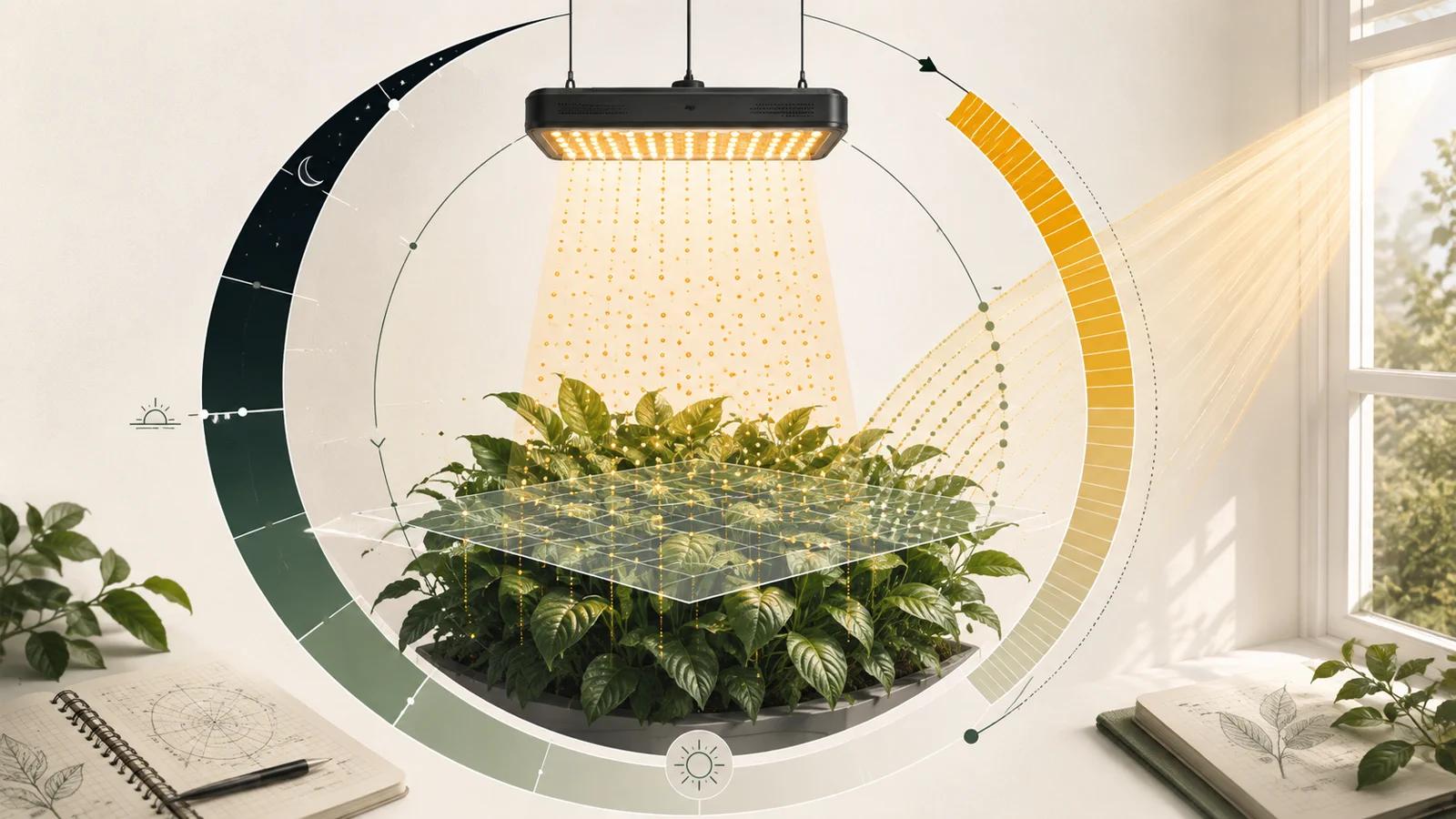
Evidence status: This estimator uses source-based PPFD, DLI and photoperiod definitions plus a reviewed formula and deterministic Python/JavaScript fixtures. Root & Photon did not measure your PPFD, natural-light DLI, fixture, crop response or timer. A numerically correct result is not a crop prescription or proof that the resulting light/dark schedule is biologically suitable.
Quick answer
Use the estimator in one of two directions. Enter representative photosynthetic photon flux density (PPFD) and electric-light hours to estimate daily light integral (DLI), or enter representative PPFD and a target total DLI to estimate the electric-light hours required after an optional natural-light contribution (Iowa State University Extension; University of New Hampshire Extension).
The governing arithmetic is:
Electric-light DLI = PPFD × hours × 0.0036
Required hours = max(target total DLI − natural-light DLI, 0) ÷ (PPFD × 0.0036)
The output is only as representative as the inputs. A centre-point PPFD value, nominal watts, lux, or one instant daylight reading can produce a precise-looking but misleading result (Iowa State University Extension; University of New Hampshire Extension). Even when two schedules deliver the same DLI, controlled basil and lettuce studies show that different intensity and photoperiod combinations can produce different biological responses (Eghbal et al.; Jeong et al.; Elkins and van Iersel; Akter et al.).
Estimator workflow summary
| Decision point | Evidence-based finding |
|---|---|
| Estimate DLI | Use representative PPFD and actual electric-light hours; optionally add a defensible daily natural-light DLI. |
| Estimate hours | Use a sourced or clearly hypothetical target total DLI, subtract natural-light DLI, and divide by representative PPFD. |
| Check the schedule | Compare calculated hours with a crop/cultivar/stage source. The estimator does not supply a default crop target or photoperiod window. |
| Stop condition | Do not force a result above 24 hours or a result outside a retained source window; revisit the inputs, light delivery or source. |
| Evidence boundary | Implementation tests verify arithmetic and validation rules only—not PPFD accuracy, crop response, fixture performance or live CMS behavior. |
Key facts
- PPFD is an input at a defined plant plane: use a representative value for the actual height, area, fixture mode and quantity—not nominal watts or a peak without context (Iowa State University Extension; University of New Hampshire Extension).
- DLI accumulates photons over a day: under constant representative PPFD, duration changes DLI proportionally (Iowa State University Extension).
- Photoperiod is not DLI: the duration and continuity of light and dark can matter independently of total daily photons (University of Minnesota Extension; Iowa State University Extension).
- Natural light is a daily contribution: one instant window reading is not a daily integral (University of New Hampshire Extension).
- Equal DLI is not guaranteed biological equivalence: different PPFD/hour combinations can produce different responses under controlled conditions (Eghbal et al.; Jeong et al.; Elkins and van Iersel).
- No crop presets are included: targets and photoperiod windows must come from a retained crop/cultivar/stage source or be labeled as hypothetical planning inputs (University of Minnesota Extension; University of Minnesota Extension).
- A result above 24 hours is a conflict: it means the target cannot be reached within one day under the stated constant inputs.
Takeaway: The estimator converts explicit inputs; it does not choose the inputs or certify the schedule.
Use the DLI and photoperiod estimator
Important limitation: JavaScript is required for the interactive form. The formulas and worked validation cases below remain available without it.
Choose defensible inputs
| Input | What to enter | What not to substitute |
|---|---|---|
| Representative PPFD | A plant-plane value or representative map for the exact height, mode, area and fixture count (Iowa State University Extension; University of New Hampshire Extension). | Electrical watts, lumens, lux, a different model, or a centre peak presented as an area average. |
| Electric-light hours | Actual on-time in one 24-hour cycle for the stated setup. | A generic “hours for herbs” value without crop/stage/source context. |
| Natural-light DLI | An integrated, logged or otherwise defensible daily contribution at the plant position (University of New Hampshire Extension). | One instant reading, outdoor DLI without a transmission method, or a seasonal guess presented as measured. |
| Target total DLI | A source-qualified crop/cultivar/stage value or a clearly hypothetical planning input (University of Minnesota Extension; University of Minnesota Extension). | A universal preset, product marketing number, or value copied without applicability context. |
| Photoperiod window | Optional minimum and maximum from the same retained crop/stage source (University of Minnesota Extension; University of Minnesota Extension). | A hidden default, two unrelated ranges, or an assumption that the window proves suitability. |
Takeaway: The calculator validates ranges and arithmetic, not provenance. Record where each material input came from.
Understand the formulas
Estimate DLI from PPFD and hours
When representative PPFD is treated as constant during the electric-light period (Iowa State University Extension):
Electric-light DLI = PPFD × hours × 0.0036
The factor 0.0036 converts micromoles per second over one hour to moles per day (University of New Hampshire Extension; Iowa State University Extension). If a defensible natural-light DLI is entered:
Total estimated DLI = electric-light DLI + natural-light DLI
Estimate hours from target DLI
First calculate the additional electric-light dose:
Additional electric-light DLI = max(target total DLI − natural-light DLI, 0)
Then solve for hours:
Required hours = additional electric-light DLI ÷ (PPFD × 0.0036)
If natural-light DLI already meets or exceeds the target, this arithmetic returns zero additional electric-light hours. That does not establish that a plant should receive no electric light or that its light/dark timing is appropriate (University of Minnesota Extension; Iowa State University Extension).
Apply the biological schedule gate
Arithmetic equivalence does not establish biological equivalence. DLI arithmetic answers a photon-dose question. It does not answer every photoperiod question. Controlled studies have delivered the same DLI through different combinations of intensity and duration and observed different responses (Eghbal et al.; Akter et al.; Jeong et al.; Elkins and van Iersel). In the 2024 basil study, 200 PPFD for 18 hours, 300 for 12 hours and 400 for 9 hours each produced 12.96 DLI, yet the treatments were not biologically interchangeable (Eghbal et al.). Lettuce studies likewise report photochemical or treatment interactions at equal DLI (Jeong et al.; Elkins and van Iersel).
After calculating hours, compare the result with a source retained for the exact crop, cultivar when material, growth stage and objective (University of New Hampshire Extension; University of Minnesota Extension; University of Minnesota Extension). If the result falls outside that source window, do not force the timer value. Revisit the PPFD input, distribution, fixture configuration, natural-light input, target, or source. Change one controlled input at a time.
Important limitation: A source window entered in the form is user-provided. The estimator checks only whether both bounds are present, ordered and within 0–24 hours. It does not verify the crop, source or biological applicability.
Review the frozen validation cases
| Case | Inputs | Expected arithmetic result | Interpretation |
|---|---|---|---|
| Forward | 300 PPFD; 12 h; 0 natural DLI | 12.960 electric and total DLI | Arithmetic only; no crop target implied. |
| Forward plus daylight | 200 PPFD; 18 h; 2 natural DLI | 12.960 electric; 14.960 total DLI | Natural input must be a daily contribution. |
| Inverse | 12 target; 0 natural; 220 PPFD | 15.15 h | Requires a separate crop/stage schedule check. |
| Within supplied window | 14 target; 5 natural; 180 PPFD; 12–16 h window | 13.89 h | Within the user-supplied window; source still unvalidated by the tool. |
| Above supplied window | 16 target; 2 natural; 180 PPFD; 12–16 h window | 21.60 h | Do not force the schedule; revisit inputs or light delivery. |
| Natural light meets target | 10 target; 12 natural; 250 PPFD | 0.00 additional electric-light hours | Dose result only; a separate photoperiod requirement may remain. |
The frozen invalid cases reject zero PPFD, entered hours above 24, negative natural-light DLI, a target beyond the software guardrail, an incomplete source window, and a minimum greater than the maximum. Both language implementations run the same cases and must return the same numbers and status codes.
Interpret the output before changing a setup
| Status | Meaning | Next evidence step |
|---|---|---|
| Arithmetic result only | The formula completed with no supplied source window. | Check input provenance and compare with a crop/stage source. |
| Within source window | The hours fall between user-entered bounds. | Confirm the source applies to the exact crop, stage and objective. |
| Below or above source window | The arithmetic conflicts with the entered schedule range. | Do not force the value; revisit PPFD, distribution, natural light, target or source (University of New Hampshire Extension; University of Minnesota Extension; University of New Hampshire Extension; Akter et al.). |
| Natural light meets/exceeds target | No additional electric-light DLI is needed in the arithmetic scenario. | Evaluate any separate photoperiod/dark-period requirement (University of Minnesota Extension; Iowa State University Extension). |
| Impossible under stated inputs | The target would require more than 24 hours at the supplied constant PPFD and natural-light contribution. | Change the scenario or stop; do not treat the number as a timer setting. |
Know the limitations
- The formula assumes representative constant electric-light PPFD during the stated hours (Iowa State University Extension; University of New Hampshire Extension).
- The estimator does not integrate variable daylight, dimming curves, moving lights or changing canopy geometry (University of New Hampshire Extension; University of New Hampshire Extension).
- It does not convert watts, lumens, lux or a phone reading into PPFD (Iowa State University Extension; University of Minnesota Extension).
- It does not supply crop targets, cultivar data, flowering-control schedules or a universal dark period (University of Minnesota Extension; University of Minnesota Extension; University of Minnesota Extension).
- It does not evaluate spectrum, uniformity, temperature, humidity, carbon dioxide, water, nutrition, disease or crop outcome.
- Software guardrails are not safe, optimal or recommended biological ranges.
- Local code tests do not validate a product, plant, measurement method, browser, theme, assistive technology or WordPress deployment.
Before you buy: Obtain a representative PPFD value for the exact plant plane and retain a crop/cultivar/stage source before using the output to compare equipment or schedules.
What we could not verify
- Your actual plant-plane PPFD or spatial uniformity.
- Your daily natural-light DLI, window transmission or seasonal variation.
- A universal DLI target or photoperiod for “herbs,” “leafy greens,” seedlings or houseplants.
- Whether an entered source window applies to the exact crop, cultivar, stage and objective.
- Whether a calculated schedule will produce a desired growth, quality or yield outcome.
- Live WordPress asset loading, browser compatibility, responsive behavior or assistive-technology performance.
Methodology
This E2 source-based package uses current university-extension guidance for PPFD, DLI, photoperiod and supplemental-light arithmetic, plus primary controlled-environment studies to test the assumption that equal DLI schedules are biologically interchangeable. Material claims are atomic and source-qualified. Search results were used only to identify buyer intent and communication gaps.
The Python reference model and browser JavaScript model use the same frozen set of six valid and six invalid cases. Tests compare unrounded numerical outputs within a strict tolerance and exact status/error codes. Displayed DLI is rounded to three decimals and displayed hours to two decimals after calculation. Root & Photon performed no PPFD measurement, natural-light integration, product test, grow trial or specialist horticultural review.
Sources
- University of New Hampshire Extension — Supplemental Lighting Run Time Worksheet
- University of Minnesota Extension — Lighting for indoor plants and starting seeds
- Iowa State University Extension — Important Considerations for Providing Supplemental Light to Indoor Plants
- University of New Hampshire Extension — Growing Seedlings Under Lights
- University of Minnesota Extension — Growing herbs in home gardens
- University of Minnesota Extension — Starting seeds indoors
- Eghbal et al. — Basil responses to different light durations and intensities under constant DLI (BMC Plant Biology, 2024)
- Jeong et al. — Constant-DLI intensity and photoperiod treatments in lettuce (Frontiers in Plant Science, 2025)
- Elkins and van Iersel — Longer photoperiods with the same DLI in lettuce (Plants, 2020)
- Akter et al. — Dynamic intensity and photoperiod schedules in indoor basil (Frontiers in Plant Science, 2026)