
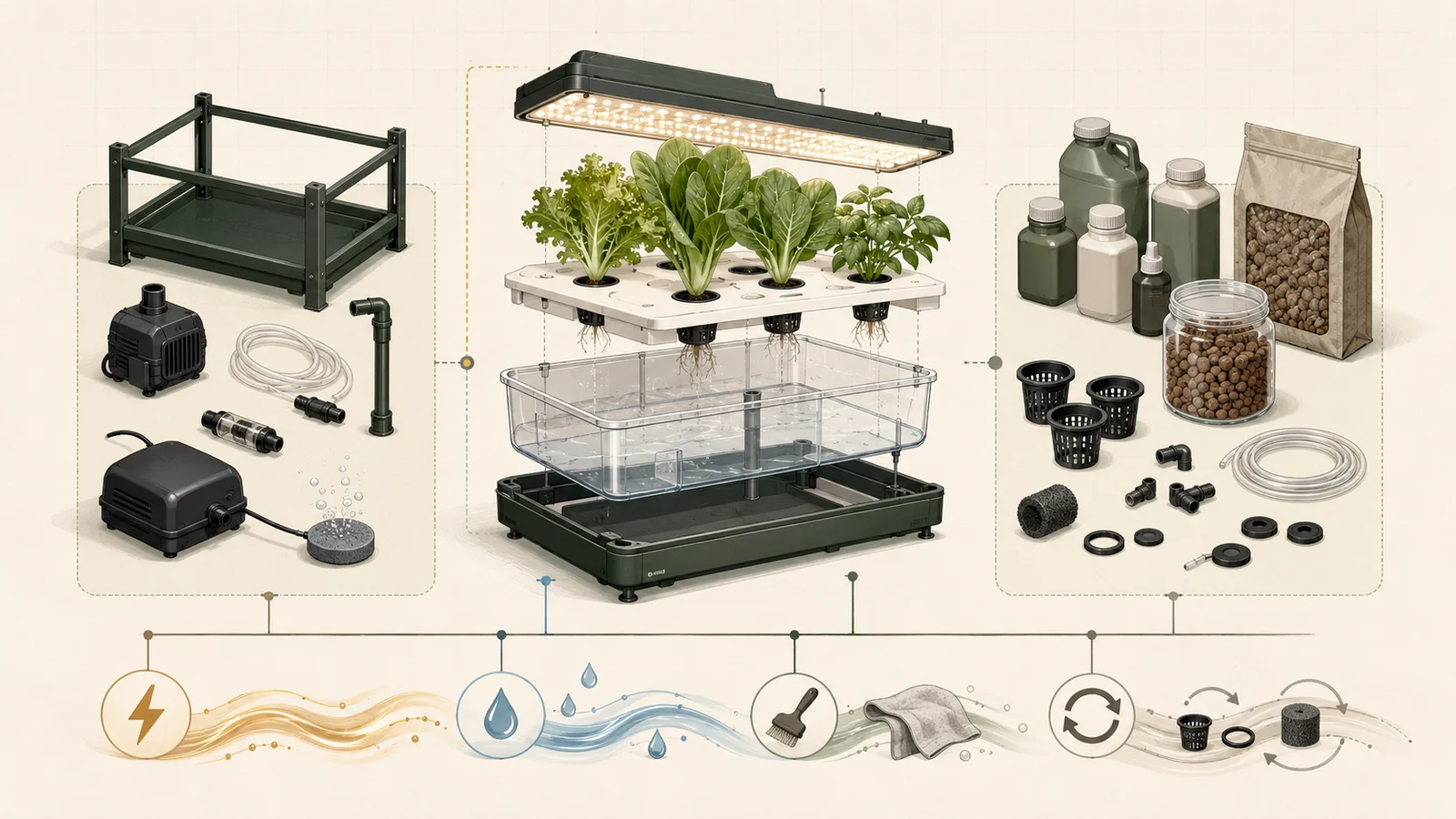
Evidence status: This is a source-based total-cost worksheet built from public U.S. government and university-extension documentation. Root & Photon did not buy, operate, measure, or test a hydroponic system for this article. No exact product price, typical market budget, lifespan, output, savings, return on investment, or payback claim is made.
Quick answer
The real cost of a home hydroponic system is not one purchase price. Build the estimate from four groups: initial durable equipment, recurring inputs, operating costs, and maintenance or replacement within a defined period. Keep every side of a comparison on the same crop goal, plant count, included functions, currency, and time horizon.
Period total = initial + recurring + electricity + water + maintenance + repair + replacement + other documented costs
Use dated receipts, current official documents, reader-supplied usage, and the electricity tariff that actually applies. If a cost, lifespan, or consumption value is unknown, leave it unknown or show a range. Do not enter zero merely to make one option look cheaper.
Total-cost workflow summary
| Decision point | Evidence-based finding |
|---|---|
| Scenario | Define crop goal, plant count, space, lighting assumption, system functions, currency, and study period. |
| Initial equipment | List the complete durable configuration, including separately purchased functions that a bundled system already includes. |
| Recurring inputs | Record seed or propagation material, nutrient concentrate, substrate or plugs, monitoring supplies, and other consumables actually used. |
| Operating costs | Calculate each electrical load from watts and hours, use the applicable dated tariff, and add water only from documented or reader-supplied inputs. |
| Maintenance and replacement | Include only events that occur within the selected horizon or apply an explicit residual-value rule. |
| Unknowns | Keep unknown lifespan, failure, labor, water, output, and loss variables visible rather than assuming zero. |
Key facts
- Define the complete system: hydroponics still needs a container or reservoir, water and nutrients, root support, light, and circulation or oxygen management as applicable.
- Purchase price is only one category: consumables, electricity, water, maintenance, repair, replacement, and operator time can change the decision.
- Use one time horizon: a 12-month total should not be compared with another option’s purchase price alone.
- Bundle boundaries matter: an integrated countertop system may include functions that must be added separately to a DIY configuration.
- Use the reader’s tariff: electricity rates vary by utility, location, customer class, plan, and sometimes time of use.
- Unknown is not zero: unknown life, failure, water use, replacement timing, output, or resale value should remain visible.
- Cost is not performance: this worksheet does not establish yield, reliability, crop fit, labor savings, or a universal winner.
Takeaway: Compare complete, matched configurations over the same period; do not compare a bundled system with an incomplete parts list.
Define the scenario and system boundary
Begin with a sentence that makes the estimate reproducible: the crop or plant goal, number of growing sites, indoor location, lighting assumption, category or configuration, included equipment, currency, and study period. “A small home setup” is not a cost boundary. “A 12-month, six-site leafy-green scenario using the listed reservoir, support, light, pump, timer, and monitoring workflow” is much closer.
The U.S. Department of Agriculture describes hydroponics as growing plants in a water-based nutrient solution rather than soil; some systems also use aggregate media. University-extension guidance shows why the cost boundary must be complete: even a small system must solve water and nutrient delivery, plant support, light, and root-zone circulation or oxygen requirements. The exact parts differ by category.
When comparing integrated and DIY approaches, normalize functions first. If one side includes a light, timer, pump, reservoir, support deck, reminders, and consumable holders, list the equivalent functional boundary on the other side. Do not add features that the crop goal does not require, but do not omit required functions merely because they are purchased separately.
Collect dated inputs
| Input | What to record | Evidence boundary |
|---|---|---|
| Configuration | Exact included durable equipment and functions | Official documents, receipt, inventory, or clearly labeled constructed scenario |
| Initial cash outlay | Dated amount paid for new durable items | Do not substitute a current market average for the reader’s purchase |
| Recurring inputs | Quantity, unit cost, frequency, and covered crop cycle | Keep nutrient, seed, substrate, monitoring and cleaning inputs separate |
| Electrical loads | Input watts, operating mode, hours, days, and standby treatment | Use documented or observed values; no Root & Photon measurement is claimed |
| Tariff | Utility, plan, customer class, rate period, currency, and date | A public average is context, not an account tariff |
| Water | Documented or reader-supplied volume and local rate | Unknown use or rate stays unknown |
| Maintenance/replacement | Event, part, date, amount, and source | No universal lifespan or failure rate |
| Operator time | Minutes or hours by task | Keep separate from cash unless the reader assigns a value |
Build the cost ledger
Initial durable equipment
List the complete configuration that exists at the start of the study period. Depending on the category, that may include a reservoir or container, plant-support structure, pump or aeration equipment, tubing, timer, light, and monitoring tools. Existing owned equipment can be shown as “already owned” for cash planning, but it should not disappear from the functional comparison.
Recurring inputs
Record each input separately: seed or propagation material, nutrient concentrate, substrate or plugs when used, monitoring supplies, and cleaning or storage materials required by the exact workflow. Use quantity and frequency, not a vague monthly allowance, whenever records permit.
Electricity and water
Calculate every electrical load separately before adding the system total. A light may run on a crop schedule while a pump or aerator follows a different schedule. A timer or controller may have standby use. Add water only when consumption and the applicable rate are documented or deliberately entered as scenario assumptions.
Maintenance, repair, and replacement
Include events that occur within the selected period: a pump, light, tubing, air stone, probe, tray, or other component only when the actual configuration uses it and the event is documented or explicitly modeled. Do not invent a “typical” life. For a short worksheet, a range or unresolved line is more honest than a false replacement date.
Use the formulas
Energy (kWh) = input watts ÷ 1,000 × operating hours
Electricity cost = energy (kWh) × applicable dated tariff
Period total = initial + recurring + electricity + water + maintenance + repair + replacement + other documented costs
Monthly equivalent = period total ÷ months in the same period
Constructed energy example
Assume a 45-watt light runs 14 hours per day and a 5-watt pump runs 24 hours per day:
45 W ÷ 1,000 × 14 h = 0.63 kWh/day
5 W ÷ 1,000 × 24 h = 0.12 kWh/day
(0.63 + 0.12) × 30 days = 22.5 kWh
22.5 kWh × $0.18/kWh = $4.05
The wattages, hours, and tariff are constructed arithmetic inputs. They are not measurements, typical equipment values, or a current rate claim.
Constructed 12-month worksheet
| Category | Constructed input | 12-month arithmetic |
|---|---|---|
| Initial durable equipment | $150 once | $150.00 |
| Recurring inputs | $11/month | $132.00 |
| Electricity | $4.05/month | $48.60 |
| Replacement | $30 once | $30.00 |
| Other documented cost | $5 once | $5.00 |
| Total | $150 + $132 + $48.60 + $30 + $5 | $365.60 |
| Monthly equivalent | $365.60 ÷ 12 | $30.47 |
Takeaway: Replace every constructed input with a dated value from the actual scenario. The example demonstrates arithmetic only.
Test sensitivity instead of presenting false precision
Build low, expected, and high scenarios for the inputs that can materially change the result. Vary one category at a time first, then combine plausible cases. Useful sensitivity inputs include operating watts, hours, tariff, nutrient or substrate use, replacement timing, and whether existing equipment is already owned.
| Input | Low case | Expected case | High case |
|---|---|---|---|
| Initial equipment | Required items already owned | Planned complete configuration | Additional required functions or replacements |
| Recurring inputs | Lower documented use | Recorded expected use | Higher documented use or more cycles |
| Electricity | Lower operating mode or schedule | Planned schedule | Higher documented load or applicable rate period |
| Replacement | No event in horizon | Documented expected event | Earlier modeled event, clearly labeled uncertain |
| Labor | Time tracked only | Time assigned a reader value | Higher maintenance frequency |
Preserve unknown costs
Do not fill every blank. The most material unknowns may be component life, crop losses, replacement timing, actual nutrient use, standby draw, water use, seasonal light schedule, app or subscription requirements, and the value of operator time. Mark each as excluded, unknown, or scenario-dependent.
A cost-per-harvest or cost-per-plant figure requires verified output and loss data. This article did not collect a grow trial, matched crop output, failure rate, or reliability dataset, so those denominators remain unavailable.
Important limitation: A lower calculated total is not proof of better crop fit, reliability, convenience, yield, or safety. Those are separate evidence questions.
Use the worksheet in a buying decision
- Reject incomplete comparisons. Add the missing functions before comparing an integrated system with DIY components.
- Choose a study period that matches the decision—often 12 or 24 months for planning—then apply it to every option.
- Use actual receipts or dated official prices only for the exact items under consideration; this article supplies no product prices.
- Use the applicable utility tariff and separate electrical loads by schedule.
- Keep operator time visible, especially when comparing a lower-cash DIY configuration with a more bundled workflow.
- Do not calculate savings, ROI, or payback until a defensible baseline and outcome evidence exist.
A “neither” result is valid. If the complete system, recurring attention, available light, or uncertainty does not fit the household, delay the purchase, simplify the crop goal, or collect the missing inputs before choosing a category.
What we could not verify
- A universal or typical U.S. home-hydroponic setup cost.
- Current prices, availability, bundles, subscriptions, or replacement parts for any named product.
- Universal consumption rates for nutrients, water, substrate, seed, or cleaning supplies.
- Component lifespan, failure rate, repair frequency, warranty outcome, or resale value.
- Matched yield, reliability, labor, water, energy, or crop-loss outcomes.
- Cost per harvest, savings, ROI, or payback.
- Any Root & Photon product use, measurement, test, or grow result.
Methodology
Root & Photon reviewed current U.S. government and university-extension sources for hydroponic system functions, monitoring and maintenance context, life-cycle-cost structure, electricity units, tariffs, and standby measurement. The article adapts those sources into a product-neutral reader worksheet, preserves the original source limitations, and uses two constructed arithmetic examples that were independently recomputed.
No product shortlist, market-price scrape, retailer inventory, user survey, product access, system operation, measurement, grow trial, safety review, or expert validation was performed. Evidence remains E2 sourced.
Sources
- USDA National Agricultural Library: Hydroponics
- University of Minnesota Extension: Small-scale hydroponics
- Oklahoma State University Extension: Hydroponics
- Oklahoma State University Extension: Electrical Conductivity and pH Guide for Hydroponics
- Oklahoma State University Extension: Building a Vertical Hydroponic Tower
- NIST: Life-Cycle Costing Manual for the Federal Energy Management Program, 2022
- U.S. Department of Energy FEMP: Take Five—Life Cycle Costs for Acquisition
- U.S. Energy Information Administration: Measuring electricity
- U.S. Energy Information Administration: Prices and factors affecting prices
- U.S. Energy Information Administration: Electric Power Monthly retail-price table
- U.S. Department of Energy FEMP: Measuring standby power
- OpenEI: Utility Rate Database API and services documentation